Over the last few weeks, I went travelling, to two mountainous places. To Portugal, to attend a psytrance festival, and to Wales, to help run a weekend retreat. A thought provoking pair of experiences, with similarities and contrasts worth exploring.
Chronologically paired, here are some parts of my tales…
Armed with a guest pass, courtesy of my involvement with Breaking Convention (we did a ticket swap with BOOM!), I set off to the mainland. Filled with trepidation (I speak no Portuguese, had no idea how to get to the festival site, and had very little money), the journey began with many unknowns, not least exactly what part I would find to play. Unaccustomed as I am to being a punter, I planned out a couple of quests for myself; investigate the signage, and, see if interesting people there could be persuaded of the opportunities of BC. Fortunately my travelling companion Rob Dickins, of Psychedelic Press UK, proved excellent company throughout our eight days together. The weather forecast was hot, sunny and dry.
My journey to Wales was preceded by contrasting feels. Invited along as a workshop facilitator by the organiser of Neuro-Magica, Dr David Luke, I had a clear sense of my role to play in this venture (and do know a few words of Welsh!). My emotional approach was therefore one of happiness, confidence, and joyful anticipation at the prospect of seeing several familiar faces amongst those attending, as well as wondering who the new friends I would make could be! The retreat centre, Cae Mabon, looked unbelievably beautiful from the website, and I had heard only good things about it. The weather forecast was cool, cloudy and wet.
Earth & Fire
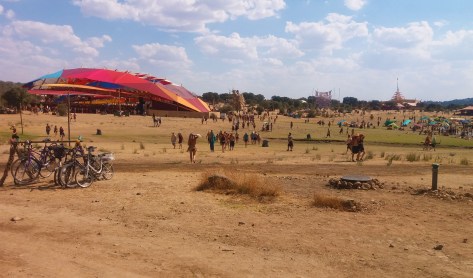
BOOM! was spread out over a mile along the lakeside. Dusty ground, with small trees dotted around providing much needed shade from the relentless sun. Taps were ample, and so refilling the bottles so necessary for pouring over one’s head every few minutes was not too hard. The pounding rhythms were continuous, and by the end of the week had all mutated (in my head) into the chorus of “No Limit”.
Water & Air
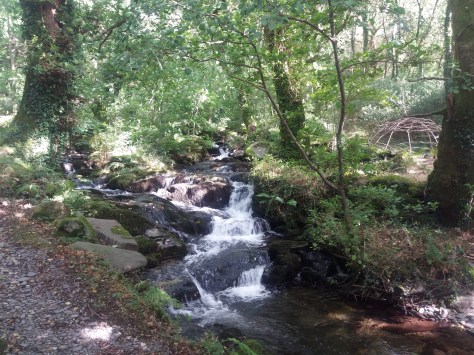
The tiny valley of Cae Mabon is carpeted with soft green grass, and the light birch trees of the space stand in contrast to the sessile oak forest of the surrounding mountain slopes. Only one tap can be used for drinking water, as this comes direct from the river (Afon Fachwen) and so to comply with regulation needs filtration. The sounds here were of the wind in the trees, and the rush of the river over rocks; often indistinguishable from each other. Flurries of strong winds on a couple of the days shook the leaves and branches, energising and clearing minds.
Having set the scenes, rather than relate all I could about these retreats, I shall instead give a few remarks, comparing and contrasting…
BOOM! gave me a week long sauna, temperatures around 40°C, reduced food intake, constant thoughts of water, gentle exercise and a 24 hour choice of pleasant, immersive diversions (talks, dancing, listening, looking). I swam in the lake twice. I will never feel so hot in usual conditions in comparison with this; yet the intense heat was most enjoyable. I saw thousands of people, the effort of the festival organisers to provide shelters and artworks over the previous months, evoked a state of presence in the place and time where I drifted from one enjoyable existence to another, moving as the moment presented itself. Doing this for over a week, with no particular need to go anywhere at any time, yet still moving effectively between places and events, provoked a state of internal silence which stayed with me for three days after my return home. Zero internal dialogue. I functioned as normal, did work, bought food, performed adequate self-care, and entertained myself, etc, all without any narrative.
Neuro-Magica was watery. Rain at times, but even when the sun came out and flooded us all with its warmth and revealed the stunning beauty of the mountains around, the fluid theme was carried by the river and the lake. And the hot tub. I swam in the lake two times, once as the sun was setting and the moon hung above Snowdon’s slopes in the distance. The hot tub (wood fired) is placed beside the Little White river, with large smooth rounded slate steps allowing safe access to the water as it speeds past at a rate of knots. The river water was cold, very cold; screams of raw existence filled the air each time someone clambered into it. This was at night, as I was occupied in the daytime. Submerging my body, feeling the power of this flow, I pictured myself growing cold in death, the cells ceasing to make the heat, growing still and solid before their next phase, relaxation into a more fluid state. Then hauling my flesh away, and back to the (now) ever-so-hot tub. I will never feel so cold in usual conditions in comparison with this; yet the intense cold was comfortable, non-threatening. With seven dwellings representing styles of building (e.g. cob, reticulated roofs, logs), the rooms were cosy and small (compared to the giant open canvas spaces of the festival!) and had enormous character. The days were a barrage of words, as ideas and playful conversations jumped amongst us all. Talkings, listenings, and a breathwork session of astounding effect, filled my storytelling brain to overflowing.
The crowds of BOOM! (33,333) meant my quest to find interesting people was thwarted by sheer numbers; I could hardly approach each of them, but selecting any one was equally impossible, so I spoke with only a small handful. Meanwhile those few who were fortunate enough to attend Neuro-Magica (26) were all unbelievably fascinating, and I had conversations with each person there.
It turned out, in that small world way of things, that more than one person had attended both of these gatherings. Notably Eric Maddern, who had been the Wisdom Keeper representing the European traditions amongst the indigenous cultures from around the planet, and who (coincidentally) owns Cae Mabon. His telling of the chase of Taliesin, which I heard him tell in both locations, took very different forms; a large, lightly covered sunlit space big enough for several hundred people contrasted with the dark, intimate, firelit roundhouse. The Saturday evening party included him giving a spirited rendition of his version of the traditional tale about the search for Mabon (from the fourth branch of the Mabinogian); this will stay with me for years as a particular highlight.
So what did I learn? In what ways did I change?

Mountain high…

…river deep.
I grew as a person, after the atmosphere of kindness and co-creative spaces flowed inexorably into my heart. I felt surrounded by fellow creatures, each one unique yet recognisably the same as myself. The structures and the activities filled me with delight at their aesthetics and their functionality, and at the knowledge they had been built by people’s hands with willing co-operation. My appetite has reset itself, to less food less often, and a change of taste towards mostly minimally processed produce (e.g. vegetables). Weather now feels less of an issue when planning what to do. Emotionally I feel rested, ready to get my head down to all the work which has been piling up over the last weeks! Resting in itself is all very well but nothing works quite so effectively as being somewhere which means you cannot work.
The things and people I have interacted with, from all over the world, have left their fingerprints on me (metaphorically speaking!). Phrases, expressions, bits of knowledge, ways of moving; all spread through groups of people as they meet and part, meet again. I truly feel part of the global population, one spark of awareness amongst so many. Part of this has been recognising the wisdom I carry (in my own way), and seeing effects it can have for others. I feel valued, and cared for.
To finish by returning to the beginning; retreating to the future. Once upon a time, there was a list of products you could buy via mail order, called The Whole Earth Catalogue. Those who bought in to this paradigm dreamed of a world where we live in mud huts with computers (to grossly oversimplify). Fast forward to now, nearly fifty years later, and technology is starting to allow this on a widespread scale. Even if only temporarily at festival sites, many young people are growing up with the knowledge that they can make their own places in the world, creating and building for themselves. This awareness is leaking out to all systems, to food growing, mutually beneficial economic systems (especially local based exchange systems), reusing and repairing even making clothes, we are re-capturing those skills industrial production robbed from us. Moreover, these communities offer a step change in how human animals live, and could well usher in new patterns of behavior which will alter the face of the Earth rapidly; towards one with the right amount of trees, sane resource usage, and a co-created ecology.
NW
(Further blogposts on various experiences at these events to follow! Baphomet showed another side to me during these adventures, and I feel the need to share.)