Maybe Mabon Might Be Made Better?

Autumn Equinox, the poor relation of all the Sabbats. We are on familiar ground with the customs of all the others; Samhain, Yule, Imbolc, Ostara, Beltane, Summer Solstice, Lammas. The names are paganised nowadays, but those of us old enough to have had legally compulsory daily hymn singing at school, know them from the church approved versions of our youth. We are familiar with what these festivities are, what they mean to us, from early years. But Mabon? Mabon is the black sheep.

a black hebridian sheep front horns

I see a black sheep looking at me

First up it was only named in 1970, by a known person. This makes it a ‘made-up’ festival (unlike the others…). This middle of the three harvest celebrations marks what I recall from my own childhood as the first religious highlight of the school term. Traditionally the Church celebrates on the Sunday near or on the Harvest Moon. This is the full Moon that occurs closest to the autumn equinox, which this year grew to golden glory on the 15-16th September, making last Sunday (the 18th), Harvest Festival in the Church calendar. Unlike that other lunar based moveable feast of Easter, its counterpart on the opposite side of the Wheel, it never acquired any holiday time, probably because it falls at such a vitally busy period. We used to bring in to school homegrown produce to be sent to those in need; vegetables and apples, jars of freshly made jam, but health & safety in the intervening years meant that my children got to take tins of food to their schools… not quite the same!

Our present day detachment from the rural cycle has accompanied the removal of our dependence upon local foodstuffs, so harvest simply doesn’t mean much these days, not in the ‘how pleasant will life be this winter?’ way it did until fairly recently.  What might Mabon (previously known as Harvest Festival) mean to us in 2016?

(Parking that question for a parenthesised paragraph, I’d like to remind those suffering from premature annunciations each year on Sept 21st that the autumnal equinox falls on the 23rd, give or take a day. This year, to be precise, at 1421h UTC on the 22nd.)

I have wondered about it in the past but this year, so soon after my recent visit to Cae Mabon, where part of the story of the hero of that name was related with such spirit, I felt moved to think about it.

Mabon is the middle of the three harvesting festivals. The work of the year reaches a frenzy of picking, preserving, and packing away of the fruits of our (or others) labours. Time to pause and take stock comes at Samhain, at the end of the harvest which started at Lammas, but for now we can count on a period of work, active devotion to the processes of our lives, gathering in as we prepare to feed ourselves while making plans in the months ahead. In this time of evenings which are neither one thing nor the other, half light half dark, we sit outside in the last of the sunshine knowing that in a few minutes the night will fall; catching up with friends takes place in snatched moments between all that shifting into the dark season entails, and brainstorming future projects.

equinox

The sun shines on

Merry Easter to those in the other hemisphere, and Merry Mabon to those closer to home. How to celebrate or mark it is more or less up to individual tastes; now that the redistribution of surplus fresh food to those lacking is deemed unsafe, perhaps make an equivalent gesture in a more magickal way, by conjuring for a better, fairer future using the resources you have to hand?

These pagan festivals of ours, rooted in Church festivals of past centuries, in turn rooted in earlier festivals of this land, continue to grow and take shapes as our culture alters. Corn dolls and Harvest Suppers have faded, perhaps to be replaced with carefully constructed photo albums and tales of summer adventures, full of insights to share. Long dark nights are on the horizon, during which we can sit with friends around fires, philosophising, enjoying what we do have, and feeling inspired about what we can grow next year.

NW

Queer: A Graphic History reviewed

Queer: A Graphic History by Meg-John Barker and Julia Scheele Icon Books 2016

I’m sure that like many a humanities undergraduate out there, I have had my academic bacon saved more than once by the Icon series on contemporary thought. Their pithy illustrated guides on topics and figures as wide ranging as Wagner, Jesus and Lacan, often provided an accessible doorway into some otherwise tricky territory. Histories were condensed and made vivid, and previously mind-bending theories were made moderately less so.

queer1

It was perhaps not surprising then that when I caught wind that one of my favourite authors Meg-John Barker was co-authoring an Icon book on Queer theory with illustrator and zine-smith Julia Scheele, I was more than a tad excited. I have already penned some reviews of Meg-John’s recent books on Relationships and contemporary mindfulness practice:

http://enfolding.org/book-review-rewriting-the-rules-an-integrative-guide-to-love-sex-and-relationships/

http://enfolding.org/book-review-mindful-counselling-and-psychotherapy/

and I find their level of both openness and insight deeply helpful and inspiring.

Writing about Queer theory was never going to be a simple task! Not only does it touch upon some highly complex philosophical ideas and movements, it’s very existence as a concept is reliant upon fluidity and a desire to defy concrete definition. (I recently wrote something about these ideas here, looking at the way in which Queer theory might inform magical practice, and there are considerable overlaps in relation to the subtlety, fuzziness and process dependent sensitivity that both seem to thrive on.)

In the course of the book the authors deftly distill some of the primary concepts of Queer theory as follows:

“Resisting the categorization of people
Challenging the idea of essential identities
Questioning binaries like gay/straight, male/female
Demonstrating how things are contextual, based on geography, history, culture etc.
Examining the power relations underlying certain understandings, categories, identities, etc.”

Meg-John and Julia then spend time exploring what the implications of such ideas might be for topics as diverse as identity politics, contemporary sexology and the shape that relationships and concepts of family might take.

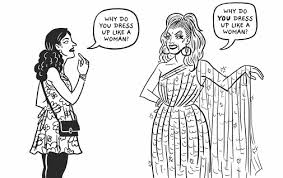
queer2

I’d imagine that writing a book like this might be a bit of a challenge: “How do I make it pacey enough to be engaging and yet detailed enough to capture the complexity of what we are trying to describe?” Frankly I think that the authors have done a great job. Partly this is due to it being a big comic book that Julia has done a great job in illuminating.  Visually Queer is great to look at capturing great portraits, humour, sensuality and struggle.

Conceptually it touches on historical forebears (such as the existentialists) and engages heroically with much of the complex postmodern philosophy that has birthed much of the Queer revolution. The sections dealing with the ideas of Michel Foucault and Judith Butler are especially vivid and helpful, primarily as I have tended to find their work pretty heavy going.

Given that Queer theory seeks to explore the reality of what we do rather than being fixated on fixed identities, it is of little surprise that the authors spend much of this work exploring the ways in which Queer theory has shaped activism on both the societal and personal stages.  Meg-John especially is noted for their excellence in taking complex ideas and challenging us to think about what this means now: how will this promote compassion and a willingness to hear the subtlety of our unique stories?

One of the things that I love about this book is the way in which Meg-John keeps popping up as an illustrated character within the text. Engagement with Queer theory and activism is something that they are deeply involved in, and their presence in the text, dialoguing with us, seems to embody something of the open process that the authors are inviting us to.

Curious readers might wonder why I was so keen to review this book on a blog about Magic.  Apart from wanting to bump up a friend’s book sales, Queer identity is not only vital to me on a personal level, but it also profoundly shapes the way that us Baphomet folks practise our chosen spiritual path. As creative ritual explorers, our magical practice is highly relational (we enjoy working with others), context dependent and focused more on process than some imagined endgame. In short, ours is a profoundly Queer Magic and dynamic works like Queer provide great fuel for this journey.

SD