The full text of this essay, part of which was presented at Breaking Convention 2023 at the University of Exeter.
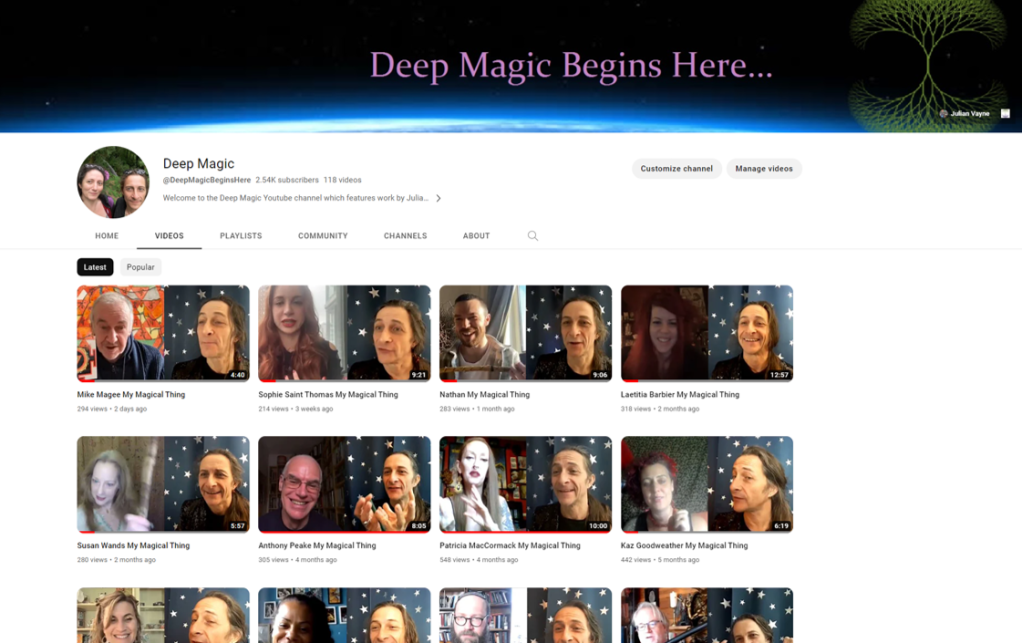
For the last 3 years I’ve been running a little side project on YouTube called ‘My Magical Thing’ where esoteric and psychedelic practitioners get to share a magical thing. Youtube.com/DeepMagicBeginsHere Here and now it’s my turn!
I’d like to do a little show-and-tell and introduce you to some of the things I use in my own work holding psychedelic space as a sitter for others and share both the literal purpose and symbolic meaning of these objects.
My singing bowl helps me create punctuation marks in the ceremony. Perhaps as the process shifts a gear I might gently use this bowl to acknowledge that transition (incidentally, top tip, people taking a psilocybin journey often shift gears in their process after visiting the bathroom). The ring of the bowl often marks the beginning and perhaps the end of the whole ceremony. Sometimes I use it in gaps between the tracks in my playlist. This can be a gentle way for the person I’m sitting with to know that I’m there in my role as ground control; present, available and an active companion on their journey.
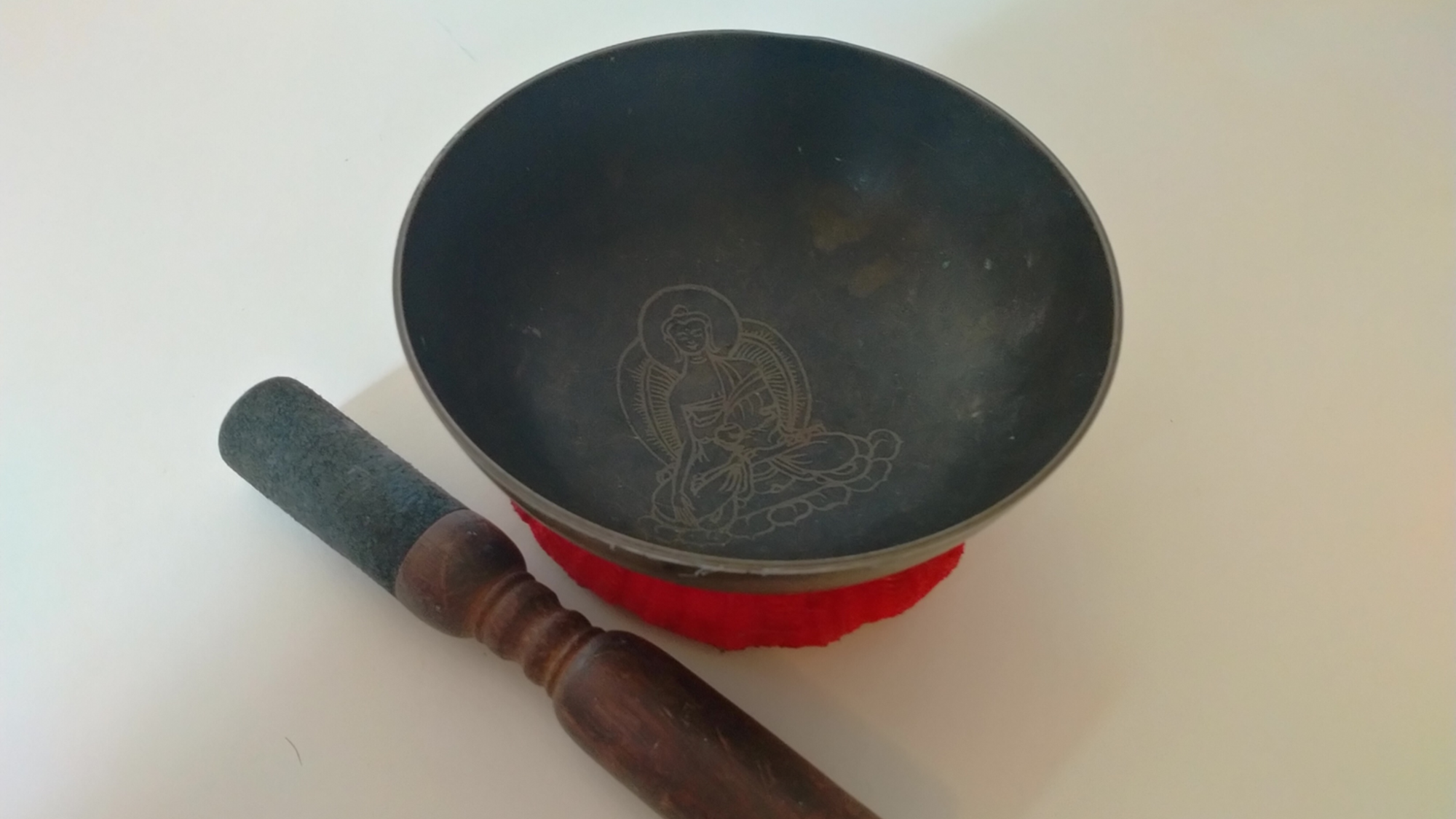
This bowl reminds me about less being more. Sure there are ceremonies where ecstatic drumming is the order of the day but in the style of work with say, psilocybin – where we invite the client to travel inward – anything we, their companion, does should aspire to be subtle, easy and accessible. I say accessible because while the singing bowl is well known in Eastern cultures it is simply a bell with a melodious tone. There is no need to know anything about the Buddha in the bowl to appreciate its sound.
The emptiness of the bowl is what allows it to work, to resonate, to vibrate and to sing. Likewise for me the psychedelic session should tend towards emptiness. We’re not trying to lay our trip on anyone here. Successfully supporting a session isn’t about our pet theories, be they transpersonal, integrative, ancient or modern or whatever. Our primary role as sitters is to create a space for others. We are like the metal of the bowl, we aspire to resonate with whatever happens – a journey which may be gentle, or frustrating, or one that strikes a powerful chord in us and where the choppy waves of the session may be challenging to navigate. But we’re not the centre of the action here, we’re a caretaker, a curator, our job is to hold the space just as the bowl does. We may be a therapist perhaps, mindful of the roots of that word as an ‘attendant to the healing process’. We are not the healer, we are those who aspire to maintain the container so the healer, the client or traveller who has taken the larger psychedelic dose, can go through their process as well as possible.
With the above observation in mind, I’ve noticed in some psychedelic therapeutic circles, particularly among those influenced by the theories of Stanislav Grof and Otto Rank, the fashion for talking about people’s problems in terms of ‘traumatic birth experience’ or similar concepts. This is, my view, an unhelpful, evidentially unsupportable, and sometimes damaging example of what used to be known as laying one’s trip on others. But more importantly, whether this or any other psychological model is ‘true’ isn’t the main issue. In this type of inward bound ceremony with psychedelics the aim is to hold space and not to unnecessarily script it. So rather than inviting us to seek out ‘core wounds’ (whatever that is supposed to mean) or other trauma in the session, it is usually better to support a spirit of curiosity and openness on the part of the patient. If we approach psychedelic healing primarily through the lens of stories about trauma, its apprehension and catharsis – which are common in psychodynamic models – we are unnecessarily telling the client what we believe will or should happen. Trauma in various guises may surface in a session, but it also may not. The goal is to help the person making the journey to do so successfully, so that the session benefits them greatly. If they experience feelings of love, joy, connection and so on, this may well be the way in which insight and healing comes. Such feelings are very different from the effects we generally expect from talk based, trauma focused, therapy. In the immediate preparation for, and intention setting of the ceremony, it is wise to emphasise a positive, open-minded approach which aspires to support the confidence, courage and curiosity of the client.
Talk based therapists can be wonderful sitters but if we are looking to professions to guide us in understanding the skills required when supporting psychedelic journeys we would do well to look instead at how midwives and nurses learn to hold space.
Talking therapy may certainly provide a helpful induction and integration process for psychedelic sessions, and, as research strongly suggests, whether talking session are useful is more about the quality of the therapeutic relationship than the psychological model in use – but the sit itself requires a different approach.
My bowl can also of course ‘sing’ as well as be stuck like a bell. This reminds me of the mutability of ceremonial things for while it is indeed the case that using a bell like this one is an ancient technology, the idea of the ‘Tibetan Singing bowl’ is likely a recent development, or perhaps a Western-culture focused marketing innovation. This bowl is something that I consider to be drawn from the cultures of the East but it certainly doesn’t feel uncomfortable to be employing this musical instrument that originates outside of my landscape. For while we should not misrepresent ourselves as part of lineages and styles that are not our own it’s okay, indeed it’s inevitable, that we should be inspired by other people and communities. We ceremonialists of all types riff on each other’s practice, we adopt and shed symbols as a snake sheds its skin, as any ethnographer of ritual will confirm. But at the same time the core techniques of ceremony remain unchanged; pay attention, listen deeper, be still, move clearly. So while our individual practice may not be ancient in itself we stand within a great tradition of practitioners who are developing systems to support our wellbeing. New innovations and cross-fertilizations, like the ‘singing’ of my bowl happen all the time. For example, practices such as yoga as a physical exercise, the kind of yoga we’re mostly familiar with in the West, is a 20th century innovation. These developments, changes and transformations can give rise to whole new traditions, which grow like new blooms grafted onto an older root stock, and should be celebrated.
This feather, a gift from a friend from a condor that they rescued in Chile, I use as a fan that sometimes helps out in ceremonies. My feather allows me to gently waft air over the person I’m sitting for. This way of touching without touching is something I first saw deployed in Native American Church peyote circles. The movement of the air can help the client have a sense that something is passing through or perhaps away from them. I’m of course careful when I use it, since as the bowl teaches, less is more. I explain before the session to the person that I may use the feather and let them feel how it feels. I often use it as part of a simple smudging ceremony I do as we begin the journey. Sometimes participants will actively call for the feather and perhaps ritual smoke (I generally use Palo Santo wood having been gifted some by the same friend who brought me the feather.) For other people such shamanic shenanigans would be inappropriate so the feather stays on the altar.

The gentleness of the feather again reminds me of the delicacy of the ceremonial space and more generally of working with psychedelics. If I use the feather I must aspire to be intuitively sure it’s right to do so. This comes only with practice. As we practice sitting we learn how to feel into the ceremony, and invite the arising of the right words, gestures and processes to come through us as we support the person making the journey. This comes with time and experience, and there will inevitably be occasions when we do things that, on reflection, we could do better next time. In order to cultivate this intuitive sense, to be a good sitter means making time to do our own practice. This allows us to cultivate skills like deep listening and interoception so we are as informed as possible by the information we can pick up in the session and less absorbed by our own ‘stuff’. For me this includes taking the mushroom medicine, sometimes alone and sometimes in a setting where someone can sit for me, on a regular basis. This is especially important if we are doing lots of sitting work.
The feather reminds me of the ancient Egyptian goddess Ma’at, the goddess of truth and justice from whom we get our word mathematics and who is often represented as a woman crowned with a feather. The feather reminds me of being honest about the process of working with mushrooms. What we expect from the medicine and what happens can be quite diverse. It’s not the same as buying an airline ticket because where we travel on our journey can be so very different. Helping to gently manage these expectations while still acknowledging the powerful transformative potential of psychedelics is a delicate balance, like the measuring scales that are sacred to this ancient goddess; we weigh the costs and benefits of our intervention with the waft of the feather, and with our measured dosage we aim, like the gentle feather, to do no harm and to strive for balance.
The feather as emblem of truth and justice further reminds me about the limits of our current scientific understanding of substances such as psilocybin. Yes there’s lots of nice, shiny new research emerging in this field which in itself, and in particular the changes in culture and law that have enabled this research to happen, are to be celebrated. But let us also be mindful of the limits to our knowledge.
In addition to current research there is also the historical research data we can explore from the first wave of Western scientific research on psychedelics in the mid 20th century, although many contemporary studies involve very small sample sizes. So while we may summarize research data in our conversations such as by saying ‘psilocybin promotes an awareness that lack of nature connectedness is an important of many people’s experience of depression’; this statement is based only on a very limited study. Sure it points towards something that many of us might intuitively suspect but let’s be circumspect when it comes to making grand claims about these medicines. It’s also not uncommon in the emerging psychedelic community to see how fashions for science and pseudo-science can proliferate. Take for example the story of microdosing which is a wild-west of all kinds of claims, some of which may be quite exaggerated or at least highly selective.
Like the feather I like to be gentle with what I say substances such as psilocybin can do. I tell people that the only two things that I can pretty much guarantee they will experience from a psychedelic journey is that 1. They will have the opportunity to see things from a new point of view and 2. They are likely to feel afterwards that they have more capacity to work with whatever is happening to them and whatever comes next in their lives.
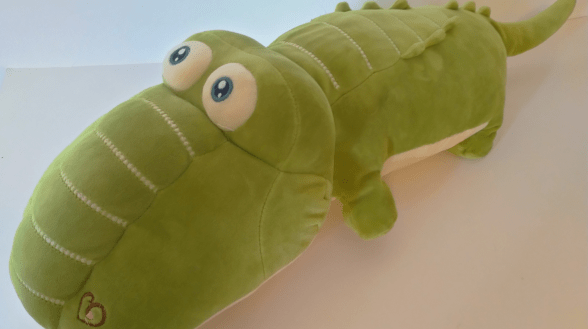
Now this is Seb. Seb, as you can see, is a crocodile. Seb is short for Sebek who is the Crocodile deity of ancient Egypt. By all means consult Wikipedia if you want to know more about his venerable pedigree! So Seb is the physical representation of our ‘lizard brain’. We can imagine this as the systems of the bodymind that allow us to make split second decisions, to play dead, to fight, to flee. I always introduce people I’m sitting for to Seb and suggest they try cradling Seb in their arms. I explain how when our lizard self is stimulated we can feel a little off balance and certainly the stimulation of the serotonin 2A receptor site in the brain which is activated by psilocybin, can lead to those sensations. I explain that by holding Seb we can, if we like, get a nice hit of oxytocin and that can help encourage us as we let go into the experience.
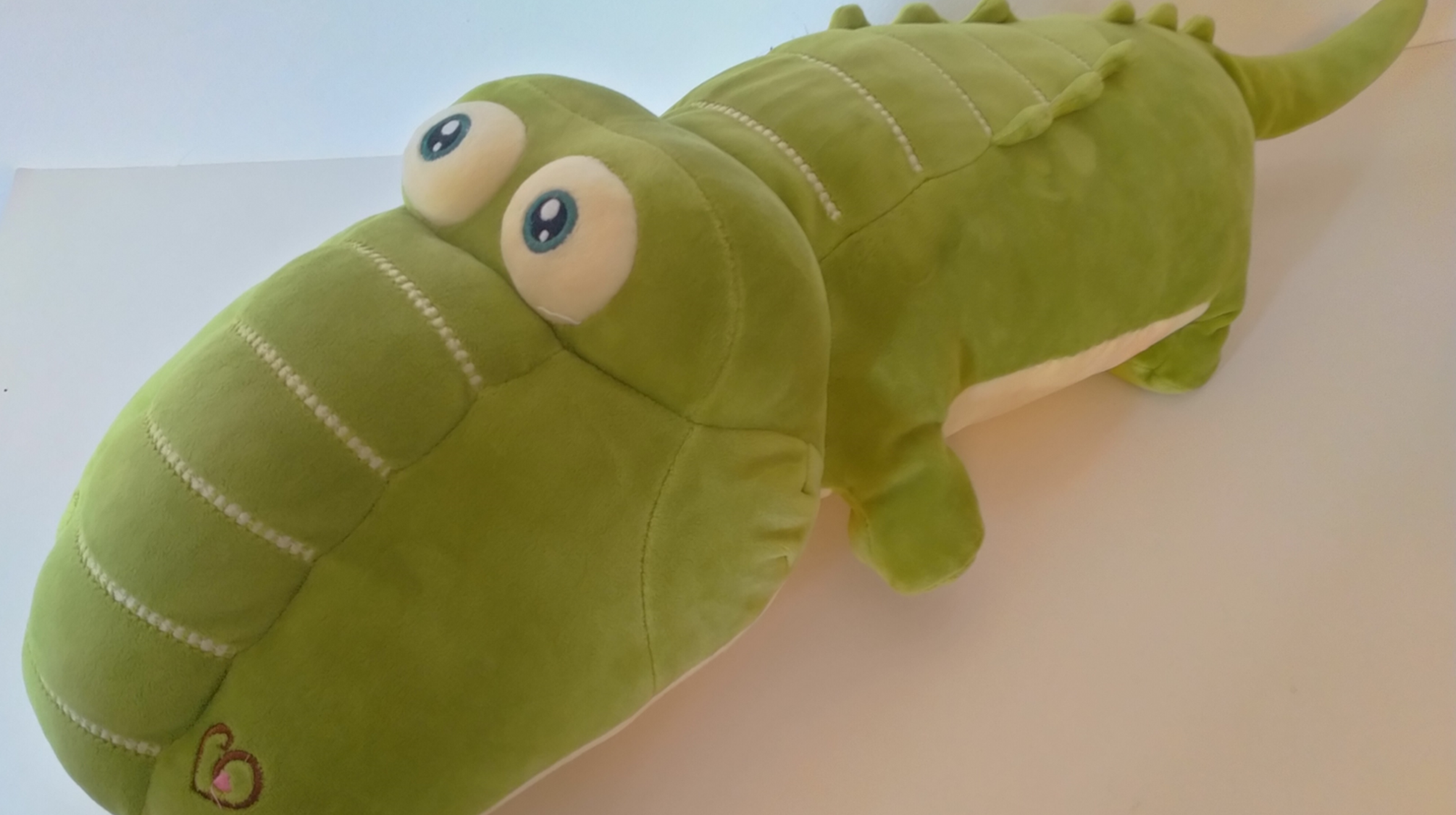
Over the years Seb has sat for the duration of the journey on people’s chests as they held him, others have stroked his paws or had him raised up to their third eyes at what I suppose was a meaningful part of the trip.
Seb, as a cuddly toy, reminds me of the ease and light-heartedness that I feel can be helpful when we approach the psychedelic experience. For all the earnest, brow furrowing talk about appropriate preparation, trauma release, and the work of integration it’s important to remember that the psychedelic experience can be funny, joyous, fascinating and pleasurable. Remember kids, most people take mushrooms for fun, and while there may be particular benefits from using psilocybin in an inward setting let’s not forget that fun and re-creation itself can be a great way to heal and be whole. What we are doing in the psychedelic ceremony is powerful stuff, but it’s also an everyday experience and normalizing it, especially in our culture where the shadow of the War on Drugs still looms large, matters.
Certainly the playful aspect of Seb (look he’s got nostrils shaped like love hearts!) is helpful to remember the playful aspects of the psychedelic experience. Finding ways to play is essential and often the psychedelic experience is about re–connecting with play which is our fundamental learning strategy as humans. One aspect of this is the way in which I invite people to prepare for and follow up their psychedelic experiences. I often say that time spent playing with art supplies (without trying necessarily to make a finished product) like paint, clay and so on, or time spent playing with a stick in the dirt or the sand at the beach are some of the most valuable things we can do when it comes to working with psychedelics. This is in my view especially true in Euro-American contexts where we privilege doing, producing, talking, consuming and achieving. Allowing ourselves some playful time, time to loaf about and time to gently let things settle is both valuable and fun.
Embracing our crocodile also reminds me that pain, discomfort, worry and fear are not the enemy. We feel pain because something needs attention and our conscious awareness notices this. Hopefully this means we can act to do something to help reduce our dis-ease, our suffering, but without the pain we don’t even know something is wrong. Sometimes the mushroom can help us zero in on our pain and with the wider, lantern style awareness that the psychedelics generate, we can see it from a new perspective and find a new way to make sense of it.
This is my magician’s hat. It’s also my hat as Priest of Chaos which is a title bestowed by people in my community of practice on those who are recognised for their role in serving the community. The hat, like the feather, was a gift. It was originally given to me by a druid friend who had added the road-kill fox tail. While I do occasionally wear the hat in larger communal ceremonies it’s not something I’d be likely to put on during a one or two to one sitting session. However my hat is usually somewhere around in the space I’m using because it reminds me of many things.

One thing it reminds me about is how we find ourselves doing this work. It’s not uncommon for people to emerge from their first psilocybin experience with a desire to share it with others. The excitement and sense of enormous possibility that psychedelics can generate is quite naturally something we’d like our friends and loved ones to try. Sometimes this desire is interpreted as ‘being called to serve the mushroom’ and to give it to others. Now that’s all very well and may be just the right motivation to become a sitter or therapist or researcher. However for me the acid test of ‘are we ready to do this work?’; is not what we think about ourselves but rather what others think of us, when others think that we are the sort of people who could help them. When people start looking for our assistance as sitters, especially when this begins to happen repeatedly, then we are clearly being asked to do this work. That’s when we are really called to serve the medicine.
My hat is suitably crazy, with a couple of badges given to me by the LSD historian Andy Roberts. These quirky additions help remind me not to take myself too seriously. I sometimes jokingly say that one definition of the shaman is ‘the person in the crazy hat with the drugs’ and this irreverence isn’t meant unkindly, rather it’s about pricking the sometimes over-blown pomposity of our own hype and indeed Western colonists fetishization around our notions of shamanism. An ability to laugh at ourselves, to prick the pomposity of the overinflated ego is best accomplished by cultivating the virtue of humility and a healthy sense of humour. Part of cultivating humility is by owning our opinions and admitting to the limits of our own knowledge, and by staying curious and cognizant of the world as a Great Mystery.
When sitting my role isn’t generally to wear a fancy hat and bang a drum. It is to quietly check the playlist is running. To offer a blanket and a few words of encouragement if needed. To provide water if requested, to serve food when the journey comes to its end. I’m ground control and while that’s a vital role I don’t need to be dressed like the airline captain to do it. Indeed my deference to the importance of the person who is doing the healing is shown in a variety of ways. One inhabited metaphor of how I express this is that I generally try to sit on the floor while the person taking the journey is on a low couch. This physical relationship helps gently underscore the empowerment and security I wish to be felt by the traveller.
The hat sports the wing of a magpie, because my tradition, my practice, is one where I have had to seek after the gold in the detritus of culture. My own society’s tradition of using psychedelics was fractured when the doors to the Temple of Eleusis closed in the 4th century AD and the possibility of psychedelic initiation was lost to Europeans. In acknowledgment of this, in recognition of the priceless gift of the re-membering of this tradition, I always ask for the blessing of Maria Sabina on my work. and play one of her songs at the start of my playlist.
Of course, metaphorically many of us wear many different hats. This provides a way of thinking about what I hope is one of the most commonplace effects of a successful psychedelic ceremony. To become open to change and transformation in order to develop our unique capacities and to flourish.
What we want is to be fully human; to fully participate in the experience of our lives and to do so we need not to be stuck wearing just one hat. Sometimes we may wear the veil of mourning, sometimes a paper party hat, sometimes a wild festive hat, sometimes something stylish or sober and sometimes no hat at all. People who seek out psychedelics for healing usually do so because they have been stuck in one gear, whether we imagine that gear to be that of an automobile or a milliner’s creation. Psychedelics can potentially alleviate our depression for sure but they don’t do this by rendering us unendingly joyful, instead they give us the chance to recapture our psychological and social flexibility. To broaden the repertoire of mental states beyond a fixation on a substance or a traumatic memory, to a wider view of ourselves and our lives. To try on new hats and see if they suit us.
Finally, I’ll add that of course this is a festival hat. One of the reasons for taking psychedelics is, as mentioned earlier, for fun, to deepen our engagement with art, with music, with each other. Mushrooms, for years before Western therapists started getting interested in these things, were taken by mostly young people to experiment with their awareness and to have fun. I’m glad to say that these days many projects are in place in these settings designed to support people who find themselves in challenging psychedelic territory. If you want to learn to be a sitter I strongly recommend volunteering for these providers such as PsyCare or the Zendo project where you could get more experience in a couple of long weekends than the few currently available licensed routes might provide in years.
So these are a few of my allies, my reminders, my tools and my friends. They are not what I expected I would present as the essential components of a psychedelic sitting ceremony when I first started out in the business. Good practice is like that, at least for me. It self assembles as a bricolage that feels right. A fusion of elements; some found, some gifted, some learned and some informed by research.

I have learned through this work that good sitting requires knowledge; an up-to-date and well-informed understanding of the drugs we’re using. It comes from kindness; where we seek not to impose our views on people, or to infantilize them, but to support them as best we can through their unique journey. It comes from experience; time spent doing the work of sitting and by engaging with psychedelics in other settings such as the religious and recreational ourselves. And experience should include our own ongoing use of these substances, and in that the recognition of experience, to know there is always more to learn. This, in my view, at least at the moment, is how we turn mere pharmacology into good psychedelic medicine.
Julian Vayne
Watch other presentations from the conference on the BC channel https://www.youtube.com/@BreakingConvention
Coming up next…
The Sacred Space Holder Program
In-person course at The Fungi Academy in Guatemala December 3-9th.
“We believe all of us should have the skills at our disposal to hold safe, psychedelic space for ourselves and our loved ones.
Currently, countless programs are popping up left and right, focusing on training skilled psychotherapists in clinical settings or multi-year programs diving deep into ancestral indigenous use.
Often these programs are focused on professionals and come at a steep ticket price. We’ve created this program for making this deeply powerful information accessible to psychonauts from all walks of life.
With this program, we intend to provide psychonauts and, particularly, sacred mushroom enthusiasts, with the tools to work with, support, and share the medicine to the best of their capacity.
While the course will reference harm-minimization and medical (therapeutic) use, the intention is to provide you with an excellent grounding in what we could call the ‘Sacred Mushroom operating manual.’”
There are just 5 places left! To find out more click here!
Music, Magic, Medicine
Join us in Berlin from 4-9th of August for a deep diving, hands-in-the-air exploration of rave as ritual in theory and practice.
An in person experimental space featuring Nikki Wyrd, Graham St John, Giorgia Gaia, Vincent Moon, Emily Esperanza, Danny Nemu, Orryelle Defenestrate-Bascule, Julian Vayne, Soundstrider and others tbc. Workshops, panel discussions, ritual and raving! https://www.musicmagicmedicine.com/
The Order of the Sun & Moon
Art & The Occult in the 21st Century
The Order of the Sun and Moon will open a alchemical laboratory and ceremonial chamber in St Ives, Cornwall at The Crypt Gallery on the 4th of November 2023. This location will remain active as a node of transformative magic until the 9th of November. Visit https://theorderofthesunandmoon.art/ to learn more.