The community of practice—the sangha, coven, temple or wider network of esoteric practitioners (such as the IOT)—is really important to me. I know myself well enough to know that, while I can do solitary work (including my ‘baseline’ practices of yoga and mindfulness mediation) it’s in community with others that I thrive.
One example of this is how, while I’ve written 12 books, most of these works have been co-authored with other writers. Bouncing ideas off each other and working collaboratively is what I love and I’ve been fortunate to have been doing this with my dear friend Greg Humphries since we met in 1998 (beginning with a sequence of rituals that culminated at the total eclipse of the sun in Cornwall in 1999). Greg and I have now produced our second book. Well, really Greg has done most of the work—the lion’s share of the text is his, as are all the wonderful artworks, drawings and photographs that accompany the words.
This new book is about one of our favourite practices, psychogeography. For us this a series of tactics in walking that allow us to come into a special type of relationship with landscape. These methods allow us to reveal the occult ‘hidden’ aspects of reality; the sacred in the everyday, the possibility of multiple narratives in spaces accessed by disrupting the dominant discourse (like what you are ‘supposed’ to find interesting when you wander round a historic house as we were doing earlier this week).
(There will be a limited number of full colour copies of Walking Backwards or, The Magical Art of Psychedelic Psychogeography available now. After Midsummer the edition will be available only as a monochrome text.)
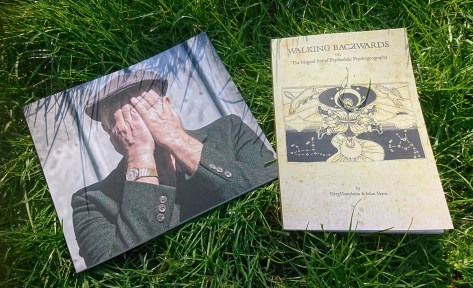
Texts of drifting, walking and wondering…
Psychogeography was the theme of a workshop I ran recently at Treadwell’s bookshop, from which I received some great feedback (like the review here). An interesting thing about psychogeographical explorations is that they attract a wide variety of people who sense that there are many possible relationships with the world we inhabit besides the narrow-bandwidth that is often served up as ‘being normal’ (or ‘acceptable’ or ‘permitted’ or similar). Excellent examples of both practical techniques for engendering these new states of awareness, as well as a deep theoretical exegesis of psychogeography, are to be found in the new work Rethinking Mythogeography… by Phil Smith. Phil is a seasoned traveller in non-ordinary spaces, creating plays and site-specific installations amongst other things. In his new book (which like the one by me and Greg, is replete with evocative photographic images) he explores the town of Northfield in Minnesota, counterpointing it with observations of the hidden histories of locations such as A la Ronde in Devon.
Phil writes beautifully, capturing in his prose the mythic intent and surreal outputs of ‘disrupted walking’.
The magic of the ordinary may at first strike you in flashes or by the sudden falling of a shadow across a scene; but if you can hold onto those moments for a while, stay calm and not grab for the first wonder, then—like the passing freight train—the magic will begin to steam around you in unfolding loops, in strings like movies or stories or chains of DNA.
The book by Greg and me comes out just as Greg (finally!) gets a major exhibition of his work. This will be happening at the Penwith Gallery in Cornwall (23rd March to 6th April) as part of the 80th celebration for St Ives School of Painting. Visitors will have the chance to see some of the amazing objects that Greg creates. These include a handmade, exquisitely carved longbow, with hand-stitched leather bow case and hand-forged and fletched arrows. This magical object, from an imagined Albion (‘Bring me my bow of burnished gold…’; part of the weapon is indeed gilded), is part of a series of pieces that bring together Greg’s skills in bushcraft and green woodworking with his magical world-view. Get along to the show if you can.
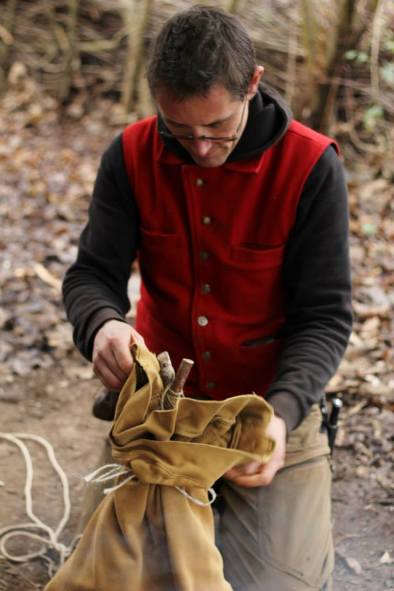
Greg Humphries, the artful woodland wizard
In other news, the Black Mirror Research network (exploring how ‘…artists have used esoteric, magical and occult philosophies as sources of inspiration’) and the Plymouth College of Art have a conference next month Seeking the Marvellous: Ithell Colquhoun, British Women & Surrealism. Over two days in sunny Plymouth some of the leading academics in the field will be speaking about important female surrealists and occultists including both Ithell Colquhoun and blogofbaphomet favourite Leonora Carrington.
Foregrounding (to use a contemporary expression) women’s voices is something I’m pleased to say is happening more and more, especially in the psychedelic scene. I’ve just been listening to the first Psychedelic Salon podcast hosted by Kat and Alexa Lakey; The Family that Trips Together, Sticks Together. As well as a fascinating interview with Scott Olsen they also present two conversations between the sisters and their Mum and Dad, reflecting on their psychedelic experiences, both individually and as a family. This fascinating and beautifully comfortable conversation breaks new ground in the field of psychedelic podcasting; we are after all 50 years on the from the first, and 30 years since the second, Summer of Love. We now have two, even three, generations of psychonauts in some families who can compare notes and share an understanding of these most profound and potentially liberating of experiences. (And now we’re on to the Third Summer of Love.)
I’m pleased to say that Alexa and Kat have invited me to work with them on some forthcoming podcasts. Stay tuned to The Psychedelic Salon and this blog for details!
Meanwhile I’ve been writing about psychoactives for a forthcoming collection of essays on psychedelics (I was pleased to be asked to contribute by the erudite and playful Erik Davis who interviewed me recently for his podcast). Writing longer stuff means that I’ve had less time for blogging here so I’m planning to start some vlogging (as I believe the young people call it…). There is an initial video here and more to follow. Please like, share and subscribe and all that.
Away from the virtual world, Nikki and I are looking forward to running a series of retreats at St.Nectan’s Glen. I’ve written about this space many times before on this blog so to have a newly built retreat centre there that we are helping to develop, and to hold space at this sacred location, is a great honour. Details of our May retreat can be found here.

Prayer ribbons and fairy towers at St.Nectan’s Glen
Nikki is also going to take part in a panel discussion alongside Dave King and Danny Nemu at the inaugural meeting of the Durham Psychedelics Society (for those who don’t know, Durham University is famous for its learning and researching in the fields of Biblical studies, Christian theology and the sociological and the anthropological study of religion). We’re both super excited to be speaking at the wonderful Beyond Psychedelics conference in Prague, (the call for papers is open now but closes soon!) and later this year at the Ozora festival in Hungary (7 days, 25,000 people and 24 hour psytrance, what’s not to like?).
On a more one-to-one level I’m also really pleased to find myself in a situation where I’m being asked to mentor and support people as they explore their own spiritual development. Part of the delight of this has been to be able to share my knowledge and experience but without adopting any kind of guru role. I offer my services in this respect as a Kalyanamitra (Sanskrit) or kalyanamitta (Pali), that is as a ‘spiritual friend’—someone who is walking a similar path and can provide support and encouragement to others, along with suggestions for practices and technique—but without any pretence to ‘knowing the answer’.
I get a huge amount out of this sharing of ideas. It’s great when this happens in a formal academic context (I’ll be teaching this year on the Spirituality & Ecology Masters Degree at Schumacher College) as well as in less formal learning settings (check out our Deep Magic pages for updates) and in peer-support environments too. Like many of us I understand things best when I’m exploring ideas with others.
As social creatures making these interpersonal connections, we have the possibility of developing both a collective intelligence (a group mind) and also of allowing the community to enable our own individual understanding. There’s a simple example of this; you may have had the experience of calling IT support and explaining the problem with your computer. As you do the explaining, even if the helpdesk person says very little, you are creating a new neural connection and often realize how to fix the problem as you are speaking. Making words to describe the problem to another person creates a new pathway for information to move through, often leading to insight and discovery. (You can try a similar process when looking for your keys by simply repeating ‘keys, keys, keys…’ which measurably increases how quickly you find your keys). Holding space with and for people, so that they can speak their truth, and come (like finding our lost keys) to moments of self-realization, is a real privilege. I think having a background in chaos magic helps, since while I have my story to tell and experiences to share that may inspire others, I’m not a ‘better’ or a ‘more powerful magician’ than anyone else. I’m also not interested in cheerleading for any particular paradigm, so while there are pagans and magicians who attend the sessions I curate, there are plenty of participants present who would not identify with those terms.
For me, as a group person and as an individual who thrives on collaboration, this diversity is wonderful. While I enjoy those more ‘inward facing’ conferences and meetings (where everyone is dressed in black, sporting various spooky bits of jewellery and making niche gematria jokes), making occulture accessible, intelligible and relevant to new audiences is, at least for me at the moment, where it’s at.
Julian Vayne


