A Tale of Two Popes

As you may well know, here at the Blog of Baphomet, we like to view the positive aspects of differing traditions so as to more fully appreciate their contribution to the whole. In this spirit I was recently reflecting on the resignation of Pope Benedict and trying to glean the positive aspects of his pontificate. I’ll be honest, prior to his becoming pope, Cardinal Ratzinger was not my favourite person in the world. As head of the Congregation for the Doctrine of the Faith he was central to the Church’s silencing the brilliant theological contributions of the Liberation Theologian Leonardo Boff and Matthew Fox, the father of Creation Spirituality. Both of these men were Catholic Priests at the time of their being silenced and yet their teachings were deemed as too dangerous and subversive. The work of both men makes a huge contribution to the Christian gospel both in terms of its alignment with social justice and a more positive relationship with the sensual Earth. Perhaps the best thing that he has done during his papacy is to step-down; I sincerely hope that its next incumbent is more attentive tohis humanity in embracing greater sexual and gender diversity and in promoting safer sex practices.

Man in tasteful 'fish like' hat

Man in tasteful ‘fish like’ hat

The world can be a chaotic, often frightening place and in our attempt to manage our fear, the desire to retreat to the known and to control via authority can feel overwhelming:safer to stay in our heads-away from the body and its longings, rather than trying to work with them. In the shadow of Descartes, Western thought has tended to depict the relationship between the body and the mind as being only partially connected at best-the messy, painful and all too mortal realm of flesh often seeming to run contra to the lofty aspirations of our best thinkers.

For this magical practitioner, the pursuit of awakening necessitates the integration of bodily passion with any more heady aspirations. Excessive attempts to by-pass or suppress the needs of enlightened self-interest, risk cutting us off from the potent life blood of our more serpentine, chthonic urges. The currents stirred up from the unconscious mind are the fuel that ensures that any more “lofty” goals are more than thin virtue and remain rooted in reality.

In trying to deepen my own engagement with the body, I’ve recently been carrying out some intensive research into the psychology and practice of shape shifting. In contemplating what it might mean to integrate those more animal aspects of ourselves, I sought the aid of the Black Pope himself Anton Szandor  LaVey. It may seem easy at many levels to dismiss the insights of LaVey due to his love of carnival aesthetics and shock tactics, but if we do so we risk overlooking the incisive polemic of his insights and his genius as a magical synthesiser cum plagiarist. For LaVey the pursuit of truly satanic ethics meant the rejection of institutionalized hypocrisy and an acknowledgement of our animal humanity:

“1 Satan represents indulgence, instead of abstinence!

2 Satan represents vital existence, instead of spiritual pipe dreams!

3 Satan represents undefiled wisdom, instead of hypocritical self-deceit!”

(The Satanic Bible pg. 25)

Stephen Flowers offers the insight that rather than LaVey’s ethics being merely anarchist antinomianism: “It harkens back to pre-Christian tribal ethics: you have the right and responsibility to live, thrive and survive.” (Lords of the Left Hand Path pg. 335) To access the bestial self is not to indulge in mindless blood-lust, while wanting to access the visceral strength of instinctive gnosis, the great needs of the tribe are still held as vital.
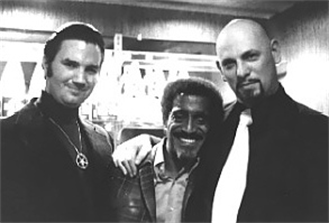
Some Lords of the Left-hand Path chillin

Some Lords of the Left-hand Path chillin’

Even though I personally believe that the gnostic path is one that ultimately moves through and beyond LaVey’s vision of indulgence, if we fail to ground ourselves in the body and the realm of the senses, our magic and initiatory work are unlikely to carry significant weight. If we disconnect ourselves from the imminent and the sensual, we risk a superficial awakening where we begin to attempt the expansion/deconstruction of an ego that has never truly been formed.

LaVey like Freud was masterful in recognising the drives and “darker” aspects of humanity. LaVey’s satanic philosophy rightly seeks to bring the libidinal drives of the Id above ground, so as to avoid the type of hypocritical suppression that he saw as rife within society. Arguably what neither Sigmund nor Anton developed fully was the realisation that the work of integratingthe unconsciouswas ultimately a path of ascent,illumination and refined return. While the adversarial rebellion of the “satanic” may be enough to catalyse the beginnings of the Hero’s journey, it is rarely enough to sustain it. In the psychological world this was brilliantly realised by Carl Jung and in an initiatory context this remains the focus of many of us working with the path of self-sovereignty and transformation.

SD

Feeding the Spirits

Why worry? The simple answer is that’s one of the main things your biology is geared up to do. Humans, in common with probably all other creatures, are designed to worry. It makes biological sense; we need to remember when bad things happen (you eat a poisonous berry, get ambushed by a tiger or whatever) in order to avoid them next time round. Our memory for bad things is phenomenal. I was teaching mindfulness meditation recently and doing a practice known as the body scan (HERE). One mediator told me after the session that she had experienced a ‘memory’ of a neurological problem she’d had with her arm several years before when bringing awareness to that part of her body. She’d not thought about the ailment for many years but, during the body scan, she could feel as if (as Spare might say) the condition had returned. After the session her arm felt perfectly normal but this was a neat insight into how we remember bad stuff and can, under the right conditions, easily recall discomfort, pain and fear.

Not a state of mind to aim for...

Not a state of mind to aim for…

Of course it’s also true to say that humans (and indeed other beasts) are pretty good at normalising things too. Boredom comes naturally to us. Just another day in the gulag, just another abusive email from the regular troll at your website, just another homeless person on the street as you walk to work   – even the nastiest things can become humdrum. When the scary becomes predictable then the shock is gone and we slip into dull resignation or even disdain. And that’s where worry comes in. If we worry our minds search around for ‘the problem’. The curious thing is once ‘the problem’ is dealt with another, new problem arises. Just like the thoughts we encounter in mindfulness. Worrying trains of thought that can be particularly tricky to wake up from because they lock into much of what we, as biological organisms are meant to do. To recall what was bad, to anticipate future bad stuff and to imagine strategies to avoid bad stuff in the future. Worry keeps ‘the problem’ fresh by picking at the scab of attention.

Much of our culture feeds and indeed exacerbates these tendencies in our biology. Much of the media is based on selling fear. Fear, which we gobble up because we like it, our neurology craves it. And to stop our mental palate getting jaded we need that fear to come in a variety of ever morphing forms; terrorism was last weeks worry, this week it’s phenylbutazone in our horse burgers, next week (after a brief topping up our Middle Eastern crisis levels) perhaps it will be the antics of doomsday cultists or the catastrophic failure of our antibiotic medicines?

This focus on fear surrounds itself with a variety of supporting memes which help us rationalise why we feed ourselves this diet. One such meme is ‘realism’; that is if we don’t choose to engage in feeding ourselves this material we must be sticking our heads in the sand, ignoring what’s going on in the ‘real world’ (as though that’s what the media presents) and living in a rose-tinted fantasy land. Such a belief can be challenged in a variety of ways. One is the observation that people who choose to engage with lots of mainstream media content, soap operates and so forth are (objectively) less good at assessing risk than those who don’t. If you spend your evenings watching gritty hospital dramas and real-life police action shows you are very likely to hugely over estimate your chances of being involved in a violent crime, and to guess a very high figure for how many people actually do die in tragic accidents. (A few nice bits of information about human reactions to on-screen violence HERE)

Now I’m not suggesting that we shouldn’t be prepared to meet the full horror of the world face-on.  A visit to the Holocaust galleries of the The Imperial War Museum, London is one way to do this or simply dip into the darker side of Youtube (such as this deeply distressing Pathé news film of troops attacking Borneo HERE). It’s a necessary condition of an intelligent engagement with the world to consider the destruction of the biosphere, the social inequalities in the world and our own personal pain. But in my view the wise person, the skilled magician, also ensures that their soul is well nourished with delight, compassion and indeed ecstasy.

One process for doing this is the traditional peyote ceremony. The basic technique is to spend a night sitting around a ceremonial fire having ingested the Grandfather medicine. At various points in the vigil the glowing ashes of the central fire are swept out to form the shape of the thunderbird or love heart. Prayer and songs are used to invoke happiness and to promote a sense of thankfulness. Cedar incense is offered to bring purification, and at the end of the rite there is a feast. Grateful of the well-being which the medicine brings, and the support of our Brothers and Sisters around us, in a space of acceptance and respect, joy pushes out the sadness, the worry, the fear. The medicine ceremony grants ecstasy and in that space the healing power of compassion and gratitude may do its work.

Those Huichol chaps know a thing of two

Those Huichol chaps know a thing or two

Like mindfulness the ritual of the peyote circle may not change our actual circumstances. But what it can do is provide us with a new input of intense happiness. In the morning our concerns are not magically fixed but what we do have is a space. Worry has been placed in perspective, into a broader context. A little of the ‘free floating anxiety’ in our lives has passed from the amygdala to the hippocampus and we are better able to face the future from a place that isn’t just informed by the gloomy fixation of our simian biology. (More on the biology of mindfulness HERE.)

There are many ceremonies, many acts, many ways of thinking that we can use to intelligently re-engineer our minds. And while we may face hard times to do so from a place of equipoise is much more likely to lead to accurate judgement of situations and good choices than if our minds are full of fear. We’re also much more likely to be capable of experiencing and indeed creating happiness for ourselves and others.

So with whatever ways are at your disposal, feed your soul and may you be able to discover the delight in your life in the past, present and the future.

JV