The world around you has many flaws. You feel confused, ill at ease about the future; if not at a personal level, on a wider scale. Yet, you know that surely there exists some kind of functionality, implicit in the observable fact that this planet (and the systems upon it), do function. So, there must be a flaw somewhere along the line.
Could it be that the flaw lies in an attitudinal issue? If I were to just believe in [insert paradigm here] then perhaps, the whole mess would shift and things fall into place?!
We all desire a sense of security, of consistency. When the world seems to challenge this we cling to our comfort blankets, pull the duvet over our head and sing loudly those refrains we know so well. And often this is sufficient to get us through another day. But, perhaps, we ought to learn a few new songs, and develop ways to get out a bit more, so we might manage to write some more functional, maybe even more enjoyable, narratives for ourselves? At the heart of Chaos Magick, this methodology of using belief as a tool gives us the chance to escape the prisons of certainty.

!!! … ???
Conspiracy
I saw a remark on facebook recently, which summed up the situation quite nicely; “Most conspiracy nuts are control freaks, who can’t handle that shit happens.” Nick Farrell.
There has to be a plan behind the random interactions, surely?! Otherwise the stories of our lives which we tell ourselves might have no Meaning. We, as individuals, might not be the central character, the hero, or even a major player. Others might have a greater role in the world than we do… for some this suspicion is anathema, and they will believe anything rather than that. At the very least, they see themselves as privy to some secret angle on the available information that normal mortals have been fooled by. They alone have privileged access to The Truth.
While some of the information passed on by such individuals might have a grain of truth to it, often the implications or the exact details are inaccurately phrased. Finer points get ignored or misunderstood, to allow for the Grand Schema they seek supporting evidence for to be held up as case proved.
Religion
Ah, Faith, how do we love thee? For the hard of thinking, religion provides a comfortable route out of intellectual rigour. And faith is so nice, so redolent with nostalgia. I remember going to churches when I was little, not for the services but with my mum as a cultural learnings expedition. I still love churches, the ancient architectural terminology, the shapes at once familiar from each building and yet uniquely constructed. Similarly, each follower of a religion has a general set of beliefs which has a particular shape, yet each one has a personal unique take on exactly how they interpret the stories and praxes of the cult they espouse.
Many religious adherents place value in the teachings attributed to a figurehead (whether a deity or a holy person). They take their cues from examples of previous souls who were in touch with higher powers. While these teachings can indeed provide useful starters to provoke Right Thinking, it is worth noting that the great religious teachers tend towards a few central tenets (eg, be nice to each other), and themselves often reject the written laws they were given as children. As the true Sufi knows, blind adherence to rules can often result in fossilised and inappropriate copying of behaviours and beliefs… circumstances differ from time to time, and so should our responses.
Science
‘Scientists say’ has to be one of the most meaningless phrases ever used to introduce a sentence. What it actually means is, a person or persons unnamed, have apparently used scientific methodology (repetition of experiment) to gather data, which when statistically analysed suggest a 95% probability that the experiment agreed/disagreed with their initital hypothesis.
Which is a useful way to work (cf, the world around you).
Scientific thinking does have one major recommendation which is that it constantly seeks to rewrite the way the world works by discovering different ways to describe the how & why of things. As with any information it all comes from a person, so don’t be surprised to find that a scientist has made errors in their work. To minimise this they check each other’s working. Not a perfect system, but one that at least admits to its subjectivity.
However, note well, that science can only ever state that a theory has not been disproved; it is merely the measuring of the probable.
Memes and viral posts
Fake petitions, untrue rumours, misleading summaries of political acts, misattributed quotes, we’ve all seen them and been taken in (even if only briefly…).
Check out the sites which list these pernicious bits of information, and explain what the story really was or was not. Thousands of people every day are upset, angered, and made to look stupid by reposting these without a moment of reflection on what the effects of their action might be. Check with yourself; does this story ring true? Do the facts look selective; perhaps other information alters the context? What motives might the originators of the viral meme have, who are they?
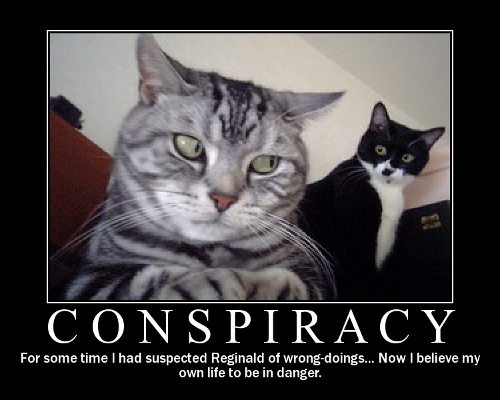
Obligatory cat meme
The Media
All is performance. Even raw documentary edits and selects to provide a fictional, incomplete version of any event. Written newspaper articles cannot tell you anything more that the opinion of the journalist, however much they may attempt to be factual.
…
Thoughts do not prompt actions. Feelings motivate action. Thoughts, however, can alter feelings… Changing one’s mind can have enormous consequences.
Information can have an impact on the thoughts we maintain within our heads. For different people, the same evidence can result in widely disparate reactions, the existing contents and structure of the mind reacting alchemically with the same fact; consequences of a statement having particular ramifications for each individual.
Choosing one’s beliefs, with due diligence, has profound implications. Sometimes we adopt beliefs because they look attractive, or because they are the best on offer at a certain moment. In the heat of the moment a new idea presented under circumstances which boost its power can seem irresistible.
Having a skillset which allows one to pause, reflect, see into the future, divine what this idea might hold for ourselves and our communities, conscious awareness of the way we choose our reality tunnel; what a world changing prospect!
NW

 The Blog of Baphomet