Children in the Circle – Paganism, Spirituality and our Families

Hanging up decorations to celebrate Yule, carving pumpkins at Halloween, dancing the Maypole and more – all of these are both modern Pagan activities, folk customs and stuff that kids can get involved with. Those of us who have the honour and delight to be parents get to engage in some very interesting questions when it comes to the relationship between our own spiritual practises and our kids. So what is the context for what’s going on? In a significantly secular culture such Britain (around 25% of English citizens describe their religion as ‘none’) there is a tendency to think that spirituality (or the apparent lack of it) is down to personal choice and conscience. Britain is also a spiritually diverse landscape, the arguable origin of a number of new religious paths (as mentioned HERE). It’s also true that the social function of religion in Britain is perhaps different from that of the USA (discussed HERE). So with these considerations in mind how do we, as families, integrate our own spirituality with raising children?
 
Pagan family

Pagan family

Hanging up the Yule/Christmas/Mithrasmas/Winterval decorations is a good example. This is an embodied practise, one that we can give multiple meanings to. A ritual like this can be something children can enjoy and participate in. In my household I describe what we’re doing in, what I hope, is a very open-ended way: ‘We’re making the house look fun because it’s dark and we’re going to have a few days holiday where we can watch movies, eat nice food, and snuggle by the open fire. We are celebrating the fact of the longest night, the beginning of the New Year, and the slow return of the light’. Unless they go all Jehovah’s Witness when they get older, my approach is also I hope, broad enough that they can appreciate what we did in Pagan, Humanist, Atheist, Christian or other terms and not find it problematic. Of course they also don’t have to join in. I’m totally happy to put the tree up and install the ivy myself, but naturally they want to help.
 
Of course there are lots of parts of my own spiritual life from which my children are excluded. All of the esoteric groups I work with maintain policies that preclude the admission of anyone under the age of at least 18 (even in the informal world of Wicca 30 years ago it was really difficult for me to get involved in a group when I was 16). However in other cultures these things differ. Children are most certainly present at ceremonies such as the Healing Dance of the San people from South Africa. In this rite dancing and singing continues long into the night as people are possessed by spirits (an event, which in that culture is often attended by bleeding through the nose). Mothers sit on the sand with their babies and, at least before they get tired and bored, the younger San kids run around the outside of the ritual space, pretending to get possessed and generally taking the piss out of the shamans in the circle. Just as one might expect.
 
One of the benefits of my own Pagan spirituality is that it allows me to include my children in the public and gentle ceremonies of celebration (such as the ones that take place at St Nectan’s Glen and at many other sacred sites in the British Isles), as well as a selection of domestic traditions. Because these traditions are rooted in the flow of the seasons they are open to interpretation and elaboration in many different ways. Intelligent children (and of course my kids are really bright) readily understand this. My eldest son, many years ago, pointed out that the sun coming back from the solstice of Yule was the same as Aslan in The Lion the Witch and the Wardrobe. And that this was basically the same as the story of Osiris and also Jesus. Personally I tend to avoid names of deities (though we all have a soft spot for Ganesh and through the medium of Marvel comics both my kids are getting more interested in Norse mythology) and instead talk about what we’re doing as people connected to the landscape we’re in. It’s all about relationships and perspectives. So at the Equinox I explain that this time is about noticing that light and dark are equal, and realising that this is one of only two days in the year where the day and night length is pretty much equal all across the whole world. No deities, no rules, do dogma, just a scientific fact that we’re choosing to notice and celebrate.
nom nom nom

nom nom nom

As well as including our children in accessible and culturally appropriate aspects of our spirituality we can also learn from them. For Lammas this year, at the suggestion of my eldest son, we made special biscuits to celebrate the fact that the harvest had come. This has become something of a theme (I mean home-made biscuits! What’s not to like?) and so for this Equinox my children made two batches of biscuits which we shared with participants at a public Pagan ritual we attended. Chocolate ones for the dark of the year, and banana and vanilla ones for the light. And so my kids have built for themselves a family and community tradition. I only hope that they don’t follow through on some of the more grotesque suggestions they seem to be considering for their Halloween recipe!
 
JV
 

Black Magick and Shooting Rabbits

Shooting rabbits isn’t easy. At least that’s what a friend of mine has discovered recently. The Devonian farmhouse in which he lives boasts a magnificent garden with a pond, numerous fruit tress and a large lawn. In the evening, while reading in his library, my friend could see rabbits emerge from the hedges and begin to feed. As a confirmed gourmet he decided that a stew with rabbit harvested from his own land would be something to have a go at. With this in mind he purchased an air gun.

The next day the rabbits were back, nibbling the grass and burrowing under the apple tree roots and damaging them in the process. My friend left the library to obtain the weapon but upon his return the rabbits had, miraculously it seemed, vanished.

Prince of a Thousand enemies

Prince of a Thousand enemies

This went on for some time. Occasionally he would get as far as opening the library door, gun in hand, before his quarry would disappear. Yet other times they seemed to be sensitive to his murderous intentions before he was even able to open the door. What was going on? Did the rabbits posses some remarkable psychic power? Some precognitive skill that was able to preserve them from the hunter?

Finally my friend was successful in bagging himself a bunny. He’d figured out what was going on and adapted his behaviour in such a way that the rabbits were no longer disturbed by his armed presence. However having killed one animal it’s now the case that the rabbits are steering clear of the lawn (at least during twilight).

So what was going on in this situation? As anyone who has hunted will tell you when we attempt to stalk an animal it’s not only the quarry we need to watch out for. In this case, even while in his library, the movement of my friend, especially the type of movement he was making (to get his gun and quietly try to slip out the French windows) was alerting the whole network of relationships in the garden. Birds notice what’s going on and give their alarm calls. This alerts the rabbits, which take cover.

This reminds me of a point made by a psychedelics researcher during his lecture at the recent Breaking Convention conference. In trying to explain the expanded sense of awareness that the drug NMT creates he quoted a remark made to him by an aboriginal elder. The elder asked ‘how can you know if something is coming even if it’s kilometres away from where you are?’ The answer is to listen deeply, to attune the hearing down to the level of the mummer of insects in the landscape. As the object or animal approaching perturbs these buzzings and chirrupings and flappings, so those changes cascade through the reptiles, the birds and the mammals in the landscape. Alarm calls are issued by many species and so the clever listener can hear that something is coming long before the noise of the object itself is discernible.

What happens in the bush is identical to what happens in the Devon countryside. The rabbits were listening not just to my friend attempting to sneak up on them with his gun. Their senses were attuned to the background hum of life forms in that landscape. In this way they appeared to have miraculous powers of perception.

It’s easy for us humans, with our amazing ability to focus on just one thing amid a range of inputs, to forget about this kind of background, holistic perception. Yet this effect goes on around us all the time. When we enter a situation there are the bits of it (people, objects, products, events) upon which we are focussed and then there are all those intimately interconnected elements that we may disregard as irrelevant. But if we want to successfully engage with the subject of our intervention (ie to shoot the rabbit) we must bear these things in mind.

In magick, like in hunting similar rules apply. For instance, we might want to explore or change some aspect of ourselves, or indeed the world around us, by our practices. As we attempt to do so we may discover that our ‘quarry’ is intimately bound-up with other aspects of the self or wider universe. We may then discover that we can’t go straight from A to B but have to spend some time settling into a new pattern, gently putting things ‘at their ease’ before we progress.

This is particularly important in cultures like our that often emphasise the importance of speedy results and goal orientated behaviours. One might for example contrast the permaculture approach to land management with that of industrialised farming. The ideal permaculture way of working with a given area of land is to spend at least a year simply observing it. Finding out how it works, talking to people who have known the land over time, spending time in and among the beings that populate the space. After a time of observation, the logic runs, what we decide to grow, to build and to change about the land in question, can be informed by our active observations and growing sensitivity to that particular place. The contrast with the quick, results driven approach of industrialised farming, where land is not much more than raw space for activity, is a dramatic one.

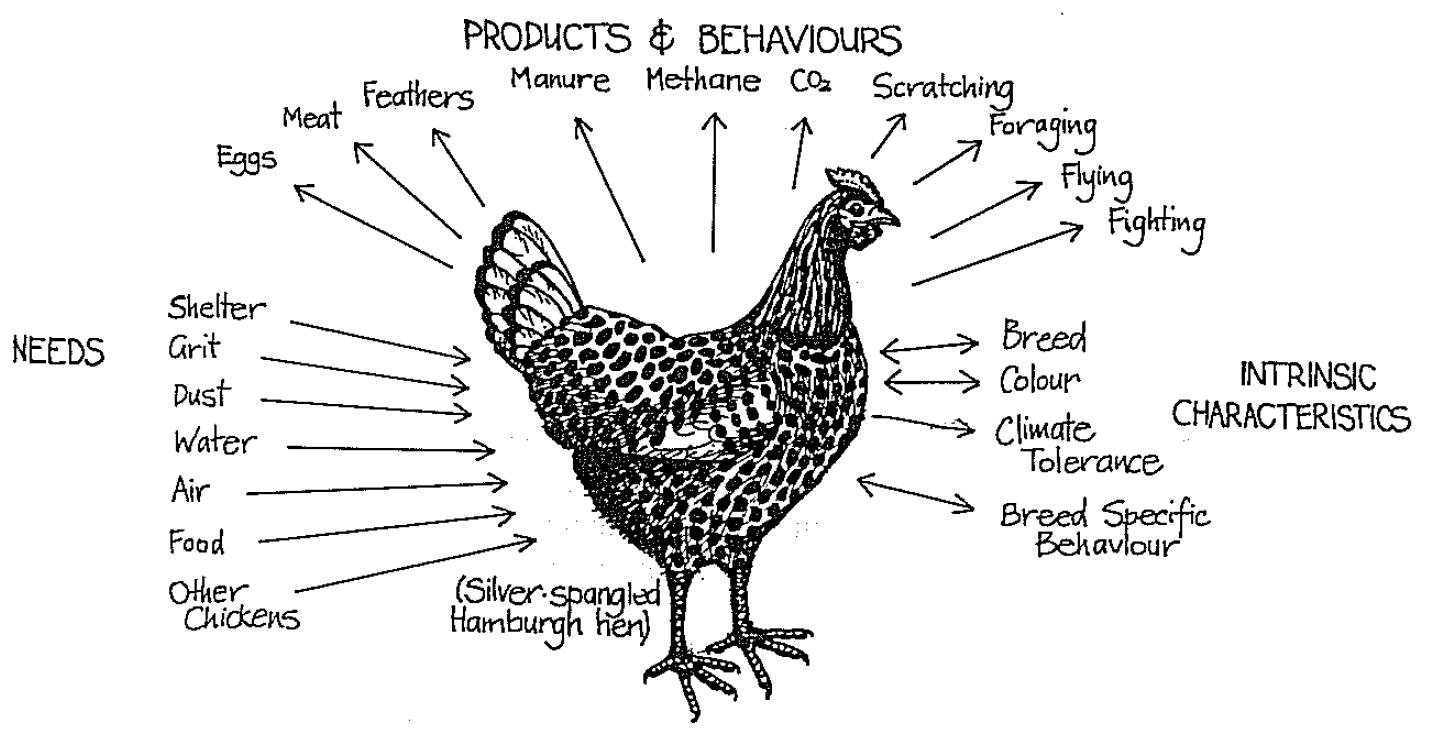
Permaculture chicken

Permaculture chicken

Given these facts it’s not surprising that the beginner in magick often fails to take their time, and it’s true that even experienced adepts sometimes find themselves being too quick to focus on ‘the result’ they are after. Not only can this mean we miss the delight of the journey to our goal, but, as with the case of the rabbits, our thundering presence in the woodland of the unconscious can spook our target and leave us none-the-wiser about why things went wrong.

When we talk of magick it’s easy to imagine that we’re talking about what Starhawk defined as power-over. Being in control, being the ruler of the psyche – all sigils and kick-ass ceremonies and servitors an’ shit. Whereas as the skilled hunter knows (be they a rabbit hunter or the kid waiting motionless by the rock pool, eager to see the slow gyrations of water snails) there is great power in stealth, in silence and in sensitivity. All those barbaric words are pretty cool, but they’re not going to work too well unless we know how to listen.

This sensitivity, one might conjecture, is more likely to lead to an intelligent view of the world as an interconnected whole. It may also lead to moral qualities such as the pursuit of virtue, compassion and tolerance. Beyond this it could be the basis for a holistic perception of the world that transcends the narrow confines of the assumed self but does not abandon the reality of our individual narrative (one could say (True) Will) in the world. In a sense this is ‘black magick’ in that it’s focused around getting what we want (in this case, some excellent rabbit stew) but in order to get what we want we find ourselves developing our sensitivity to the universe; expanding our notion of who we are, and better understanding our story, and that of others.

JV