The Spheres of Chaos – Geosphere

In addition to the eight Sabbats of Chaos Craft another motif we’ve continued to use in our work has been that of the Five Spheres. This conceptual device, developed by Pete Carroll in consultation with Nikki Wyrd, links to the vowel sounds (I,E,A,O,U) that are incorporated in the ‘middle pillar’ part of the Gnostic Banishing rituals.  In these practices attention is given to the crown of the head (the Chaosphere), the throat (the Noosphere), the heart (the Anthrosphere), the belly (the Biosphere) and the base (the Geosphere). The whole system is described in detail towards the end of The Book of Baphomet.

We’ve started a series of rituals to explore each sphere. The first in the sequence is the Geosphere; the world of the rocks, the stones and the crystals (as the old Pagan chant puts it). This is place of the Elder Gods, and of our sense of hunger.

His snorting throws out flashes of light; his eyes are like the rays of dawn.

His snorting throws out flashes of light; his eyes are like the rays of dawn.

Each ceremony itself (so far we’ve done three rites) has included simple shamanic style techniques; the use of poetic text, drumming and silent meditation. Our aim; to commune with these different interpretations or layers of reality,  while bringing a distinctly Left Hand Path and Setian mindset to this work. I plan to post some of the material used in these rituals on this blog.

The Geosphere, imagined in terms of the life of a person, is our intrauterine and infantile existence. Looked at in cosmological terms, it is that great dyad of space and time. It another sense it is the realm of raw physics;

Hydrogen begat Helium,

Helium begat Carbon,

Carbon begat Oxygen

In terrestrial terms the symbol of this sphere is the equal armed cross + representing the physical earth upon which we stand. From the magnetosphere that shields us from the solar wind, down through the depths of the ocean, riding upon the backs of tectonic plates, and deeper, to the core of our planet (which glows at the same temperature as the surface of the sun). For our lived experience, as dwellers on the surface, it is the four directions, the crossroads.

The spirit of this sphere (in a Typhonian stylee) is the monster Leviathan and the poem we used is taken from The Book of Job. It is also the place of Apep or Apophis, the great dragon-serpent whom Set keeps at bay, protecting the sun in its nightly journey through the underworld. I sometimes imagine Apophis as entropy, that mighty stooping dragon who, within the narrative of the cosmological Standard Model, seeks to drag down complexity into a vast uniform heat death of elementary particles and radiations. Space and time gives birth to all things, and in the end (it seems) will destroy everything too. The all potential womb is also the all embracing tomb.

But for all this, biology and mind rises up (like Set) against (and within) this inky black darkness. We are mud that sat up and became sensate.

(In a perhaps less Setian style one might also point out that the universe, for all its faults, seems peculiarly adapted to the needs of the kind of physics and chemistry that allows for life. Our cosmos seems perfectly set up not only to permit but to encourage life. Were the weak force (or the others in that great fundamental quadruplicity) just a little weaker, and it could all have gone horribly wrong.)

If you fancy doing your own meditations on the Geosphere you could use the poem and soundtrack below. The recording was made during the ritual. Part of the background is a NASA production of the song of the earth in space. There’s also the sound of stones being ground together in the temple, resting upon the bones of a mighty whale.

Go Deep & Enjoy!

JV
Banish with Laughter

Laughter is the best medicine, at least that’s what some folks say and, in the tradition of chaos magic, laughter is certainly accorded important status. As well as the well known technique of Banishing with Laughter (BWL) chaos magic, since its early days, has tended to incorporate distinctly discordian elements; Eris, current 23, The Rev. Bob Dobbs and so on. Within The Illuminates of Thanateros there’s a specific role known as Insubordinate that acts to deploy (amongst other things) humour, to ensure that people within the Order in positions of authority don’t become too self-important.

There are many types of laughter, which in itself is part of the importance placed on it in BWL; laughter can be kindly or cruel, it can be a way of relaxing people and opening up playful possibilities or it can be a tool to ridicule, to silence and to harm.

If we look around the spiritual traditions on our planet we can see a wide variety of different ways of engaging with, and sometimes actively opposing humour. Take for example the pivotal and historically accurate role that laughter plays in Umberto Eco’s The Name of the Rose. (*Spoiler Alert)* A murder plot, set in a 14th century Italian monastery revolves around one Brother’s attempt to suppress a text by Aristotle about laughter. The dialogue below is taken from the 1986 movie:

William of Baskerville: My venerable brother, there are many books that speak of comedy. Why does this one fill you with such fear?

Jorge de Burgos: Because it’s by Aristotle.

William of Baskerville: [Chasing after Jorge who runs with the Second Book of Poetics by Aristotle intending to destroy it] But what is so alarming about laughter?

Jorge de Burgos: Laughter kills fear, and without fear there can be no faith because without fear of the Devil, there is no more need of God.

William of Baskerville: But you will not eliminate laughter by eliminating that book.

Jorge de Burgos: No, to be sure, laughter will remain the common man’s recreation. But what will happen if, because of this book, learned men were to pronounce it admissable to laugh at everything? Can we laugh at God? The world would relapse into chaos! Therefore, I seal that which was not to be said.

[he eats the poisoned pages of the book]

Jorge de Burgos: In the tomb I become.

[he tosses the book at the candle, which ignites a fire that destroys all the books in the abbey tower]

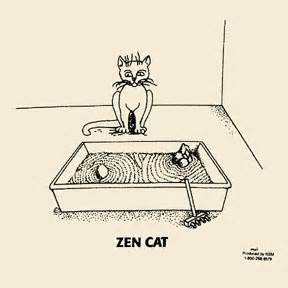
Consider other times and other spiritual traditions; where is the place of laughter in Islam? In Wicca? In Hindusim? In other styles and traditions (including  Scientism, humanism and atheism)? Zen of course has plenty of jokes (although it also maintains a hard-core warrior style too, showing that humour doesn’t necessarily equate with flakiness).

zen cat

Laughter about a tradition that emerges from within a tradition itself is perhaps the most healthy form of humour. The great tradition of Jewish jokes told about and by Jews themselves is one example of this. Perhaps the further we travel conceptually from what we ourselves identify as, the less our humour is likely to be kindly and funny (and the more it’s likely to be unkind and even to mask actual intention to harm).

Pagan and occult cultures in the English speaking world can be very variable in their ability to engage with humour. Some of this may be down to there being in-jokes which are shared within these cultures that wouldn’t be half as funny (or make any sense at all) to outsiders. For instance I can neither confirm nor deny the existence of a ‘Chaos Song Book’ featuring classic sing-along-a-tunes such as ‘My Old Man’s A Magus’ (sung to the tune of ‘My Old Man’s a Dustman’) within one chaos magic order I know. I assume there’s something similar in, for example, the Temple of Set but (as someone who’s not a member of that Order) I can’t say for certain.

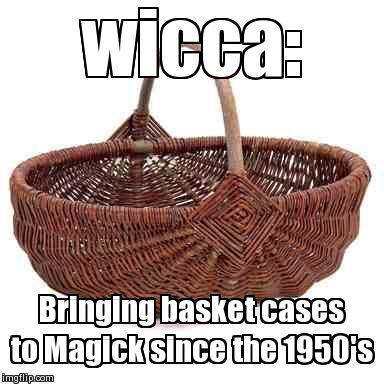
Laughter can act as a great way to open up discussions, if it’s handled well. For instance in a Facebook chaos magick group throw away (and sometimes rather unkind) jokes about Wiccans might elicit calls of approval from some of the assembled multitude (especially folks from the USA where the perception and story of Wicca seems to be very different from that in the UK). Speaking as a Wiccan I could take offence at this but instead it provides an neat opportunity to challenge simplistic assumptions of the ‘All Wiccans are like/believe X’ variety. Unsurprisingly, views of the universe that begin ‘All Wiccans/Muslims/Chaos Magicians/Satanists/Jews/Muggles etc etc are like X’ are far from nuanced (or even accurate) descriptions of the world. But engaging with the humour in a gentle, generous spirit can make for some useful opportunities for discussion. The big mistake would be to become defensive about people making fun of Wicca per se. Indeed it is, in my view, very important that we’re able to make fun of ourselves (if nothing else if we’re not able to, it’s certainly the case that others will happily do thus for us!). An an example of this I posted the picture below to said Chaos Magick group (shortly after the Wiccan ribbing had taken place). The image incidentally was one I came across in The Pagan Federation (England & Wales) page.

Wiccan basket case

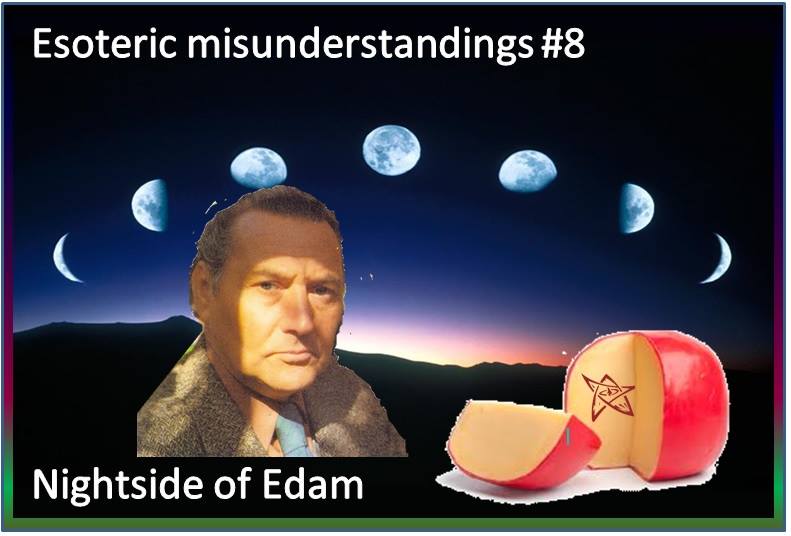
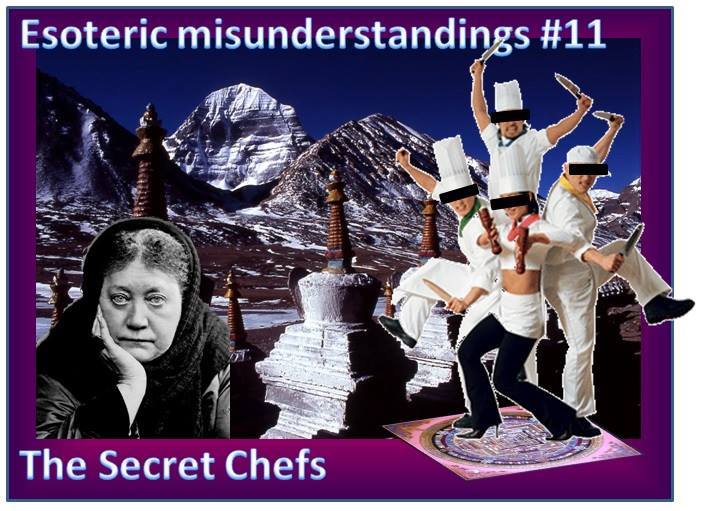
And so, in the spirit of generous humour here are a few offerings. A series of occult memes that have raised a few smiles on-line and a longer cut-up/mash-up I produced featuring the extraordinary work of E.A.Koetting (all that uber darkness demonic stuff seems in invite some playful humour).

Enjoy!

JV

Esoteric Misunderstandings 4

Esoteric Misunderstandings 8

Esoteric Misunderstandings 11

The original http://www.becomealivinggod.com/about/

The remix