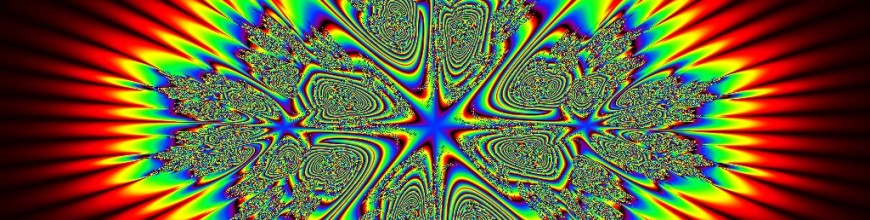
For every complex problem…

One of the lovely interpretations of the classic chaos glyph (that eight-pointed star thingy which itself has various names, none of which are perfect descriptions) is the idea that it represents the magician expanding outwards in all possible directions. This is a symbol of diversity and multiplicity rather than a unitary simple Truth. The many-rayed sigil reminds us that, as American essayist and satirist H. L. Mencken pointed out; “ For every complex problem there is an answer that is clear, simple, and wrong.” In the complexity of human existence (which has, I suspect, always been pretty complex even in various imagined ‘simpler’ ages) what appear to be ‘straightforward’ answers (often served as naive religious, philosophical or esoteric Truths) often turn out to be bunkum.

point star wotnots

pointy star wotnots

Sure there are times when we must decisively act. When we must say ‘no’ and draw a line in the sand. There are times when we must slice those Gordian Knots and cut through complexity to find clarity. However the kind of poor quality simple answers I’m thinking of are the kind of (supposedly) axiomatic articles of faith that get trotted out without much reflective thought.

Take, for example, a view that began to emerge as Freud et al were exploring the subconscious architecture of the human mind. As any 1960s hippy will tell you; the main problem with society is that we’re all sexually repressed. If only we could somehow be free sexual beings; free of the patriarchal fear of female erotic power, free of repressive laws about nudity, free of our own Judeo-Christian notions of sexual guilt and shame. If only we could be free in this way everything (and the suggestion is that miraculously dealing with what is perceived as the big problem will somehow fix all the other problems in culture) would be groovy. While there is certainly merit in exploring the issue of sexual openness the problem is that in individuals who, perhaps as a result of illness, don’t exhibit any sense of ‘repression’ end up finding life in consensus reality pretty tricky. Sexual disinhibition can arise as a result of various neurological problems and for the people with these difficulties, their families and carers, the trauma caused by a reduced ability to understand what is appropriate behaviour in a given context can be greatly distressing.

This is not of course the same as saying that sexual mores in culture cannot and do not change. I was recently at a wonderful beach in Cornwall where it is accepted that people may, if they wish, go naked. There has been a generally gradual social process which means that, still with boundaries, nudity is accepted in this locality. Equally we can look at the objects left by other cultures which point to the flexibility of human social mores on nudity and sexuality. I was recently involved in the curation of an exhibition and associated sexual health project which takes objects from the past and other cultures and uses these as lenses through which we can explore how ideas about sexuality change and how we can use those insights to reflect on our culture today. Change certainly happens, and sometimes change is sweeping and radical. But even dramatic change happens within a context, which we ignore at our peril.

Full of sex objects...

Blyth House, London. Full of sex objects…

When we consider simple (wrong) solutions there’s also that often quoted idea that ‘if only we could live in the moment’; to deeply appreciate the now rather than being swept up in our ideas about the past and future then we’d all be so much happier (and of course society would be so much better…). But is this ‘simple truth’ of  the power of now really, like ‘love’, all we need?  Look at the life experience of individuals who only (as a result of neurological trauma) live only in the present. What we see are people with memory illnesses who find their situation confusing, distressing and, like those with sexual disinhibition, impossible to integrate into consensus reality. Living in the moment is great, mindfulness meditation is great, but only as part of a balanced diet that includes having plans, regrets, hopes and fears.

There’s also that pervasive idea that ‘all we want is to be happy’. Again, a simple solution to the complex problem of human experience. But is happiness really all we want? I had an interesting conversation a few weeks ago with my children where we discussed whether, as a thought experiment, we would be prepared to take a pill that would make us happy for the rest of our lives. Having discussed the various problems and paradoxes involved we decided that none of us would take the happiness pill because if we did (although we’d not notice, because we’d just be happy…) we’d somehow have lost something of our humanity. (Or as one wag once put it; “I’d rather have a full bottle in front of me than a full frontal lobotomy.”) Happiness is an aspiration for many of us, but a lifetime of total blissful joy – would that actually be cool? What of the context in which we are being happy? What, as James T.Kirk repeatedly observes, about the importance of struggle as part of the human condition?
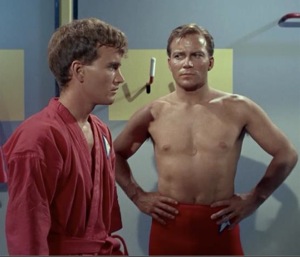
Kirk and the homo struggle

Kirk and his Homo struggle

For me the chaos sphere/chaos star/octaris/eight-fold pointy thing is a reminder that changing ourselves and the world is a multifaceted and complex process. We need a variety of skills, of tactics, of selves and of truths. We need to take a wide view and engage with the full range of experiences available to us. So rather than take refuge in simplistic statements (whether couched in esoteric, politcal or other terms) that pretend to a self-evident marvellous power of radical and total transformation, the icon of chaos reminds us that the world is complex, mutable and multiple. The eight-fold star invites us to explore the full panoply of what it means to be fully human and to remember that for every complex problem…

JV

Exploring Thelema and Chaos Magick, with Pete & Sef (Part 5)

Fountain Head

Fountain Head

Dear Pete,

Originally, there was a serious danger of my essays becoming “Gnostic Movie Review Club”, but I’ll leave everyone else to watch The Fountain and draw their own conclusions in light of my response. I’ve spent enough time deliberating over this, so let’s get straight to your question:

I’ve always wondered if seeking The Knowledge and Conversation of the Holy Guardian Angel seems like a good idea. The procedures for discovering it seem functionally indistinguishable from recipes for creating an obsession. It looks like a suspiciously monotheistic belief and thus a self-contradictory and limiting obsession with an ideal that has become effectively unattainable. You said that even with Crowley you follow the message not the man.  Does the OTO acknowledge anyone as having ever attained it?

This has taken some time to pin down properly, and the meat of the matter is (as I said to one friend and colleague who is in the A∴A∴ this morning): “I don’t want to piss on the chips of the earnest Aspirant, but some other peoples’ bonfires really need pissing on.”

The answer to your question in itself was given by several commentators on the various cyber-fora, and in particular by Brother Adrian whom you met at the Occult Conference, when he said:

“What has the HGA got to do with OTO? Seeking Knowledge and Conversation of the HGA is the work of the Aspirant of A∴A∴. The concept of the HGA is absent entirely from the OTO system.”

That would not however make for a very good discussion piece, and I believe we are in the fortunate position of educating, or at least challenging, in our respective traditions. Now I need to clarify that, again, I am speaking for myself as an initiate of O.T.O., not for the Order – nor for the A∴A∴ as I am not a member – but I am hoping that I can separate some issues which are rife within the Thelemic community consisting of members of one, both, other, and no organisation(s) associated with the above.

Much like the misunderstanding I discussed in my previous post, there is a problem which runs to the core of Thelemic discourse: the mislabelling of the Higher Self as the Holy Guardian Angel. O.T.O. in part concerns itself with the candidate’s approach and knowledge of the Self, and the HGA is approached in the early work of an Aspirant of A∴A∴, as Brother Adrian stated. I am not here to try and tell people what the HGA is, because that has as many possible answers as Aspirants who work with one. What I want to state categorically is that people only need to focus on the HGA if that is their system, not start applying it to systems which do not need or want it. The system of O.T.O. does not require the concept of the HGA, and shoe-horning it in leads to confusion at best, and complete misapprehension and misapplication of the material at worst. This goes for many, many other systems as well.

I have always had a strong notion of my Self, and coming into contact with the concept of the HGA has only served to blur this notion, when in fact I should have been working towards refining my idea of who I am and what I am here to do. The HGA has a specific function for those who work the systems which rely on it, but these are not applicable to every system and downright unhelpful in others. Mathers’ great strength was in synthesising multiple streams of information, many of which he had translated into English for the first time, but this also led to an eclectic approach which could easily be called “pick’n’mix” and the hanging of everything on the Tree of Life had little historical precedent. His Abramelin was unlikely to be older than 17th C but he considered it to be a pure source of knowledge, and in so doing made this practice a bedrock for much of the Western Mystery Tradition (WMT).

Instead of enjoying a period of self-determination and personal responsibility, free from having to go through an interlocutor to determine the Will of God, the WMT seems to have drawn itself back into the same paradigms that Jesus Christ himself came to overthrow when he broke the barrier into the Holy of Holies by dying on the cross. Rather than a progression into full responsibility for one’s magick and accordingly one’s results, it seems many magicians are trying to put these back into the domain of a nebulous HGA in a clear dereliction of their own personal agency. The danger isn’t obsession with a spirit by lone practitioners, but obsession with an idea which is only applicable to a particular set of schools, by many practitioners all at once. Thelema is the Aeon of the Crowned and Conquering Child-King, and if we are to live as Kings and ruthlessly prosecute our Will, we must take whole and full responsibility for our lives and our destinies.

To sum up: The HGA is not the Self (Yechidah) or the Intuition (Neshamah), although some aspirants may see it as useful to view it as such along the way. In the O.T.O. system the HGA does not exist, and the nebulous misconception of the HGA outside of its proper framework is detrimental to modern systems of magick. It is a hangover from the Golden Dawn and Abramelin workings which Crowley incorporated into the A∴A∴ system for lower-grade work, and this is as far as it should go. Magicians drawn to finding and attaining Knowledge and Conversation with the HGA should work those systems and leave them there.

As a collective community, occultists need to drop the obsession with “the HGA” and concentrate on becoming the best that they can be and doing all in their power to do what they love, and make a difference in so doing. I agree that this is the only empirical value “Do what thou wilt” can have, and it is my hope that my impact and legacy on the occult and esoteric community will be viewed favourably by those who come after me.

Therefore, seeing as you were kind enough to discuss yourself, and as the EPOCH is now being read and digested across the world, my question to you is this: What do you hope for your work to enable, enact, or create? Would you enjoy seeing the Chaobala worked into an entire current, or would you fear for another Crowleyanity modelled on Pope Pete?

I hope you will also touch on this at the first Bristol Session when you and Matt Kaybryn present on the EPOCH, and thank you for coming on board with my aims for The Visible College to spread learning, discussion, and community in the occult world – much as your invitation to this discourse has done.

All the best,

Sef