For me psychogeography (or less formally, ‘going for a walk’) is a key practice. By moving through the landscape in a suitably mindful way one can use the journey to literally explore both the inner and outer landscape. I made a journey recently, walking beside the great river that forms the valley in which I live.
At the outset I’m impressed by the weather. On this occasion this is the unusual stillness of the early spring, the river forms a silver mirror to the high grey sky above. A few wading birds explore the shallows, dipping for their food and silent gulls row through the motionless air.
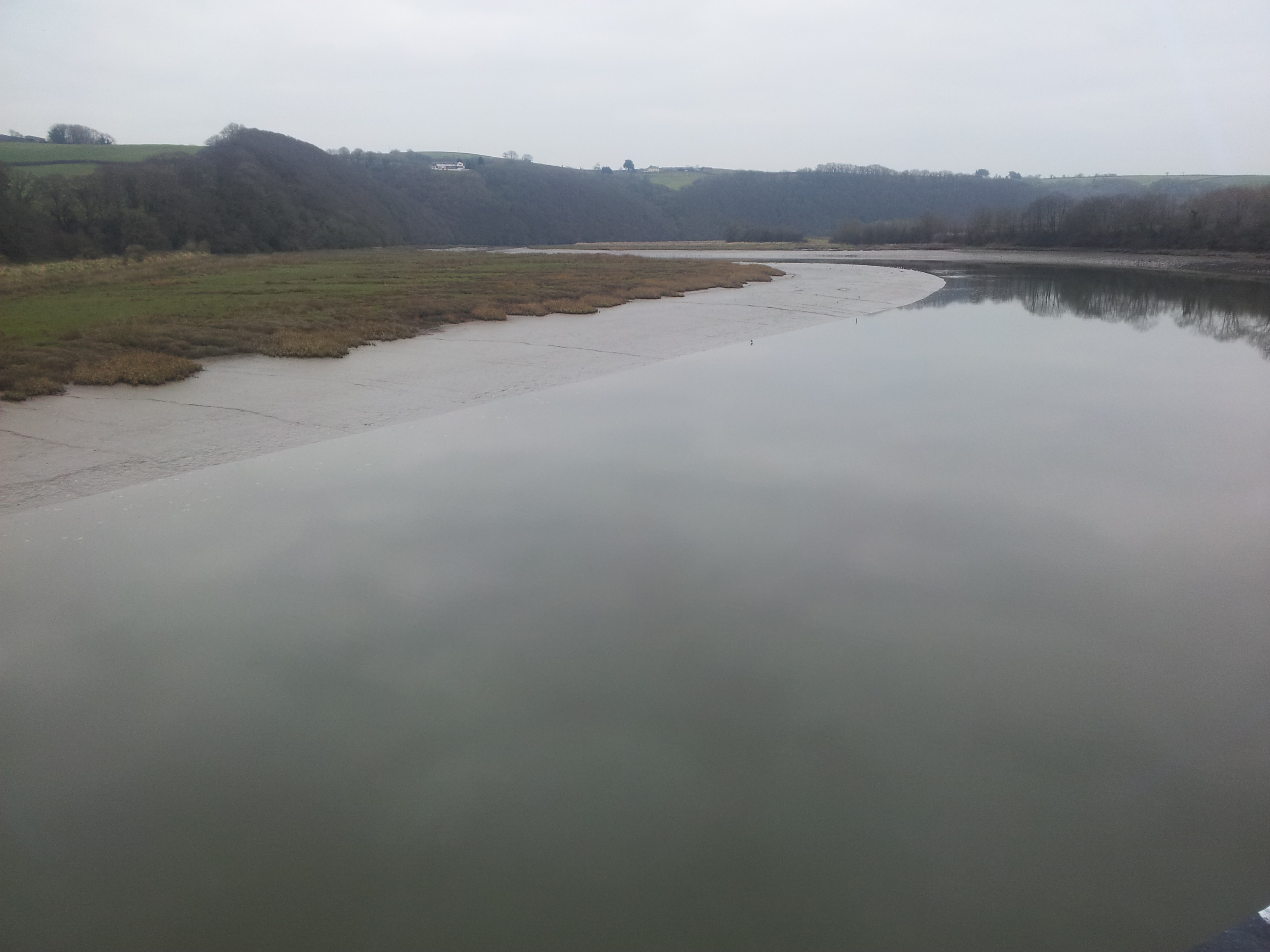
Turbulent river made still
As I walk my mind picks over recent events, as in a dream, processing and probing experience in order to put it in place. These events included an opportunity to explore ways in which visitors to historic sites engage with the objects in those collections. The National Trust had invited me to speak at their conference and I was pleased to find that a rather lovely sign had been produced to direct delegates to my presentation.

sign of the times
A few days later I was in the Ashmolean Museum with my Sister. This is a world class collection which contains all manner of wonderful things. As I’ve written before visiting a museum is literally a chance to enter a Shrine to the Muses. Mindful of the ethical difficulties that museum collections frequently represent (in Britain our major museums are often free, though it is often through our colonial imperialism that the objects we see found their way into those display cases), these are places in which to be inspired.

Jai Ganesha!
Walking on. Catkins stand watch as the spring rises, and gorse glows yellow gold at the edge of the wood (and tastes sweet and alive). Having walked through the outskirts of my home town, I took a turn off the path and into some woodland. Here memory gives way to the immediacy of the surroundings. A stand of pine trees rise up, creating a soft woodland floor of needles. This yielding leaf litter is punctuated by the first furled forms of Lords and Ladies.
Here I spend some time with the pine spirits. Often overlooked as being not so cool as broadleaf trees, I am captivated by their repeated fractal forms. I am deeply aware that these are living beings. Alive just as I am and, in their own tree-ish way, aware of the world just as I am.
As well as our commonality I wonder about our differences. While it’s clearly not about better or worse it does seem that my awareness is different from that of the tree. I wonder about the common religious suggestion that humans are somehow specifically created in the image of God and reflect that (aside of the obvious anthropocentrism) this is because we are deeply self-aware. The development of this egoic boundary is both our connection to the divine, as the embodiment of God, and the cause of our Fall (at least according to some paradigms).
I run my hands over the bark and collect some of the resin exuded by the trees. This locally, and freely gathered incense is perfect for the ritual of purification I’m planning to do (that is, Spring Cleaning my home).
Later, on my return, I stop to gaze at the river and my memory drifts back to the death of my Dad that happened in December of last year. At a good age, and after a brief illness, I was able to be by his side in his last days. I was blessed with a kindly, caring father and in my own way I hope that I can honour his memory by being a good parent myself and in the work that I do (much of my professional work is about teaching and supporting people to realise their own aspirations).
At the end my Dad had the best of medical care. Care that would have been beyond my means in many other nations. This puts me in mind of a conversation with a Brother who works within the National Health Service. Though the NHS isn’t some perfect panacea, it does represent a tremendous investment of care by the State and the people who provide those services, to the people of Britain. The fact that I can summon, with no cost at the point of provision, an ambulance to help someone taken ill creates a deep unconscious sense of being cherished by the people and organisations I share my island with. As an election begins to loom here in the UK I can fully understand why the NHS is seen as one of the critical services that politicians must convince us that they will support.
Once a close loved one dies something very interesting and deeply powerful may happen. As their individual narrative ends so the relationship that one still has with that person becomes a relationship with The Ancestors. My Dad has become part of that archetype of The Father and luckily for me the fact that we had a good relationship when he was alive allows me to find healthy and beautiful ways to now connect with that psychic structure. Wrathful Jehovah and his kin may be part of The Father archetype too, but my pathway to this force is now guided by the psychopomp of the kindly man whose large hand I held as the warmth evaporated from it. While there is certainly a sense of loss and of sadness, I also know his body was tired out. The spirit of the man I knew is now liberated from its outworn shell and is become part of that Great Spirit.
Turning back to home I can’t resist the temptation to again cut away from the path and ascend several hundred feet to the crest of a rolling Devonian hill. Great beech trees stand sentinel over the rising green earth, and gnarled oaks ride like Hagazussa on the dry stone walls marking the boundaries of grazing lands.

Smack my beech up
This exertion galvanises me, and I return home to work, more and better, refreshed by my walk, inspired and enthused. For me this walk is an act of magic, an everyday magic, where we use skilful means to process those things that have been rattling around in our minds. The walk, be it the pilgrimage or the situationist drift, gives us a literal new perspective, it shakes up and smooths out our psychic selves, as well as exercising our physical bodies.
It reminds us, away from our books, and screens, and other people, of all those other beings in the world; sky, birds, river, pine, gorse and more, and gives time for us to hear their teachings.
JV

 The Blog of Baphomet