Adapting our Religions and our Pacts

I was told an amusing and instructive story recently by my Brother. He was relating an experience of a Mexican shaman we know who had been leading a ceremony in Miami. In the style of ceremony being performed it is conventional, after a person has finished speaking, to say ‘Aho‘. This is a contraction of the Lakota phrase ‘Aho Mitakuye Oyasin‘ which translates approximately as ‘I understand this [the prayer/offering/song etc] is for all my relations [ie all the beings of the universe], so be it! These ceremonies are typically very heart-felt, devotional and thanks-giving styled affairs, and so the presiding shaman felt he needed to find out what was going on with the Japanese guy in the circle. You see every time someone said ‘aho’, even if this was at the end of a powerful and emotional prayer, the Japanese man would giggle uncontrollably. The reason my shaman chum discovered was a simple trick of language. ‘Aho’ in Japanese means ‘stupid’ and that was the joke. Every time someone said something poignant or passionate they would finish by saying ‘stupid’! (And be echoed by all the rest of the circle.) Moreover when I checked this out the Japanese ‘aho’ (あほ), actually one of several possible ways of saying ‘stupid’; means something (as I understand it) less like ‘silly’ and more like ‘retard’!

This is just one of many examples we can find where particular religious customs don’t travel very well in our global culture. Another might be the fact that in British cities with high levels of immigration from the Middle East and North Africa traditional religious dress may be responsible for health problems. Long sleeves, robes and even veils mean that people (presumably especially women) don’t get sufficient exposure to the sun, and this means a lack of vitamin D. Various regional authorities have issued health guidance and, where necessary, vitamin supplements to address this problem.

alchemical sun-substance

alchemical sun-substance

Texts from religions which had their genesis in the arid regions of the world are of course full of prohibitions and practices which worked perfectly well there (and then) but make no sense, or are even actively dangerous, in other latitudes (and times). Not eating pork, keeping milk and meat separated when preparing food – these and other traditions made sense thousands of years ago, in the days before refrigeration, canning and many other inventions. But not when these behaviours are transplanted to places where rain and mould are more in evidence than blazing sun.

When we speak of tradition we’re always talking about something that imagines it’s conservative but, when considered over time and geography, is actually something highly diverse and adaptable. No matter how much literalist fanatics (and fantasists – since, as I said ‘traditional’ change is inevitable) claim that one must stick to some imagined letter of the law (be that law of Moses, Muhammad or even perhaps the Master Therion), praxis will and must adapt (or die).

Maybe the only issue (of the fitness of the belief ‘meme’) is whether that religious impulse – whatever inspired it and holds it as valuable in the mind of believers today – has the skills to adapt. The same may be said for beliefs such as Wicca or chaos magic. These traditions (which inevitably claim to be distinct and special – chaos magic for example claiming that it is not a belief but a ‘meta-paradigm’ and therefore super cool, and different, when compared to anything else…) inevitably have their roots in a specific time and place (in both cases cited – the 20th century British Isles). However these esoteric beliefs too must, perforce, adapt and change if they have, and are to have, any longevity and meaning.

In the case of Wicca this may mean the change from the apostolic succession of Gardnerian/Alexandrian lines and the absorption of a healthy dose of the earth-centred approach and pragmatic spell-craft of ‘Traditonal’ witchcraft and shamanism. In the case of chaos magic this may mean that new ‘Pacts’ (in the sense of ‘gentleman’s agreements’ to politeness and mutually beneficial working relationships) may be formed. (And of course ‘pacts’ are binding, like ‘religio‘ that binds us into our shared beliefs). While I have no doubt that Orders such as the IOT will remain useful networks for (primarily) in person group collaboration, other pacts (the full name of the IOT is actually ‘The Magical Pact of the Illuminates of Thanateros‘) are being created (especially where face-to-face interaction may not be possible or desired). A great example of this is within on-line communities such as the wonderful Chaos Magick Group (CMG) in Facebook.
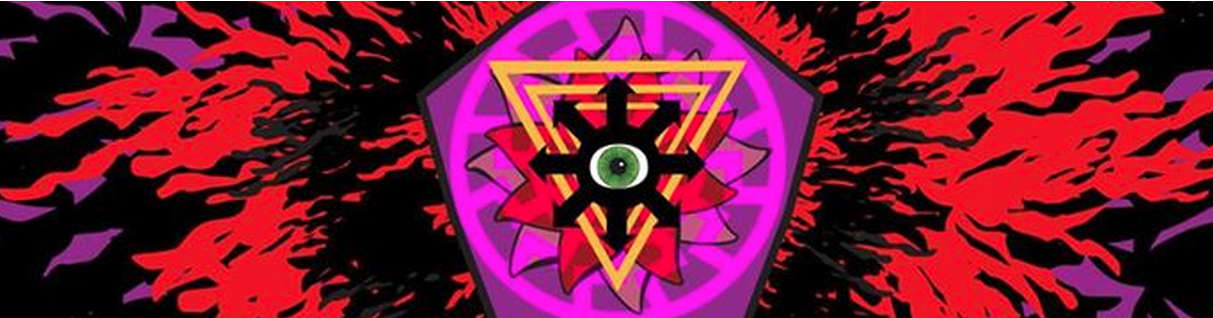
The morphing banner of chaos

The morphing banner of chaos

In the (embrassingly recent) past I’d opined that I hadn’t seen much collaborative action emerging from such virtual groups. Sure there had been alliances within those spaces (including for shared ‘results’ workings) but nothing (that I’d seen) emerging beyond those groups to enrich wider occulture. However this is changing (or perhaps I’m finally noticing what’s happening and getting with the program…).

A recent collaboration within CMG has produce not one but two excellent albums of music (ranging from beautiful songs, through to ritual soundscapes). You can check these out HERE and HERE. There’s also a fabulous tarot deck which, through the power of the mighty Admins (in a manner reminiscent of herding numerous punk majix Nyan cats…), has been collectively produced by tens of artist/chaos magicians. This deck will be available for purchase soon, and details related to it, plus a sneak preview of a few cards, may be found HERE.

I’ve also been deeply impressed by the collective intelligence demonstrated in CMG and a number of other on-line chaos magic(k) pacts. CMG, for example generally maintains a wonderful level of ribald humour, deep respect for diversity, but also the strength of collective character to be able (even in such a liberal space) to eject people who are currently unable or unwilling to not be arse-holes when communicating with their peers. I’ve seen people (certainly including myself) learn in those this virtual space. Plan, plot and execute cooperative actions, have fun, argue (respectfully), fall in love and even find Illumination (as well as posting some hilarious cat/rabbit/boat/other memes…).

Let’s celebrate rather than bemoan these adaptations, of our religions, our beliefs, our practices, and our pacts as magicians. Let’s notice where we are, in different language communities, different lands on the earth and locations in cyberspace, and let these environments inform what we do. May these new forms of faith, and the pacts we make to explore them, flourish in all their exciting diversity!

Aho! 😉

JV

To Duality, and Beyond!!!

When my children were very small, they were supplied with a set of cards by a well-meaning relative, of ‘Opposites’. Up Down, In Out, Hot Cold, Dark Light, Soft Hard, etc. The pairs were illustrated so that the concepts could be appreciated by pre-reading minds, and locked together uniquely.

We spent many happy hours with these cards, discussing carefully how they were misleading and that most adjectives/adverbs indicate relative qualities, on a far wider spectrum than could be depicted by two sample points. Take temperature; ‘hot’ was illustrated by a sunny summer day, ‘cold’ by snow. However on a cosmological scale, a sunny day (say 25oC) and a snowy day (about 0oC) are incredibly close together, with ‘naturally occurring’ temperature ranging from close to the absolute zero, a nebula at -272oC, up to 99,999,999,725oC in the heart of a newly formed neutron star.

Looked at in relation to this scale our instructive ‘hot’ and ‘cold’ examples appear ridiculous.

However!

Please, do not think I mocked the examples given in the set of cards, nor derided their usefulness and practicality. As comparative terms, ‘hot’ and ‘cold’, ‘up’ and ‘down’, ‘in’ and ‘out’ are vital to the functioning vocabulary of a growing child.

My objection was the forcing of these terms into a concept of ‘opposites’.

Of course, when addressing my babies, I used different terminology and examples. They had inadequate knowledge of the universe to talk of neutron stars and nebulae (unlike our far more educated readership here at the Blog).

So, now we have had a nice easy access lead-in story, the moral of this blogpost is, that we have choices we can make when presented with apparent ‘opposites’.

As with the trite example of temperature, we can opt to see things as points on a scale. Degrees of difference. Even adding a third axis of comparison, where the setting of a thing defines how it gets conceptualised; a nice recent example of this comes from marketing research.

This research tells of how people in high arousal states prefer simple, clear messages, presented as statements. “This laundry detergent gets clothes very clean.”

People in states of low arousal were more engaged by messages presented as questions, leaving room for them to add their own thoughts to the product the company wished to sell. “Does your laundry detergent get clothes as clean as this one?”

And thus, we have context dependant meanings of comparatives, which can even reverse their effectiveness under certain circumstances.

In this example, the different methods of addressing the audience are not just different in themselves, but are effective dependent upon the audience’s state. (Which state are you in right now? Would you prefer me to ask you philosophical questions, or give you pre-processed facts and opinions?)

Other options are always available

Other emoticons are available

Storytelling, as I began this blogpost, neatly provides us with the option to take either perspective. We can go along with it as ‘fact’, whilst if we have the inclination, we may reflect upon the tale and ponder ‘questions’ it raises within us. Perhaps storytelling points towards another alternative to the binary options of ‘fact vs opinion’?

Moving out of the confines of dualistic binary choice thinking, can result in some wondrous creativity. Try it for yourselves; here are a few starter pairs of words which often get presented as if they are exclusive, oppositional, and/or absolutist:

Me Them

Internal External

Personal Communal

Good Bad

Active Passive

Right Wrong

Happy Sad

WARNING! Listing ‘pairs’ of words like this produces what I shall refer to as the Lévi-Strauss effect (this has nothing to do with jeans, check out Wikipedia if you need to know who Claude L-S was…).

One could argue that listing things, especially visually like this in columns, can create artificial categories, associations, and links in the human mind, which is largely geared towards seeing patterns (even when they don’t really exist). So by placing a certain one of each pair first as we read, we privilege that information, as position implies to our narrative constructor that these ‘first column words’ are in some way similar… and even, more important and therefore valuable.

Meditating upon such matters shows us ways to navigate the simple, childish version of reality we are encouraged to inhabit. It takes time and some effort, as do many worthwhile things. Consider other points on the linear scale that each pair indicates, wonder how the 3D version of comparatives might appear as well. Austin Osman Spare’s exercise which urges one to consider the ‘opposites’ of black and white, to imagine their combination (grey), and then the ‘opposite’/pairing to the combination; this can propel the mind into non-duality quite rapidly. The instruction is then to apply the same methodology to other ‘extremes’, in order to escape standard patterns.

These distinctions between pairs, opposites, comparatives, scalar quality identifiers, are incredibly relevant to our concepts, definitions, and behaviours of self. A basic distinction between the duality of Self and Other is key to most lifeforms, else how would anything know what to eat? Sensorial perception of the external environment tends to go pseudopod in tentacle with a rudimentary mental map, which can model constructs of that environment internally, and base behavioural decisions upon that internal map.

This is not to be confused with self-awareness in the sense of consciousness, btw.

This Self/Other construct is deep. Whatever arbitrary markers we might be provided with in order to distinguish between Them and Us, alters all our emotional (and hence behavioural) responses to those marked.

Within any relationship we tend to define ourselves in contrast to the Other. Ramsey Dukes wrote an excellent essay on this topic in What I Did in My Holidays: Essays on Black Magic, Satanism, Devil Worship and Other Niceties.  He uses the way couples tend to split into paired traits/behaviours, so one takes on the fiery more provocative role, while the other is calmer, cooler, and shows restraint instead of rushing into things. Such stereotyping of roles gets enhanced, as each partner acts more extremely in type, one desperate to provoke some, any, kind of reaction, while the other becomes ever more glacial and reasonable in the face of irrational anger.

As Mr Dukes points out, this process is not always helpful to a continuing healthy relationship. Each of us has fiery and icy aspects (as well as others), which need expression to allow for a rounded complex of personalities.

I would suggest, that one could imagine cases where a person stuck feeling mainly one emotion continuously for years is likely to present with health issues, both mental and physical (another ‘pair’ of ‘opposites’, which I like to spend much time and effort blurring the boundaries of in my writings).

A healthier couple then, might deliberately play at switching being the stronger, the desired, the ideas person, the carer; remembering throughout that these too will pass, and that other options (including both acting the same role) are always available.

To sum up; much of magickal thinking/perception relies upon removing received linguistic categorisations from the world, perceiving directly what is there/here (gnosis), and then returning to a state of ‘normality’ slowly enough to reassemble those linguistic categories in a potentially novel way which might allow for fresh emotional responses to existing environments, and hence affect behaviours. Also, magickal thinking allows us to play with altering shifting these concepts along linear or other shapes of scales, within the confines of a smaller area (the magic circle), which we can successfully get our heads around a subset of what the universe has to offer, before trying out such engineering on the wider world.

Using the chaosphere as our scale we can try to expand greatly upon the simplistic duality line, attempting to find eight ways of measuring/comparing e.g. the physical quality of temperature, or moods of various flavours. These could, or could not, correspond to the existing conventional eight colours of magick (which are the conventional planetary groupings). As with many spurs to creative thinking, going beyond a single solution into multiple answers creates further outside-the-box imaginings. (So, eight here is arbitrary, chosen merely for sake of familiarity, and to provide a starting pictorial symbol. You can of course make up your own, which could be 3D in nature, like the tetrahedral arrangement; which for me always brings to mind the ancient defensive weapon, the caltrop.)

Next, I would like to extend the microcosm to the macrocosm, and ask if our tendency to compare and contrast applies on this wider stage. And if so, does that help anyone?

As groups, we identify and think in analogous ways to those described above for an individual person. The process is less localised, and often slower to emerge, but broadly speaking similarities can be observed.

This insight has great power.

Magick, the act of changing the environment in accordance with one’s Will, has no more important aim than this, the amazing ability of our species to be thoroughly self-aware, as individuals, and as groups.

Could magick, the act of changing the environment in accordance with one’s Will, have any more important aim than this, to use the amazing ability of our species to be thoroughly self-aware; both as individuals, and as groups?

NW