I don’t have perfect health. My body after nearly 47 years taking breath, has had things happen to it, and has broken in several places. A casual passer-by would never know but, I have; ligament damage to my knee, a weak Achilles tendon, currently a bad back (from sitting funny last week and spreadsheeting for three hours), and a severely damaged inner ear. Also, various other temporary aches and damaged bits come and go, along with the rounds of viruses, bacteria, and so on. My skin and bones record dozens of small scars from long forgotten injuries.
This is my normal. Having a blemish free body, unaffected by incidents after so long would be unnatural. It is a miracle I am alive at all! I marvel at how well biology does at maintaining this form I inhabit in recognisable similarity year to year, despite replacing all the cells on a regular basis.
Evolutionary adaptation takes into account this wear and tear, accidental impacts, and attacks from hostile micro-organisms. As well as repair, it has blessed us with death, and its companion, reproduction, so as to give the life force a restart every generation. Our tissues are designed to receive damage and recover from it as best as possible. Life expects us to be hurt.
I once heard a skin specialist being interviewed, who was asked what we could do to keep our skin totally safe. He said, cover it in petroleum jelly and stay indoors permanently; which he immediately followed with, of course that is impossible. Living entails a process of acquired ‘imperfections’. Like trees none of us has grown entirely according to the biological instructions we were provided with at conception, our surroundings alter our shapes and behaviours. This even applies to how our DNA instructions manifest themselves (see epigenetics).
Having experiences gives us personalities, and interesting appearances. Like trees, the ‘perfect’ human form would likely seem bland and without character.
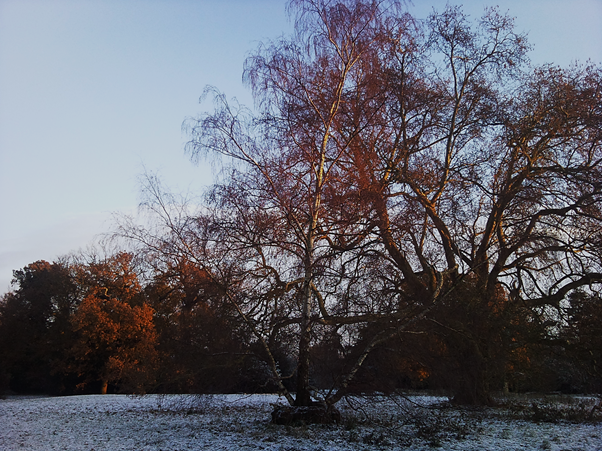
My perfect tree
Part of living is accepting that we do not remain in that mythical state of ‘perfection’, even if we are born with no obvious errors; which in itself is not something we ought to expect. Having the ability to see what we do have, in the face of adversity, to count our blessings, gives us a different take on who we are.
In a world influenced by the futile quest for a standardised perfected body image, the scars and marks of survival can loom large. For me a big step in defining myself came when I was asked by my friend (a psychologist with many years experience of counselling those with chronic conditions) what percentage of me was ‘ill’, and what ‘healthy’. I realised that whilst my internal sense of (literal) balance was flawed, it made up only about 3% (subjectively) of Me. The other 97% was in fact in pretty good shape. Suddenly instead of feeling broken, beyond repair, I felt that I had worked well at keeping what I could functional; my senses were fine, I had limbs that did what they should, I had reasonable fitness. I could do more things to make that ok part of me better, or perhaps Good; even if I couldn’t change the damaged inner ear.
And so I did. I’ve spent the last few years practising yoga, eating well, ensuring I sleep properly, and enjoying the things I can do, pushing aside the terror of inadequacy by building the abilities I have; so that when I get dizzy or have issues then the weller bits of me can compensate. This is not a perfect solution, but, as well as the health benefits, this strategy has made me feel I have influence over myself, my behaviours. A feeling not to be underestimated in its power.
On a magickal level the approach has changed my attention, which for me right now seems to be one of the defining skills of a magician; to direct attention as necessary for optimal results. And as I switched to this different perspective, I began to discover (by myself, and via information shared by others with me), possible remedies for the problem, as its import shifted to non-critical. Perhaps, by allowing the damage to be there, whilst seeing the strengths I had, this made space for the previously non-existent (in my world) herb-lore to appear?
However, I write this suggestion very cautiously. It is easy to say, ‘think positively! and all your ills will vanish!’ That is not my intention here. Our aim ought to be to acknowledge our imperfections, our normal state which means we cannot, then look for and focus on the normal we have which means we can.
My inner ear is not mendable. The surrounding biological systems and my way of life however can adapt, so nowadays when I lose balance I barely notice that my body catches me before I stagger and fall. The fatigue can be held at bay (mostly…) by factoring in rest periods throughout every day. Feeding the health, giving attention to wellness, pushing aside the trauma of not-perfect.
Recently I visited my mum, and we were talking of my university days; and I found myself glad that I had done that training, but, pleased it had been forced to stop, as I now have a career which suits me far better. With hindsight, I learnt so much from the years of pain and discomfort, those twists of my branches away from the programmed high reaching symmetry of a scientist has given me a lower profile with greater stability, and arguably made me far more likeable… though without a control it is hard to tell 😉
I would like to encourage those readers who have health issues, whether intrinsic or from external sources, to make a slight shift in perspective, and (in a Pollyanna way…) play the game of rejoicing in their abilities.
Accentuating the positive can drive out the negative. Directed attention does miraculous things to the bodymind. We notice what we look for; seek out your strengths, and you might be amazed at how those weaknesses atrophy.
NW