“When I was 17, I had fasted, I had not slept for 24 hours, and I put staples in a wall to pull ropes through in the outline of my body…I started lashing myself to the wall, legs and torso tight…I wanted an experience right on the edge of death…I had a conscious out-of-body experience…You have a body but it’s fluid.” Extract from the RE/search interview with Fakir Musafar in “Modern Primitives”.
Having spent a fair amount of time musing over the significance that the Gurdjieff work might have for the contemporary magician, I thought I’d take a bit more time unpacking each of the paths that combine to make up the 4th Way. If awakening within the 4th way entails the activation of the body, heart and mind within “the usual conditions of life”, in my mind it’s essential that we look at what working with these aspects of Self might look like. At the outset, I’d also add that while using Gurdjieff ’s language, I don’t feel that artificially distinguishing between body, emotions and mind fits well with most of our experiences of reality.
Gurdjieff describes the way of the body as being that of the “Fakir”. Perhaps not a term that familiar to the average westerner, but given his extensive travels throughout the middle-east (Cf. “Meeting with Remarkable Men”), one that was very familiar to Gurdjieff The Fakir was generally a contortionist who through training, dedication and a fair degree of masochism, performed amazing feats with their bodies. The way of the Fakir is one in which the starting point of one’s journey is the physical body and the use of austerity and asceticism in order to harness its potential. For Gurdjieff the Fakir learns from observation-like a hatha yoga class or five rhythm’s dance workshop, we learn best by seeing others seeking enlightenment through the body.
The story of how we relate our physical selves seems critical to our age. Much ink could be spilt on the way in which the Judeo-Christian and Decartean traditions have led to many of us in the west having an experience of being cut-off or ostracised from our bodies. We can feel like “ghosts in the machine”-disembodied drivers of unruly vehicles that struggle to stay on the road. So many of us want more, and as we struggle with the sense of psychic fracture, we turn to the body as a possible route for a more visceral, earthy connection.
This need to connect has birthed a multiplicity of approaches and responses: martial arts, a multitude of bodywork therapies, tattooing and body modification being just a few examples of how we are seeking to recapture our journeys by marking them on our bodies. This impulse drove the 17 year old Roland Loomis to become Fakir Musafar the father of modern primitivism. Shamanic lore is rich with examples of technologies that use the body as a means of seeking gnosis. Whether via application of weights and constriction or through consciously seeking bee stings, these animist psychonauts sought a multiplicity of means for inducing consciousness change via the body. I would argue that the stereotype of the pierced chaos mage is as much about this need as it is our love of cyber-punk aesthetics!
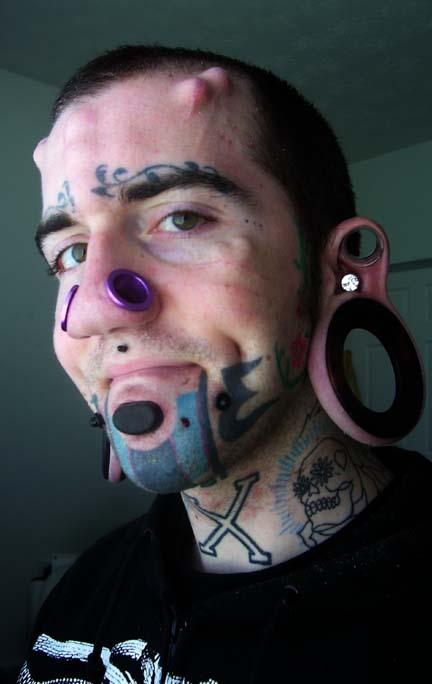
Magickal modifications
This re-visioning of the body as a means of enlightenment fits well with the tantric axiom of “Samsara as Nirvana” i.e. the realm that others see as illusion or impediment is actually the avenue via which the “higher” centres of emotion and cognition are accessed. To my mind the tantric endeavour is primarily concerned with using the senses and the body as a means of awakening. The primary technologies of mantra, yantra, mudra and nyasa challenge us to find God in the body. These technologies are techniques of extending and intensification-we more fully access the natural by using applying “non-natural” or ultra-natural means.
Make mention of tantra to most people and it conjures images of endless orgies and Sting’s long-suffering wife. Whatever the value to be found in neo-tantric practice as a contemporary sex therapy, unless these techniques challenge our conditioning and loosens the blocks to liberation, they are apt to become little more than another hobby (albeit a highly pleasurable one!). Why limit bodily ecstasy to the genitals? The technologies of occult tantric challenge us to open every pore as Shiva/Shakti in union-each moment then becoming a means for accessing Freud’s polymorphous perversity.
The Gurdjieff Work’s means for engaging with the body similarly challenges the participant to work with the natural in a non-natural manner. The “Movements” are a series of gestures which when put together become dances that pretty much stand alone in captivating the viewer with their mesmerising strangeness HERE If the goal of the Work is to awaken from a machine-like sleep state, the movements are designed to force the body out of slumber via their running contra to “natural” tendencies. While an attempt to awaken via the body alone may have limited results in Gurdjieff ’s schema, if we integrate it with both the heart and mind, it can become the work of the cunning man.
To pursue the work of the magician via ritual and the use of ecstatic technologies means to be in the body. Whether via dance, yoga or sacred sexuality practices, as we bring greater consciousness to bear on the kinaesthetic so the body transitions and mutates to become expansive and mysterious. Whether via kundalini awakenings or Holy Ghost shaking, the hidden potentialities of the body loosen the armour of our outdated personas, so that we might risk the new vistas of our future Selves.
SD

 The Blog of Baphomet