Many years ago a friend (a Cambridge graduate and journalist) opined that modern Paganism really hadn’t created any great art. This made me rather cross. Aside from the not insignificant issues of ‘what is art’?, and ‘great by whose definition?’ I claim that there is a vast array of excellent Pagan art, across every artform, in the contemporary world. Indeed if we allow the term Pagan to include, or be extended to, esoteric art, then it’s rather hard to find any art these days that isn’t influenced by, or springs directly from, a magickal sensibility.
The field of music is particularly rich. Whether we are dealing with the directly esoteric work of bands such as Current 93 (frontman Dave Tibet also happens to be a noted scholar of Coptic & Gnostic writings) or the hugely popular Qabalistically influenced work of Madonna. If we want a high-brow composer perhaps Philip Glass who describes himself as a ‘Jewish-Taoist-Hindu-Toltec-Buddhist’ is a possible candidate and certainly for folk music the Eisteddfod winning Damh the Bard is certainly ‘one of us’.
In the field of architecture one might suggest the Damanhur community who secretly created a vast system of corridors and amazing vaulted chamber temples inside an Italian mountain. As an example of what is clearly esoteric art this shines, quite literally, as a beacon of architectural brilliance. Then there are those artists who are less well known but are deeply embedded in their own practice and craft, creating objects which sing with beautfy, attention and a deeply Pagan sensibility. One of my favourites in this field at the moment is Phil Cowley Jones. Phil creates or rather ‘births’ the most exquisitly crafted, explicityly shamanic, tools at a level of skill that should see them exhibited in gallery spaces as well as being played by practitioners.
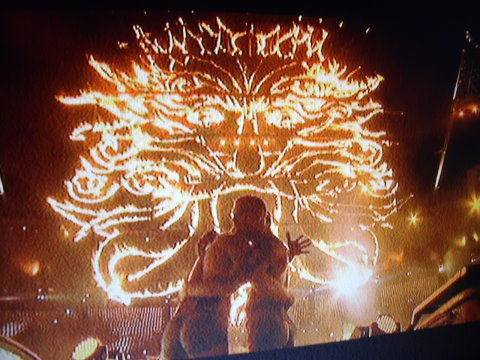
Pagan iconography at the London 2012 Paralympics closing ceremony
For poetry I recommend the work of Peter Redgrove. As well as co-authoring the first major work on menstrual mysteries (The Wise Wound – Menstruation & Everywoman with Penelope Shuttle) and an excellent work on the subtle anatomy and sensory systems of our species (The Black Goddess and the Sixth Sense), he also produced numerous volumes of poetry and almost a dozen novels. Redgrove both writes about magick and was indeed a practitioner himself, both through his own practice and by using his writing as a vehicle for his Pagan sensibility.
For prose that often shades off into poetry, one should pause briefly to mention the work of Alan Moore (Peace Be Upon Him). Moore is, as he will tell anyone who cares to listen, a practising magician. His numerous writings include the graphic novel series Promethea which, for my money, is the most engaging text on the subject since Dion Fortune’s The Mystical Qabalah as well as being a ripping good yarn. His poetic vision Snakes & Ladders is, as they say in America, awesome.
For visual art, and perhaps also installation, we might mention the work of Alex Grey. Creating artworks which lay bare the psychedelic experience in paint isn’t an easy thing to do but Grey admirably pulls this off time and again. He’s also taken his painting to the next level by creating a total environment within which the work may be encountered in his Chapel of Sacred Mirrors in New York. Then there are the technically brilliant and deeply magical works produced by Una Woodruff. Not only is Woodruff a very successful artist in financial terms but her work expresses her own unique form of witchcraft, with each canvas being in itself a powerful spell.
Then there are all those artists who may not be banner-headline athame-waving occultists but certainly create work which is deeply indebted to the magickal revival. For instance earlier this year I got the opportunity to work with Jeremy Millar. Millar produces all kinds of art that is shown in galleries around the world. While we worked together on a project in North Devon we spoke about Voudou, possession and trance states and I shared with him my involvement with occultism. Part of the reason for the discussion was that his work had appeared in The Dark Monarch a major show at Tate St.Ives in 2010. The theme of the show was esoteric art and alongside Millar’s work was that of Derek Jarman (ritual film-maker and collaborator with occultist Genesis P.Orridge), Ithell Colquhoun’s surrealist work and the collages of tantric adept Penny Slinger to name but a few. In his work Millar had reproduced a text by artist Sol Lewitt but had altered it so that the word ‘artist’ was replaced by ‘magician’ and ‘art’ by ‘magic’.
Many expressions of modern spirituality (from Philip Glass’s ‘Jewish-Taoist-Hindu-Toltec-Buddhism’ to contemporary neo-paganism) emerge from processes which are at once intensely personal and widely syncretic. We learn from what’s around us and in doing so weave our own ongoing interpretation of the perennial wisdom. This process, of being inspired by the environment and finding a unique way to express that inspiration is, in my opinion, an important aspect of what it means to be an artist. It is for this reason that so much magickal art exists because there is a direct parallel between the artistic process and the autonomous development of one’s own spiritual path. Both are creative acts, both rely on a culture of freedom (the absence of draconian censorship in the case of art, or witch-hunting in the case of alternative spiritualities), both empower the individual to explore and continuously create their oeuvre (as an artist) or The Great Work (as an esotericist ). Both rely on a blend of persistent practice and playful inspiration.
To be charitable I could say that my former chum simply couldn’t see the wildwood for the trees. His post-modern ennui had perhaps dulled his appreciation of those glorious artistic creations emerging from, and influenced by, Pagan culture. Creations which were in fact around him all the time. But then beauty, like art itself, is mainly in the eye of the beholder. And if our eyes are closed then any beauty that is present will certainly elude us.
JV
 The Blog of Baphomet