Tantric Thelema and the Wrathful Buddha of the New Aeon

Written as a proper tantra (addressing his beloved the author speaks…) this book continues the excellent fusion of the western occult tradition (particularly as it manifests through the work of Crowley) and Oriental occultism. Tantric Thelema occupies the same cross-cultural zone as Crowley’s Book 4 (on meditation) and the style of groups such as The Arcane and Magickal Order Of the Knights of Shamballah (AMOOKOS, who bring together Hindu Tantrism and Thelema). The author certainly comes across as someone who really knows his magick in both theory and practise. Using the Vajrayana style of Buddhism Sam Webster provides an interpretation of Thelema and The Book of the Law that makes total sense, and is much grander and deeper than those rather superficial quasi-Nietzscheanapocalyptic readings. In this work the hawk-headed Lord of the Aeon is presented not as an angry child but rather as a wrathful Buddha, who, through ‘skillful means’ swiftly liberates all sentient beings.

There are plenty of rituals in the book, and programs of practice. These (as with most tantras) are nice as serving suggestions but are not obligatory in terms of making use of the ideas in this book. I’ve certainly been able to adapt some of the techniques in the book to my own Work very easily.

The core of this tantra is distilled into some brilliant passages in Chapter 2  ‘Taking Refuge, Dedicating Merit’. In this section Sam Webster like Joscelyn Godwin (author of Theosophical Enlightenment), ‘…wonders what it would have been like if Bennett and Crowley had discovered Tantric Buddhism, the Vajrayana or Tibetan Buddhism.’ Webster goes on to show explore how the bigger picture of the Vahrayana approach helps grow our magick rather than diminish it, enriching the neo-Pagan movement (including Thelema) just as it did to Bon in Tibet and other esoteric practices in the East.
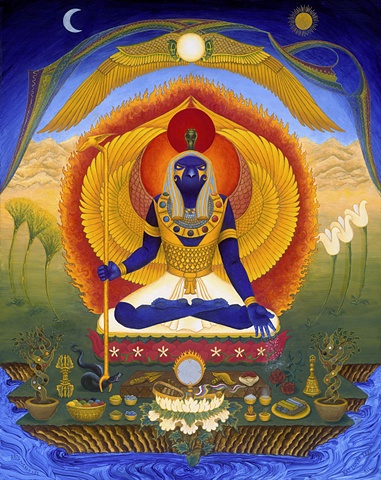
Webster writes; “…the Pagan tradition is floundering and needs a deeper, richer, tap root by which to develop itself beyond mere spellcraft and seasonal celebrations…When Buddhism escaped the hands of the monastics and attained to the greater view of the Mahayana it began to spread outside the Buddhist philosophical colleges to the villages and craftsfolk. There, among the native magick-using folk of India who were honouring the seasons and their many deities, some heard the call of the greater view. They embraced the understanding of the void nature of the ground of all things (Shunyara) and saw that compassion (Bodhicitta) was the necessary corollary and result. Rather than give up the magick and methods of worship they had known for countless generations they brought them to bear on the task of attaining to the complete realization of this View. Thus was born Tantric, Vajrayana Buddhism.”

Crowley engaged with Buddhism but, given his experience of it in its more transcendental and monkish styles, couldn’t quite square that philosophy with the assertion that ‘Existence is pure joy..’ in Liber Al (or indeed his penchant for getting mashed). So in answer to the question, what would have happened if Crowley had met the Vajrayana school I suspect the answer would look very much like Tantric Thelema.

Webster’s work helps propel the iconography of Thelema, and more broadly Western Ceremonial Magick, into a new orbit. So if you fancy taking refuge in the Hawk-headed Lord of Double-Justice this is certainly the book for you. Ha!

A Little Off-Balance

“This expression of the I Ching reveals the dynamic magick of AMOOKOS. The Ridgepole is the fluid yet equipoised point existing between the two states of active/passive” Tantra Magick Shri Lokanath pg. 93

Quite a few of the spiritual traditions that I personally find helpful as a magician have the concept of balance at their heart. Within the vast array of Buddhist traditions, the concept of the “middle way” is generally recognised as embodying the aspiration of steering between the excesses of either forceful asceticism or indulgence. The Etz Chayim or “Tree of Life” within the Kabbalistic schema contains the “middle pillar” that sits between the black/white, male/female polarities of severity and mercy. Within Hindu Tantra, Shushumna- the central channel of tantric psycho-physiology sits between the solar/lunar opposition of the Ida and Pingala nadis. Each of these traditions contains their own unique religious languages that defy over-simplification or homogenisation, but there seems to be a shared goal of seeking a way between apparent polarities.

Both philosophy and religion have sought to observe and communicate something of the natural oscilation between primal polarities. In Taoism we have the notion that when something becomes either too Yin or Yang then inevitably the movement will begin towards the other. For Hegel every idea or thesis would inevitably have its opposite antithesis. The tension between these two poles eventually produces a middle position or “synthesis” as a reconciliation of these ideas. This synthesis then becomes its own thesis and so the dance continues!

"Let the dance continue!"

Odinist pole action…

In thinking about such middle-ways, one wonders if there’s a danger that we could end up either endlessly compromising or winding up with some kind of bland centerism. What might it actually mean to work with balance and why does it seem to be such a frequently reoccurring motif within esoteric work? Over at Odin the Wanderer I recently attempted to reflect on the rune Dagaz as a specifically heathen manifestation of this mystery:

“In meditating on the rune “Dagaz” over a number of years it is one of those runes that has taken on a huge significance for me as an emblem of spiritual aspiration. Personally I experience its essence as an expression of the twilight reality that exists in between light and darkness. For me it embodies the realm of the magician-shaman par excellence. As we “walk between the worlds” it is inevitable that we encounter that liminal knife-edge where polarised certainties either break-down or are sustained in dynamic tension.

When I gaze at Dagaz, my eye is naturally drawn to the point of connection between the two triangles – am I traveling down a hall to some distant far-point, or am I at the aperture of a side-on hour glass where time travels from past to future? Dagaz invites me to dwell in the “now” that is the point in between.

This idea of a third reality that sits in between two apparent opposites has a real basis within the heathen tradition that goes beyond a borrowing of the Taoist “Yin Yang” or Kabbalistic “middle pillar”. Northern lore is strewn with the sacred three – Fire, Ice and the universe created in the tension between its polarity, the Norns, the three aspects of Odinn, the Valknut, the nine worlds (3×3) and so the list goes on.

To engage with Dagaz is to become aware of these dynamic tensions and the potentiality that exists in working in this third place.

What I don’t wish to imply is that heathenry advocates some kind of endless compromise. When we mark the turning of the year, we are seeking to acknowledge a movement away from the sun and back toward it as the year passes through the seasons – an oscillation, if you will. Dagaz invites us to acknowledge polarity and to engage in a dance with it!”

So we’re backing to dancing again-the flow of the body as it moves in response to the music-subtle adjustments and micro-movements as weight shifts from one foot to another. To be “in balance” rarely entails a 50/50 split, often it seems to be more about staying on ones’ feet as we seek to channel the ecstacy rising up.

Magick is often the conscious induction of instability in order to create change. These are technologies that are designed to plunge elbow deep into your unconscious and give it an almighty stir. As much as results magick might produce quantifiable change “out there”, it seems undeniable that the major locus of magickal activity and change is “in here”: “in consciousness according to Will” (Dion Fortune). If its stability your seeking, stay away from religious and spiritual traditions that have a major magickal component (and that’s most of them) – you’re only going to upset/unbalance yourself.

As dancers in the Great Work we balance, unbalance and re-balance as we use our Magick to keep moving and shake out any signs of psychic atrophy. For me the goal of balance, seems to be less about pursuing some safe middle-ground, and more about cultivating the poise to move how and when we need to.

SD