
Loosening the armour

Having just re-read Julian’s great article on shaking and my last offering on balance, I thought I’d reflect more on my own work with embodied ecstasy and what its purpose might be in relation to the on-going project of “The Great Work”.

In thinking about what we do as ritual magicians, generally we use sights, sounds, smells and sensations in order to build a psychological microcosm. By doing this we are seeking to attract those energies with which we want to work and we are trying to evoke an atmosphere that is congruent with the goal of our magical endeavours. Given that we are often trying to access a state of consciousness “other” than that normally available, it seems right that effective magical work often has a sense of tension and “atmosphere” often induced by the sense of collective expectation.

We will all have our preferred means for getting “in the zone” for ritual-for me it’s generally music. As the incense billows and the altar candles are lit, it’s the steady throb of shamanic drumming and rattles that propel me towards the work.
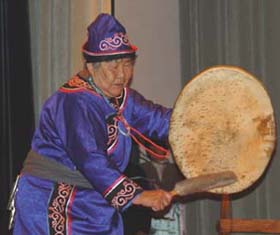
Get your shaman throbbing, head out on the highway...

Get your shaman throbbin’, head out on the highway…

It might be the building tension around the beginnings of some potent spiritual work or the fact that I’m a dancing diva, I find invariably that I have to starting moving-swaying, some gentle “shaking out” or stalking around the ritual space. In his excellent Seidways Jan Fries describes the building of such tension as being like a boiling cauldron. Whether one chooses to explore this energy as a seething practice or channel it in a form of fluid, spontaneous movement will be determined by context and the desire of the magician.

Ecstatic dance, group shaking and psychodramatic shape shifting are but a few of the methods of exploring what’s rising up in and through the body. The yogic concept of Sahaja-the natural, the simple, the spontaneous, expresses the potential sense of liberty and child-like freedom that encourages deeper exploration of these techniques. Julian has already described many of the physiological benefits of such practices but I was wondering what they might allow us to access in terms of individual and group psychology.

In trying to integrate the insights of western psychotherapy with the methods of somatic alchemical approaches, it will come of little surprise when I name-check Wilhelm Reich. As a student of Freud he was immersed in the master’s insights concerning the process of ego formation and the unconscious, but like Carl Jung, Reich’s own startling insights lead him to breech the confines of psycho-analytic orthodoxy. Reich primary focus was the relationship between “Orgone” (the psycho-sexual energy that pervades the universe) and the way in which human development either enables or impedes its flow. One of his primary realizations concerned the way in which the core conditioning and defences of individuals could result in the formation of “body armor”. Much of the psychotherapeutic technique developed by Reich and his followers was concerned about how body-aware approaches could be used to help soften and shift those barriers than reduce our openness and ability to connect to others.

For me, what this points towards is that technologies such as shaking and dance allow us to connect to the vitality and Eros of the body without having to necessarily rush towards a culturally shaped script around “having sex” or even “doing sex magick”. As we connect to our body and breath, the serpentine energy of our dance allows the possibility of unlocking our inner knots. In parallel to many “internal” martial arts, the sweating of our prayers through movement helps us to access a greater sense of openness.

In combining dance and movement with collective ritual work, I believe that we provide enhanced conditions for the further development of soul. The research of Paul Zak and other neuroscientists have documented that religious rituals and dance are both great methods for triggering the production of the neurochemical oxytocin. The production of oxytocin is associated with feeling a greater sense of closeness and attachment, more effective management of stress and an increase in our ability to learn (neuroplasticity).

With my pointy chaos magician’s hat on I can’t but help thinking about rituals making use of the Vampyre archetype and techniques experimenting with energy exchange. Although the energy invigorating us may be primarily our own,there may be sense of mutual “feeding” as the groups intent and shared exploration creates collective atmosphere. Certainly my own experience in the group I work within, is that as we have revisited these approaches over the turning of the year that there is a deepening sense of a group bodymind that is reactivated when the drumming starts and the psychonauts strut their stuff!

SD

Magick Works?

‘Does magick work?’ asked a member of the audience at a lecture I gave at a recent Swansea Pagan Moot. Since I once wrote a book called Magick Works the answer would seem to me to be ‘yes’ but let’s unpack that a little more.

The first issue is whether we can talk about magick working in the same falsifiable, empirically testable sense as a mechanistic science experiment.  My answer to this is ‘possibly’. I have the privilege of knowing three people who have doctorates in parapsychology in the British Isles. Of these three learned persons (who have not only a great knowledge of psychic stuff but are mean statisticians), one thinks that psychic powers (magick) are bunkum, one thinks there is a real phenomenon at work, and one remains uncertain.

Outside the world of random number generators and Zener cards the scientific analysis of parapsychological phenomena is at least as complex as the science of any social process. But there are methods for dealing with this kind of fuzzy data. Techniques such as phenomenological analysis of texts (such as counting word frequency across a series of accounts) allow us to peer into the quantitative aspects of the human experience. But there are still problems in trying to falsify the claims of the individual magician.

If I cast a spell to get a better job and I’m successful it’s impossible to re-run the experiment of my life without the ritual and see what happens. We do have evidence, across many individuals, that psychological techniques (such as positive thinking, a modern re-statement of magickal practice) do have overall beneficial effects in areas such as being successful at job interviews. But for an individual case, although I may think it was the sigil I built that helped me, it may well be simply that the interviewer really liked my tie and that was the deciding factor that got me the job. Of course given a magical world view this would still count as a success, since I picked that particular tie that day and that particular interviewer was swayed by my sartorial style.

The power of the Old School Tie

The power of the Old School Tie

Then there is the issue that magick isn’t really about a simple causal chain; ritual A creates result B. It is, for me, a much more complex process. Being a magician is about being sensitive to, and weaving the web of Wyrd to generate a universe of pleasure, freedom and power (ideally for all sentient beings). In this sense every act, like Crowley says, is an act of magick.

A while ago I was playing host to two friends from Cornwall. One of them was looking to move into new accommodation and she was trying to get together the deposit required. I’d just been given a gift of £100 and at that moment had a strong sense that I should give this money to her. This thought was encouraged because I’d just read Psychomagic by Alejandro Jodorowsky, which talks about the importance (specifically in the context of healing) of symbolic, intuitive magical acts.

Several months later I had the honour of attending an all-night ceremony with three Huichol Indians in the space that my friend was now guardian of. This ceremony, which was an extraordinary event and very powerful for me on many levels, might not have happened were it not for that gift of money many weeks before.

This leads me to another important point. The example given above shows how, from my perspective the ‘act of magick’ (gifting some money) helped create a reality for me of pleasure, freedom and power. However I would avoid drawing a simple causal chain of events which suggested that I was solely responsible for manifesting that ceremony months later. There were many other acts, many actions, many actors in the web of Wyrd between my gift and that event.

Many stories, not least that of King Canute, serve to remind us that, no matter who we think we are,  reality is far from under our control. The magician does not in fact stand outside of the universe ordering it about. We may act on the system but we are also acted upon by it, and indeed arise through it. For this reason a wise magician cultivates a good sense of humour; the best defence against hubris, superstition and ego-mania.

Finally, in answering the question ’does magick work?’ we should consider the importance of the imagination. Magical techniques are based on a direct engagement with the imaginative faculty, and it is the imagination that underlies all our culture, art, science and technology. Take the telephone; this technology allows us real-time communication, from mind to mind, across the globe. But this function, this concept, evolved from a dance between the human imagination and direct personal experience of the world (experiment, or as I like to call it the ‘gnostic project’). Without the imagination of what might be possible, of building ‘what ifs’ and ‘as ifs’ in our minds, we would be incapable of coming up with the applications of our discoveries. This reminds me of Phil Hine’s lovely definition;  ‘Magic is a set of techniques and approaches which can be used to extend the limits of achievable reality”. Through engaging the imagination, using magical methods, possibilities open up in whatever field of action concerns us. And those possibilities, like the imagination,  are endless.

Magick is an exploration of the Mystery, and that Mystery is always receding, like a rainbow, towards the horizon of what we know.

JV