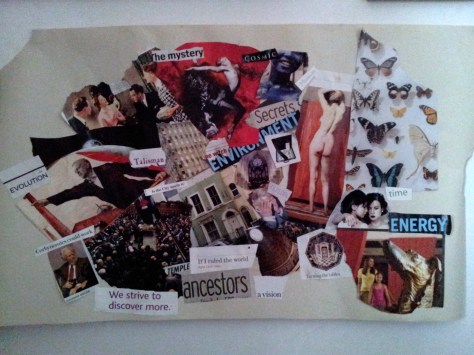
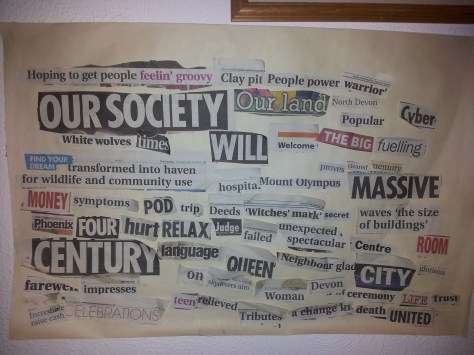
I’m sitting in Julian’s front room and I’m surrounded by a multitude of artefacts from past rituals and hours spent in meditation. While the wood burner and main altar space provide a natural centre piece, today my eyes are drawn to the array of cut-up collages that deck one of the walls. These are not elaborate or overly wrought attempts at occult art; rather they represent raw, psychic high-dives in order to explore fragments of self and the processes that unfold as we try to explore darker, stranger terrain.
Cut-up
Having recently read and enjoyed Queer by Meg-John Barker and Julia Scheele, I started reflecting on the possible connections between how cut-ups and Queer dynamics might interact in our process of exploring Self. I have already written a post reflecting on how cut-ups might interact with aspects of ego psychology, but their book got me to wondering further about how cut-ups might represent a highly queered and magical form of expression. As I observed back then:
“Like collage, cut-ups seek to use existing material in new ways that often involve the combining and juxtaposition of words and images so as to create new insight and meaning.
In tracking the lineage of cut-ups as an approach, from the surrealism of the Dadaists, Brion Gysin, Burroughs and Genesis P-Orridge, we can begin to see the depth of magical thinking embedded in this technique. As we seek to engage with and manipulate reality, the cut-up not only embodies the desired efficacy of our sorcery, but also the fluid shape-shifters that our arte forces us, the magician, to become. If our magic has any real depth, then our ego must undergo a similar process of reassembly.”
Cut-ups for me are a potent means of challenging our attempts at fixed certainty and polarity. Ideas and images that we previously kept apart are cast together in potentially abrupt disruption. These cut-ups don’t allow for tidy answers or for a buttoned-up, linear sense of self, rather they represent a bubbling up from the unconscious that may reveal as much about the dynamic tensions at work as they do potential answers. Apparently unconnected images are juxtaposed with stark headline text and so new meanings and connections are made. To me this dynamic process feels potentially unsettling and hugely creative and thus quite Queer:
“Queer is by definition whatever is at odds with the normal, the legitimate, the dominant. There is nothing in particular to which it necessarily refers. It is an identity without an essence. ‘Queer’ then, demarcates not a positivity but a positionality vis-à-vis the normative.” David Halperin Saint Foucault: Towards a Gay Hagiography
The Queer self is one that has a profound connection to the constructed and performed. As an outsider position it has had to survive by being magpie-like in pulling together those jewels and glimmering half-truths that help make sense of what it means to live with a greater sense of magic and power. Others may dismiss its rag-tag approach for its lack of coherence, but like the trickster or the holy fool it holds up a mirror to those parts of culture whose attempts at control appear all too reliant on dusty outdated certainties.
For me the playful complexity of Queer identity is one that disrupts my attempts at locating my sense of self in fixed descriptors and concrete identities. Any attempt to side-step curiosity and open-handed questioning is unlikely to withstand Queer’s rainbow-laser side-eye. This type of awareness asks that we acquire and develop skills that allow us to more effectively tolerate process, journey and uncertainty.
Wild words
Similarly the process of the cut-up requires vulnerability as we step-back, allowing patterns and (potential) meanings to emerge. Techniques such as cut-ups and automatic writing/drawing are certainly more towards the artistic end of the “Art and Science” dialectic, but such creativity shouldn’t be mistaken for laxity. Ironically it often seems that as we seek to make use of approaches that are less linear and apparently chaotic, that we have to exercise a more focused sense of awareness in gaining benefit from them. It may be that those people who are drawn to more scripted workings do so because it provides them with a greater sense of security and control.
One of the primary reasons that I was drawn to the magical path was its sense of collaboration and play. World views and metaphysics that declared absolute certainty were no longer viable but I was still hungry to explore the mystery of consciousness and the glimpses of awakening that were coming in and out of view. Techniques like cut-ups and collage can provide us with potent and creative means for accessing new insights regarding the paths we are seeking to walk. They are rarely complete answers, more often they are snapshots of a work in progress that we may need to slow down and wait for, rather than rushing to a sensible, adult conclusion.
SD
 The Blog of Baphomet