
Queer: A Graphic History reviewed

Queer: A Graphic History by Meg-John Barker and Julia Scheele Icon Books 2016

I’m sure that like many a humanities undergraduate out there, I have had my academic bacon saved more than once by the Icon series on contemporary thought. Their pithy illustrated guides on topics and figures as wide ranging as Wagner, Jesus and Lacan, often provided an accessible doorway into some otherwise tricky territory. Histories were condensed and made vivid, and previously mind-bending theories were made moderately less so.

queer1

It was perhaps not surprising then that when I caught wind that one of my favourite authors Meg-John Barker was co-authoring an Icon book on Queer theory with illustrator and zine-smith Julia Scheele, I was more than a tad excited. I have already penned some reviews of Meg-John’s recent books on Relationships and contemporary mindfulness practice:

http://enfolding.org/book-review-rewriting-the-rules-an-integrative-guide-to-love-sex-and-relationships/

http://enfolding.org/book-review-mindful-counselling-and-psychotherapy/

and I find their level of both openness and insight deeply helpful and inspiring.

Writing about Queer theory was never going to be a simple task! Not only does it touch upon some highly complex philosophical ideas and movements, it’s very existence as a concept is reliant upon fluidity and a desire to defy concrete definition. (I recently wrote something about these ideas here, looking at the way in which Queer theory might inform magical practice, and there are considerable overlaps in relation to the subtlety, fuzziness and process dependent sensitivity that both seem to thrive on.)

In the course of the book the authors deftly distill some of the primary concepts of Queer theory as follows:

“Resisting the categorization of people
Challenging the idea of essential identities
Questioning binaries like gay/straight, male/female
Demonstrating how things are contextual, based on geography, history, culture etc.
Examining the power relations underlying certain understandings, categories, identities, etc.”

Meg-John and Julia then spend time exploring what the implications of such ideas might be for topics as diverse as identity politics, contemporary sexology and the shape that relationships and concepts of family might take.
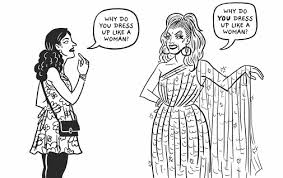
queer2

I’d imagine that writing a book like this might be a bit of a challenge: “How do I make it pacey enough to be engaging and yet detailed enough to capture the complexity of what we are trying to describe?” Frankly I think that the authors have done a great job. Partly this is due to it being a big comic book that Julia has done a great job in illuminating.  Visually Queer is great to look at capturing great portraits, humour, sensuality and struggle.

Conceptually it touches on historical forebears (such as the existentialists) and engages heroically with much of the complex postmodern philosophy that has birthed much of the Queer revolution. The sections dealing with the ideas of Michel Foucault and Judith Butler are especially vivid and helpful, primarily as I have tended to find their work pretty heavy going.

Given that Queer theory seeks to explore the reality of what we do rather than being fixated on fixed identities, it is of little surprise that the authors spend much of this work exploring the ways in which Queer theory has shaped activism on both the societal and personal stages.  Meg-John especially is noted for their excellence in taking complex ideas and challenging us to think about what this means now: how will this promote compassion and a willingness to hear the subtlety of our unique stories?

One of the things that I love about this book is the way in which Meg-John keeps popping up as an illustrated character within the text. Engagement with Queer theory and activism is something that they are deeply involved in, and their presence in the text, dialoguing with us, seems to embody something of the open process that the authors are inviting us to.

Curious readers might wonder why I was so keen to review this book on a blog about Magic.  Apart from wanting to bump up a friend’s book sales, Queer identity is not only vital to me on a personal level, but it also profoundly shapes the way that us Baphomet folks practise our chosen spiritual path. As creative ritual explorers, our magical practice is highly relational (we enjoy working with others), context dependent and focused more on process than some imagined endgame. In short, ours is a profoundly Queer Magic and dynamic works like Queer provide great fuel for this journey.

SD

The Books of Magic – reviews of some top volumes of esoterica

Twister Power is the prequel to Dave Lee’s novel Road to Thule and like that first book this is another heady blend of drugs, magic and future technology set against the backdrop of a world  heading towards economic and environmental collapse. The use of technology to enhance parapsychological powers is central to the plot and there are a number of asides in the novel that explore the history and development of magic. A dystopian cyberpunkesque tale, Twisted Power will be of interest to both sci-fi heads and futurist sorcerers.

Magical future shock

Magical future shock

Defining Magic: A Reader does what it says on the tin. This academic and (by and large) accessible volume explores the repeated attempts by the academy to answer that perennial question/koan ‘what is magic’? From James Frazer and his formulation of sympathetic and imitative magic, through to much less ‘sceptical’ or ‘detached’ theoreticians (such as Susan Greenwood) this book provides a very fine window into the two thousand year old process of people trying to establish what that slippery word magic actually points to. Recommended to both academics in this field and esoteric practitioners who want to gain valuable insight into the meaning and history of their practice.

Noumenautics by academic, philosopher and psychonaut Peter Sjöstedt-H is another fascinating book from the Psychedelic Press UK imprint. The first section deals with an analysis of the psychedelic experience (particularly those states produced by psilocybin mushrooms and LSD), while the latter section of the book presents a close analysis of (neo) nihilism and in particular the work of Schopenhauer and Nietzsche. This volume joins the ranks of those tomes that emerge when you drop psychedelic drugs into the brain of a writer. The particular nihilist spin that Sjöstedt-H provides is fascinating, though I’d like to discover (perhaps in future writings) more about how the author sees the relationship of this philosophical school and psychedelics.

Mushroom philosophy

Mushroom philosophy

Riding out from the serious academic stable of Oxford University Press is The Devil’s Party, subtitled Satanism in Modernity. This is wonderful collection of intelligent papers covering many and diverse aspects of the development of Satanic culture and identity. Highlights for me included the thoughtful and generous re-appraisal of LaVey’s The Satanic Bible, and a  great essay about probably the first self-described Satanist Stanislaw Przybyszewski. Interesting, though in my viewed flawed, is the final paper on The Order of Nine Angles (which seems to exist mostly as a juvenile literary fiction rather than, as the author of the paper imagines, an actual organisation). Overall this is a fascinating, inclusive and well researched exploration of the new religious movement of modern Satanism.

The Museum Dose by the amusingly monikered Daniel Tumbleweed combines two subjects close to my heart; namely cultural spaces and drugs. Daniel takes us on a tour of locations including The Guggenhein Museum and Brian Eno’s exhibition ’77 million paintings’ at Café Rouge. Moreover these adventures happen on exciting drugs such as 25-MeO-MiPT & C-t-2 respectively. In these and ten other places the author invites us to explore, though his excellent prose, the interface between psychedelics, art, history and imagination. This book will be of interest  to both cultural curators and fans of psychedelic literature. Even if exotic drugs are not your bag the engaging authorial voice still makes this a great read.

The final book in this set is the Mutus liber of the tarot, specifically the (Facebook) Chaos Magick Group (CMG) Tarot. This social media mediated collaborative project saw 47 artists and chaos magic practitioners creating a diverse and deep series of images. The whole project took around 2 years from inception to manifestation as a physical deck, with project co-ordinator Paul Nott expertly herding the chaos cats until, as you can see in this video, our collective desire was realised.


CMG has  proved to a wonderfully creative space with a collective intelligence capable of identifying and booting out objectionable online nutters but managing to preserve a brilliant Discordian culture. I contributed two cards to the deck as did Nikki Wyrd and we are both really proud to have been part of this excellent venture. Check the deck out (and make a purchase if you Will) here.

Enjoy!

JV