Words from the Spirits: a few fabulous texts reviewed

Fulgur publishing were, some might argue, the first producers of ‘talismanic’ books (in the modern high-end esoteric literature sense of the term). Now, as publishers of the Black Mirror journal, Fulgur have pushed the ‘talismanic’ project to a whole new level.

Black Mirror itself is an academic research network which is devoted to the study of arts and occultism. This second edition (numbered 1) of their journal is out now and contains a wonderful range of essays. These include an esoteric practitioner perspective on the art of tattooing, a great essay on Le Bal, one of the final ballets of Sergei Diaghilev. The author of the paper, Katerina Pantelides, defines magic as ‘…the performance of desire’s total possibility to dissolve and transform one’s notion of selfhood.’ This is my new favourite definition.

There’s a brilliant essay about the work of Leonora Carrington, one of my favourite witch-artists. Then the perhaps better known (to occultists) Austin Spare, gets a very thoughtful treatment in relation to his neither/neither principle and the process of magical/artistic obliteration.

This is a properly academic journal and so the quality of the writing is excellent. A great range of contributors that manages to be intelligent and approachable (and occasionally funny).

As one might expect with Fulgur the edition is beautifully produced. Typography and images sit elegantly together, the illustrations and photographs are beautiful and, as is traditional, it’s bound to become a collector’s item. But what marks this is a cut-above the rest of those fancy occult tomes is the fact that this stylish volume contains peer-reviewed, academic, accessible, cutting edge, stimulating esoteric writing. It’s about as far from Ye Derivative Bok of Ye Spooky Sigil as it’s possible to get!

If you want to discover something that’s going to stimulate your left and right hemispheres equally, and take you to the cutting edge of the academic/occult interface, then a Black Mirror is what you need.

Not Robbie Williams

Not Robbie Williams

Psychedelic Press have also released a new journal. This is volume XVIII and maintains the same high-caliber writing as previous editions. There’s a cool academic style essay by mushroom wizard and cultural historian Andy Letcher. Then the tables are turned and Andy Roberts (author of Acid Drops and Albion Dreaming amongst other books, who usually does the interviewing) is himself interviewed. Some fascinating observations are made, and wild tales told!

There’s an excellent essay about the use of sensory deprivation and darkness as a means to attain the psychedelic state, including a personal account of the technique. Snuggled into middle of the volume there’s some quality modern psychedelic poetry, crowding into graphic novel panels and expanding into swirly, liberty cap illuminated text.

I therefore recommend Psypress Journal to all heads, counter-cultural historians and explorers of the wyrd.

Psilly picture

Psilly picture

Talking with the Spirits, edited by Jack Hunter and David Luke is a world-wide tour of spiritists, shaman, online clairvoyants and many other folk who spend their time trafficking with denizens of the Otherworld.

Each academic paper provides an introduction to, and often field world from within, traditions ranging from locations as diverse as Brazil, Cuba, Britain, Taiwan and many more.  Here the black mirror of ethnography is held up to the doings of occulture in a way that is intelligent and respectful. If you want to know about the spirits, and especially want to explore (in a chaos magic stylee) the underpinning ideas for different traditions, this is the book for you.

(I was particularly interested to note how in many approaches to the spirits these entities are not seen as occupying a ‘separate reality’ but rather as beings that exist in, and emerge from, the world.)

What Talking with the Spirits also provides are snap-shots of practice; such as in David Luke’s essay on the development of spirit possession in ayahuasca using groups, and the emerging social networking culture of internet psychics described by Tamlyn Ryan.

A recommended read for spirit botherers everywhere.

Spirit writing

Spirit writing

Meanwhile…I’ll review Part 2 of the Nemu’s End series, Neuro-Apocalypse in the next set of reviews. I have, after just a couple of pages, been sucked in by the Rev’s brilliant prose. I may be some time… 🙂

JV
Heretic Heroes (Part 2)

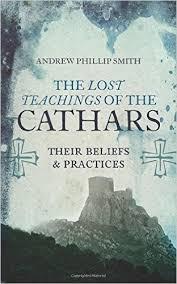
Book Review: Andrew Phillip Smith The Lost Teachings of the Cathars, Watkins Books 2015

It’s easy to get overwhelmed when trying to get your head around a religious movement. The moment we get beyond catchphrases and pop culture references, the ideas and experiences that lay behind words like “Tantra” or “Gnosticism” can quickly result in the need to have a bit of a lie down in a darkened room.

lost-teachings

Given the potential complexity of such terrain, it always comes as a relief when you find an author who is able to maintain the precarious balance between factual accuracy, readability and contemporary relevance. In the realm of Gnostic studies Andrew Phillip Smith has consistently been such a voice. Not only has he been editor of the fabulous journal The Gnostic but he has also penned a clutch of super-helpful volumes such as The Secret History of the Gnostics and A Dictionary of Gnosticism. In The Lost Teachings of the Cathars, Andrew has now turned his attention specifically to the issue of how the Gnostic religious impulse has continued from antiquity into the medieval period and beyond.

The first part of the book provides us with a well-written account of the Cathars as a religious movement, and their likely connection to other groups such as the Paulicians and Bogomils that pre-dated them. While there are a number of other books out there that cover similar territory, Smith’s account reads like a lively travel journal that incorporates both his own travels through regions such as the Languedoc, and his insights regarding what we know about Cathar teachings and their connection to earlier forms of Gnosticism.

While the Cathars can rightly be viewed as exemplifying a heroic attempt at religious freethinking, their story is ultimately a tragedy. The period between the 11th and 14th centuries in which they flourished in southern France and northern Italy was continually beset with conflicts with the orthodox Roman church, which they viewed as corrupt and in thrall to a false understanding of both God and salvation. Although there was variety and complexity in what we know of Cathar belief, it is generally agreed that they were dualists who viewed the realm of matter as being the product of a lesser god.

What Andrew’s book does more fully than most studies of Catharism is to closely consider their practices and their likely significance within the community of believers. He explores the available material that we have regarding their primary sacraments such as the consolateum and the apparellamentum, as well as the purpose behind the celibacy and vegetarianism adopted by the group’s adepts (the Perfecti). He also examines the manner in which their radical reinterpretation of Christ’s teaching ultimately brought them into such violent conflict with both civil and ecclesiastical authorities. Whatever one makes of their dualist theology, it is hard to remain unmoved by the devastating holocaust that was inflicted upon them at Montsegur at the culmination of the Albigensian crusade.

Brother on Brother Action

Brother on Brother Action

Most of the previous books that I have read on the Cathars have tended to end here, trying to make sense of these peace-loving mystics who fell foul of a corrupt church so desperate to hold on to its ability to control. Here though, what Smith does next is consider the way in which the last embers of the Cathar tradition have been revived by various teachers and groups in subsequent centuries. Like so many traditions that produced few written documents to define their teachings, the Cathars have become a screen onto which all manner of groups and writers can project their own desires and agendas.

From here it gets both weird and interesting as we get to dig into some more recent history.  Otto Rahn’s imagining of the Cathars as the custodians of the Grail brought him to the attention of Himmler and the SS  (Indiana Jones anyone?) and probably contributed to his early demise. Also we have the French Gnostic Church getting revived  (in 1889) via disembodied Cathar Bishops turning up at séances, and perhaps most spectacularly we have a mass Cathar reincarnation occurring in Bath, England. This latter story of an English psychiatrist being convinced by a patient that both of them were reincarnated Cathars, illustrates something of the way in which they have become a conduit via which the aspirations of our Aquarian age have been funnelled.

While lesser authors (and cynical chaos magicians) might take cheap shots at the nature of these explorations, Smith examines such efforts in a spirit that is at once critical and yet generous in understanding them as part of our shared human attempts to find meaning and identity. Such generosity is to be applauded and to my mind reflects a tolerance that the Cathars themselves would have welcomed.

Highly recommended.

For a chance to see Andrew and myself co-presenting about the Gnostics at the Occult Conference in Glastonbury, here’s a link! http://www.occultconference.co.uk/schedule/speakers/exploring-gnosticism

SD