
Surreal Christology (Part 2): The Mirror

It’s hardly surprising that mirrors get used a lot in magic; frankly they’re a bit weird. When we look at them they extend space, they reverse and they potentially distort. Whatever we think we look like in our heads, when we look into a mirror we are pushed into a dialogue between that internalised self-perception and the version of self represented in front of us. We may be delighted by what we see or we may become flooded by dysmorphia. Our dis-ease may be skin-deep or it may reveal deeper truths about who we want to be and how we wish to interact with the world around us. Whatever we think is driving us, if we see ourselves more fully we may be confronted by aspects of our daemon that are as likely to shock as they are to empower.

The magical use of mirrors can be manifold, ranging from aids for spirit evocation to scrying tools that allow the diviner greater access to their own unconscious processes. To explore a mirror nocturnally, via candle-light, is to journey to occult edges, and the practice of covering mirrors following a recent death alludes to a need to stabilise our environment in the midst of grief. Given the way they seem to play with the nature of time and space, it’s of little surprise that the Surrealists found them so fascinating.

hand_with_reflecting_sphere

Self-portrait in Spherical Mirror, 1935. MC Escher.

The Surrealists on occasion had mirrors explicitly within their art (often as puddles of quicksilver or mirrored melting clock faces) but more often their presence seems far more implicit. Via their use of depth of field and inversion, when we engage with surrealist art we can often feel that we are gazing at a reflection, with all the subtle strangeness innate to that process. Like the melting clock we are required to relinquish our hold on our sense of time and solidity; i.e. things get a bit wobbly and dream-like.
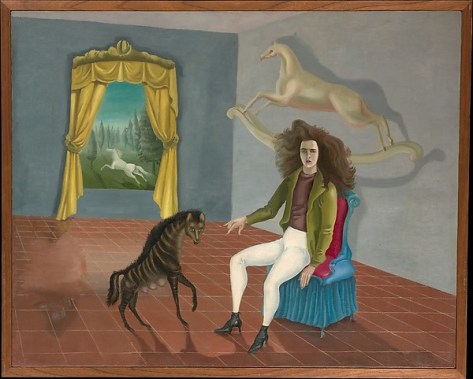
horse.jpg

Self-portrait: The Inn of the Dawn Horse, 1937-38. Leonora Carrington.

In many ways myth and mythic heroes can act as powerful mirrors for viewing ourselves. When we consider those stories or figures that we are drawn to, they can often reveal some significant aspects of who we are at both a conscious and unconscious level. While our initial attraction to a myth may reflect a need or a connection that seems quite obvious e.g. a promise of liberation or an exemplar of individuation, when we renew and revisit this process over time, arguably something subtler takes place. When we truly engage with and internalise these spirits, their strangeness starts to haunt and shape our dreams and outlook.

In terms of my own experience, while my initial flight into Christianity was largely related to my adolescent confusion about the fluidity of my sexuality and gender identity, the Queerness of mystery still managed to break through via my interactions with the myth of Christ. While recognising my personal projections onto the gospel narrative, I eventually uncovered in my reading of Jesus a blurry ambiguity that remains inspiring. Yes this was still the radical who threw over tables in the temple, but he was also the mother hen who wanted to gather the lost underneath his wings.

In a personal world where the versions of maleness, certainty and force made little sense to me, my own gnostic encounter allowed access to a gentler, more mysterious experience. This Christ became a mirror through which I could view myself more closely. Such looking can be far from comfortable, but over time it allowed me to engage with deeper truths about who I needed to become. For me this magical process of engaging with the Christ myth allowed me (somewhat ironically) to become accepting enough of myself that I no longer wished to call myself a Christian.

This Gnostic Christ seems to be asking me to both take more responsibility for my path, while at the same time doing less violence to the core of who I am.  This reflective process is most definitely a work-in-progress and has been far from tidy or pain-free. To walk a magical path requires that we “dare”, even when it means the willed deconstruction of those stories and heroes we hold as precious. This is a narrow road, but it holds the potential of liberty from the claustrophobia of childlike sentimentality.

Whichever mythic mirror feels most attractive to you, I would recommend revisiting it with a Zen-like state of beginner’s mind. Find some great art concerning these myths, or better yet create some art of your own. In my own recent explorations of the Queerer dimensions of Christ I have been inspired by some of the art on sites such as Kittredge Cherry’s  “Jesus in Love” blog. Often these creative explorations into the surreal and less-lateral aspects of ourselves provide us with gateways to discovery and the possibility of further evolution.

Find art that feeds your soul and allows greater insight into who you are and who you can become. Seek the Mysteries!

SD

Heretic Heroes Part 4: “Let My People Go!” Witchcraft as a Liberation Theology

Most religious systems are ultimately designed as systems of liberation. They may differ in terms of what they think we are in need of liberation from (Sin, Desire, Ignorance, Maya etc.), but my own reading is that they are seeking to offer some sort of solution to our haunting sense of discomfort. While such answers may begin with the insights of an enlightened individual, they rarely remain as such. Given time to evolve and gaze outwards, many religious traditions develop a Mahayanist dimension where the liberation of the individual demands a response to the “other”. Bodhisattva vows and states of kenosis (self-emptying) are no guarantee of socio-political engagement beyond well-intended paternalism, but they can often provide the basis for developing more empowered notions of interdependence and systemic awareness.

The 1950s and 60s witnessed an important movement within the Roman Catholic Church in South America, when people who were engaged with the coal face of day-to-day hardship, re-envisioned the gospel message in relation to political and economic oppression. The Liberation of the Israelites from Egypt and the Gospel message of Christ were viewed as narratives of freedom whereby “the downtrodden were lifted up” (Luke 1:52). With the birth of Liberation Theology in the works of Boff, Gutierrez et al, past dogmas were no longer sufficient, and the rigors of true discipleship were now to be measured in terms of deeds or praxis. As Desmond Tutu powerfully observed; “If you are neutral in situations of injustice, then you have chosen the side of the oppressor.”

che-liberation

Liberation icon

In recent discussions with some of my siblings from our coven, I’ve been wondering again about the relationship between liberation and this thing we call ‘Witchcraft’. What does Witchcraft claim to offer liberation from? And is it able to embrace or embody liberation at a collective level?

Much ink has been spilt in attempting to define what Witchcraft may or may not have been, and while we have may have re-appropriated it from accusing lips, its evocative potency often evades concrete categorisation.

Cognitive Liberty

In his Europe’s Inner Demons, Norman Cohn masterfully analyses the evidence with regard to the likelihood of the Witches’ Sabbath having any basis in historic fact. Cohn concludes that it was highly unlikely that the fevered imaginings of persecuting clerics had any foundation in relation to some sort of denominational adherence to a set of pan-European ‘night ecstasies’. What seems more evident is that their actions were overwhelmingly directed at other groups of people who still considered themselves Christians. While it is almost inevitable that some of these Christians practiced magic (and by doing so, demonstrated their humanity), the fear projected by these clerics was more often motivated by an ungodly desire to control.

The Church’s ability to control would always be challenged by the heterodoxy of groups such as the Cathars, the Brethren of the Free Spirit and the Beguines, the power of their subjective gnostic experiences being valued above any external authority. Whatever the degree of adherence to such beliefs by the mainstream of society, the ideas that such outsider groups represented embodied a type of cognitive liberty that eroded the hold of any centralised hegemony.

While we may not buy into Michelet’s idealisation of the Witch as Satanic freedom fighter, there is something subversive contained within even the simplest act of folk magic. To express a sense of agency through a magical act that uses means outside or beyond the Church’s recognised sacraments is to commit an act of heteropraxy and defiance.

freedom1

“I want my folk magic back!”

Within the collective psyche of Europe, the Witch has often acted as an icon of disturbance and freedom. The projected fantasies of clerics and folkloric imaginings often allude to something dark, disturbing and subversive. The Witch often acts as an attractor for the shadow aspects of those cultures within which they are suspected of dwelling. They are the hags and the shape-shifters whose messy bodies both arouse and unsettle us. They seem to be scapegoats onto whose heads the repressed longings of society are spoken.

In bearing the weight of such dangerous passions they often hold a position on the outer edge of social and ethical evolution. In seeking to own their own sense of spiritual and moral agency, it could be argued that magicians have often played a catalysing role in pushing the boundaries of moral acceptability. When we consider a figure like Crowley and his impact on 20th century culture, while his personal chaos may still make him less than attractive as a role model, the bisexuality and entheogenic exploration that then caused such outrage are now far less contentious.

To question orthodoxies and seek new means for personal exploration will inevitably threaten those for whom stability is paramount. Those of us who consciously embrace identities such as ‘Witch’, ‘Magician’ or ‘Gnostic’ are honor bound to aid our cultures’ development, in prodding them to embrace diversity, multiplicity and liberty. When we take on this mantle we must remain awake to the reality that we both represent the freedom that so many seek, and that we still risk being scapegoated by those who would seek to control.

SD