Divine Androgyne (Part 3): Monstrous Alchemy

The impact of Queer experience on the ideal of androgyny is a truly disruptive one. Gone are our neat Kabbalistic flow charts and clear cut Neoplatonic stages of descent. In contrast to these linear sequences, this Queered Androgyny is an ever oscillating, multi-directional chaos-star whose many rays can be simultaneously moving both outward in expression and engagement, and inward in reflection and self-nurture.

This principle of Androgyny is fed as much by the lived experience of unique, individual Androgynous people as it is by the realm of aspirational metaphysics. It as much as about the creativity of the Radical Faery and Butch Lesbian as it about Adam Kadmon or Ardhanarisvara. For me, to work with this form of Androgyny means to acknowledge both a dialectical process that seeks to capture the world of ideal forms, while at the same time experiencing a dialogical reality in which a multitude of positions need to be held together without a necessary resolution.
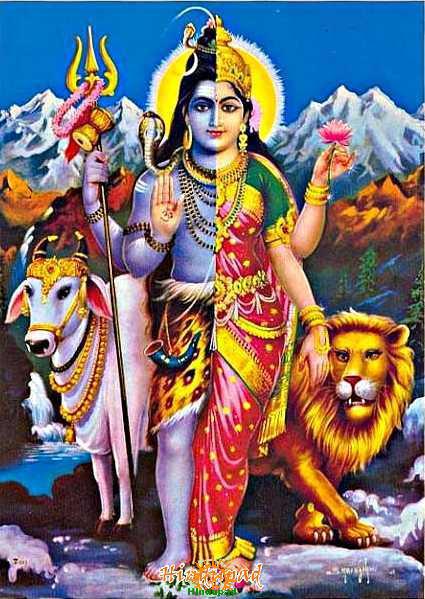
Ardhanarishvara

‘Can’t tell if you’re a boy or a girl’

To seek deep benefit in engaging with these ideas and images seems to require that we tolerate a certain degree of uncertainty. So often this form of doubt, confusion and psychological tension is seen as a negative or a hindrance to spiritual development and yet I believe this does not need to be case. For those of us seeking to walk an occult path, we are often called upon to make use of emotions and methods which our exoteric cousins view as dangerous or retrograde. If however we are able to engage consciously with the sense of resistance experienced in grappling with the complexity of such dialogues, then this very tension can bring about alchemical change.

If the stated aim of magical work is to create change, it would seem somewhat odd to then resist the transformation when it comes; and yet in my own life this has so often been the case. Change can happen at many levels and impact both how we experience ourselves and how we engage in relationships with others. Often the routes to change are manifested in dilemmas, loss and conflict, and the keys we need are to be found in attending to the strangeness of our dreams and the currents of the unconscious made manifest in our Art.

This is the unconscious territory that the Surrealists were so adept in exploring in their work, with the strange often jarring images revealing aspects of self that were bizarre, blurred and often monstrous. In alchemical terms this connection to the unconscious and the shadow represent the stage of nigredo or “blackening”. For the surrealists such territory was vital to their artistic inspiration and similarly for our magical work to have any really depth or sustained power, we must tap into this libidinal black flame of inspiration.

carrington

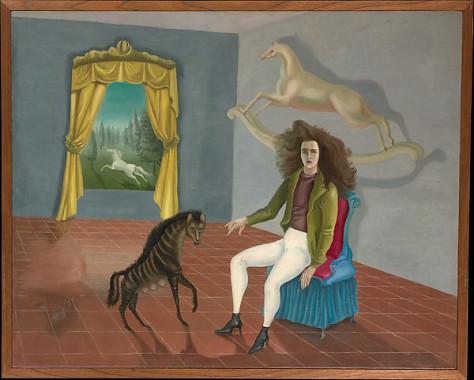
Leonora Carrington Inn of the Dawn Horse

We have already explored something of the fertile intersect that exists between Surrealism and the artistic deployment of occult ideas and images. Themes as diverse the etheric double, the daemonic and the Witches’ sabbat were explored to varying degrees and there seems to be a significant connection between this use of magical themes and the often weird animalistic characters with which they populated their artistic landscapes.

The link between the magical, the animal and the potentially Queer is present in much Surrealist work and for me the most engaging aspects of such exploration, lies in the way in which it seems to capture that zone of liminal strangeness and mystery. The Surrealist imagination was alive to potency to be found in understanding the animal (whether actual or in more mythic forms) as a way of recontacting the sensual and instinctual realms that weave through the body. For me this wilder magic seems to connect to an almost pre-verbal stage of development that resonates with Spare’s idea of “atavistic resurgence”.

The folklore of the Lycan and Vampyre point us towards a magical worldview in which we can explore the vitality gained through a deeper connection to the visceral. Similarly the Witches’ animal familiar the “Fetch”, or the animal-dimension of Norse soul-lore breach our polite attempts to conceive of a humanity devoid of wildness.

In contrast to the clean, vertical fusing of Ardhanrisvara, the truly Queer genius of Levi’s depiction of Baphomet is partly located in the way in which the animal sits alongside the male and female. In trying to work with our own processes of dissolving and coming back together, Baphomet’s animal dimensions remind us of the power, joy and danger that can be accessed when we risk tuning into the whole of ourselves.

My own attempts to access these states has come via bodywork, dance/shaking states and prolonged trance drumming. I have also had a great deal of pleasure revisiting Gordon MacLellan’s excellent book Sacred Animals which provides some excellent practical guidance for exploring these themes. The ability to inhabit these places feels vital for those of us seeking to embody both freethinking and the magic of the Queer. These places beyond binaries and old certainties rarely allow prolonged rest, but they are undoubtedly transformational!

SD


Surreal Christology (part 4): The Androgyny

Part of what appeals to me about Surrealism both as an artistic school and also as a way of engaging with human experience, is the way in which it seeks to embrace experiences of fluidity and uncertainty. Surrealist art often dives deep into rich realms of the unconscious where attempts at neat categorisation quickly start coming apart at the seams. This is a twilight realm in which polarities such as animal versus human, safety versus threat and male versus female are both challenged and played with.

I have previously written about the way in which Queer theory and experience has provided for me a language for understanding the blurry liminality that I experienced in relation to my sexuality and in my spiritual explorations. Queer theory often provides an irreverent take on the complex interplay between biological sex and the way in which we perform our genders. This playfulness is as likely to be found in visual art as it is in text and for me depictions of Androgyny (both religious and secular) can help us gain insight into this strange territory.

kahlo

Frida Kahlo Self-Portrait with Cropped hair

 In the work of both Frida Kahlo and Leonora Carrington we see the way in which both of these female artists engage with depictions of the gendered body in ways which seek to disrupt many of the cultural expectations of their time. Kahlo powerfully utilised the juxtaposition of Mexican traditional dress with glorious facial hair to present a more authentic version of themselves. In both her art and life Kahlo bravely explored the fluidity of both her gender presentation and bisexuality, despite her physical disabilities and the personal turmoil she experienced. She even refused to be pigeon-holed as a Surrealist stating; “I never painted dreams. I painted my reality”. In my view artists such as Carrington and Kahlo worked with androgyny in a manner that embraced the dynamic and shifting nature of what this concept might mean. As Erin Hinz has observed in assessing themes of androgyny within Carrington’s work:

“Carrington experienced the social limits of her female body and choose to create bodies that fused these restrictive codes with animals, ancient ideologies in an alchemical way that transmuted these base constructions into precious, mystical and complex expressions of identity.”

dawn-horse

Self-portrait: The Inn of the Dawn Horse, 1937-38 Leonora Carrington

While the interplay of both male and female aspects of the self was lauded in the works of Jung and first wave feminists (cf. Virginia Woolf’s iconic Orlando) others have been less than keen. While the call of these early writers was taken up by later luminaries such as June Singer and Carolyn Heilbrun, some second wave Feminist theologians such as Mary Daly saw it as an escapist trap that “sucks spellbound victims into itself”. From the perspective of her radical separatism, Daly viewed it as an attack on both the essential potency of womanhood (“Why do I need to be half-male?”) and an attempt to falsely reify certain qualities of humanity as being polarised “male” or “female”. From such a perspective, the aspiration towards androgyny amounts to a form of sexual sublimation and fantasy that distances women from the visceral experience of female embodiment and passion.

While such voices need to be part of dialogue concerning androgyny, it could be argued that while they are seeking to challenge ideas of stereotyping and gendered fixity, via their biological essentialism they may be in danger of another existential cul de sac.  While concepts of androgyny may well be in danger of minimising difference and a true valuing of women’s experience, the desire for such an essential separateness also risks missing experiences of playfulness and exploration that seem vital to shared human experience.

For me the challenging deconstruction offered by third wave feminisms and Queer theory, is less about the removal of category and difference and more about a willingness to dance and blur at the edges of where we think such borders lie. There seems to be a psychological complexity to such approaches that allows for the power of dreams and the unconscious in allowing the primacy of the experimental and experiential. Perhaps we are back with the Trickster in prophetically destabilising neat categorisation and asking for the space to be uncertain and to explore.

This queered vision of androgyny provides a sigil for challenging and shifting our sense of what we think we think we know. This androgynous mystery acts a mirror via which deeper aspects of self might be gleaned. Whether when gazing at our own reflection or in viewing the other, the presence of such oscillating fluidity can provide the possibility of change, and with change, hope.

In relation to my own journey I have already sought to describe how my initial flight into Christianity was largely related to my adolescent confusion about the fluidity of my own sexuality and gender identity. Despite the damaging efforts of my self-suppression, I experienced at least a part of my liberation via my encounter with the Queer androgyny of Christ.

While owning my own needs and bias, I eventually encountered in my reading of Jesus a blurry ambiguity that that provided for me an alternative mode of being. This was the Jesus who cleared Temples and overturned tables, but also who blessed the gentle and sought out the one lost sheep. At a more cosmic level he was also the mythic Christ of the Gnostics, who as the “first Adam” existed in some spacey realm in which they at once contained many genders while being also beyond them. This metaphysical fluidity – while looking decidedly freaky to my fellow seminarians – provided me with a doorway via which I could begin a new chapter of greater self-understanding. Such explorations are definitely ongoing, and continue to this day.

SD


Reading List:

Ellen Goldberg: The Lord Who is Half Woman: Adhanarishvara in Indian and Feminist Perspective 2012

Carolyn Heilbrun: Towards a Recognition of Androgyny 1993

Erin Hinz: The Work of Leonora Carrington: An Alchemical Transmutation of Gender through Magic, Animals, and Narrative

http://genderstudies.nd.edu/assets/64258/e_hinz_the_work_of_leonora_carrington.pdf

June Singer: Androgyny: Toward a New Theory of Sexuality 1976