For me one of the benefits of working with the turning of the year (especially alongside the 8 colours of magic), is that I often feel as though I’m being asked to maintain a balance in relation to the diet of my magical/spiritual activity and to pay attention to the way in which such work promotes health. If for example the heights of ego magic at mid-summer risk the danger of grandiosity, so the demands of Lammas and harvest help ensure that I pressure test any sense of advancement.
In the Northern Hemisphere this time of year can be an interesting time to take stock. Whether we call it Samhain, Halloween or All Souls, the entry into the colder, darker period of the year often provides a natural impulse to slow down and review what we are doing and how this lines-up with our personal aspirations.
One of the great benefits of having both close magical friends and using a magical diary is that they both provide aid in the process of reflection and the way that I keep returning to important themes that I would have been less aware of if I had been left to my own devices. By making the most of such support, one of the reoccurring themes that I keep bumping into, is the importance of the body in my current spiritual practice. In discussion with beloved friends over cups of tea and in deciphering the rambling stream of consciousness contained in my diaries, I have to contend with the question of what it means to experience both the joys and limitations of the physical realm.
For much of this year I have been exploring my relationship with my body by reconnecting to my love of surfing. Living by the coast, I have the good fortune of getting into the sea and exploring the pleasure and challenges that it offers. I tend to surf either without a board (bodysurfing) or on a small inflatable surf mat. Both of these approaches are viewed as somewhat eccentric within the wider surfing community, but help maximize the rider’s closeness to the power of the wave. Outwardly the rider may not seem to be doing much beyond gliding down the face of the wave, but for me they provide a direct experience of nature’s power and the ever changing conditions of the Ocean. However odd and unimpressive this might seem to onlookers, the simple and intense pleasure of this watery Tantra keeps calling me back.
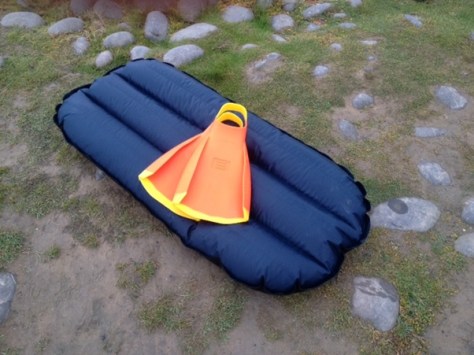
Inflatable surf action!
My relationship to surfing is a complex one. I started surfing at age 10 when living in Australia and was an enthusiastic devotee until my family returned to the UK 6 years later. For the next 10 years I hardly went in the sea, and my focus on Christianity and theological education provided all the distraction I could want. When I eventually started surfing again, I simply assumed that despite the need for more wetsuit, I would be able to resume my obsession as before. Sadly my body didn’t agree, and following the move to Devon with my partner I was quickly faced by the reality that this love of mine was making me ill. I was confronted by limitation in the form of chronic fatigue symptoms and the realization that I couldn’t really do this, and work and have a life.
The letting go of my surfing obsession was made easier by becoming a parent and the inevitable demands and focus that this requires, and yet I still can’t/won’t let go of this thing I love. Surfing inevitably teaches me all those hippy lessons about flow, and awe at nature’s beauty, but it has also taught me some important things about limitation and self-care. I now avoid those beautiful winter waves and when I do surf in warmer months, I pay attention to my diet, my Qi Gong practice and the need for rest. Other illnesses and life events have provided more stark challenges, but my ability to surf/not surf has definitely allowed me some insight in how I experience my body.
Within the excellent work that Julian has done mapping on the colours of magic to the 8 major fire festivals Samhain is seen as having strong correspondences with black magic and the realm of death. Perhaps this is inevitable as we hunker down in front of fires and contend with early sunsets, but this drawing in and reflection brings associations with endings, darkness and remembering those people or things we have lost. When we work with the body we can become aware of not only the intense pleasures that can be sensed and experienced, but also the frailty of our physical selves and their finite span.
For those of us walking a magical path, the reality of own deaths can trigger a range of differing responses. Having worked hard at refining our psyches via the rigours of esoteric endeavour, the ending of our physical life as we know it can feel like an injustice that we rage against in a desire to buy more time. Alternately, in taking inspiration from Buddhist practice, can we use our awareness of mortality to sharpen our appreciation of this moment and review how we wish to be living now?
If I knew that I had three years left, what changes would I be making in the choices I make and in the quality of my relationships?
What if I knew I had 1 year?
What if I knew I had 6 months?
Stark questions, but also ones that can inspire us to awaken and taste life more fully!
Blessed Be.
SD

 The Blog of Baphomet