Getting Higher is turning into something of a wild ride! As well as a mention in The Guardian and the opportunity to appear on several podcasts (most recently with Mikedelic), I was also invited to formally launch the book at the Ecology, Cosmos and Consciousness salon at the October Gallery (haunt of cool folks like William Burroughs, Pablo Amaringo and Nnenna Okore). I was delighted to find the event sold out and indeed there was a waiting list! So, for those who couldn’t attend on the night, here is the text of the lecture that I delivered – enjoy! 🙂
“I’m an occultist; that is someone who studies the occult, the hidden. This means the twilight of human experience; extraordinary states of consciousness, spirit entities, trance states, telepathy, flying saucers, black magic, there must be something in astrology, gay liberation, the Loch Ness monster, the abominable snowman, the Surrey panther, copper bracelets for rheumatism, levitation, water divining, poltergeists – all that jazz. More than this I’m a magician (like a shaman but without so many anthropologists staring at me), someone who uses the methods of magic; rituals, initiatory ceremonies, meditative and imaginal practices and all that stuff.
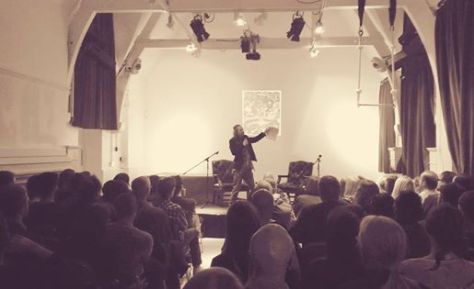
Me banging on about drugs
Magic, shamanism, occultism et al are systems of thought concerned with the real imaginal. That is the lens of perception through which we experience the universe and through which we act. These imaginal technologies, which sometimes look like religion, sometimes like psychology, are ways of changing and directing awareness to make transformations in the inner and outer worlds.
Drugs were part of this territory of magic for me, inspired primarily I have to say by the life and work of the notorious Aleister Crowley. Crowley as I’m sure many here know had a life full of sex, drugs and magick, and died tragically young at the age of 72. He experimented with, among other things, mescaline, as did several of his chums from the Hermetic Order of the Golden Dawn such as the writer Arthur Machen and poet WB Yeats. Years I later I would encounter mescaline, not in Thelemic magical ritual, but rather through American shamanism as it entered Europe.
I am a native of the British Isles. I like to think of myself as a shaman from Stevenage (a town with the strap line ‘Where Imagination Takes Hold’) but the entheogenic traditions of my own country are lost to me. There are shadows in the landscape (in the cunningly arranged acoustic effects of chambered tombs) and folklore (the stories of intrepid adventurers in the fairy realm). There is the bright re-imagining of practices in modern paganism. But there is no tradition in the historical record of the entheogenic use of our native plants, even the blessed liberty cap. So I’ve had to look to techniques of changing awareness embedded in the Western occult tradition and then further afield, primarily to India and the Americas.
In Getting Higher I present something which I guess could be looked at as the ‘chaos magic’ approach to entheogenics. Chaos magic is a style of occultism that emerged in the late 20th century and was characterized by a highly eclectic occulture that incorporated multiple belief structures within an envelope of experimental practice. Getting Higher attempts to explore both traditional and novel practices of entheogenics and present what I consider to be shared core teachings. This is perennial wisdom for psychonauts, a ‘core shamanism’ where sacred drugs are permitted.
I’ve been into magic for some 35 years and actively practicing with other people for only a few years less. For, while I have my own practice, I really enjoy working with others and collaborating on projects, which is why many of my previous books are co-authored. For Getting Higher I worked with many amazing people. I’m very grateful and honoured to have worked in ceremony with practitioners from a variety of traditions. As a Westerner I particularly acknowledge the contribution to my own practice from those cultures in places such as India and the Americas, who have been attacked by the structures of the culture in which I live. I hope that I can use their wisdom to help me, and anyone who reads this book, to create a society in my native land that is less inclined to exploit and destroy. This is why we need this medicine, for while there are indeed many amazing and uplifting things about Western cultures, there is a sickness in our soul which I suspect may be due our millennia long disconnection from the psychedelic gnosis.
I’m also honoured to have had the foreword written by the fabulous David ‘Agent of Chaos’ Luke. My teenage hero, the illustrator and cartoonist Pete Loveday, has provided the great cover art and illustrations to the text. The wonderful team at Psychedelic Press UK have done so much outstanding work that it really feels like a team effort. I’m particularly grateful to my lovely partner Nikki.
When Getting Higher was first written I had terrible trouble. You see, the thing with the psychedelic state is that, as you all know, everything is interconnected, so where to start? For a number of years this book was no more than a skeleton of notes. But during that time, and the years that followed, I tried to pay special attention as I took part in a variety of different ceremonies. What should I pass on from this? What would have been helpful to know here? Since then, I’ve passed the book via a few friendly psychonauts to see if they feel I’ve missed anything out, and while more can always be said of anything, and any explanation expanded, I think we all felt that the core material was there. Hence I could legitimately claim that this was the manual of psychedelic ceremony.
As well as describing what I see as the core technology (to use a phrase that turns up in chaos magic) of various non-European entheogenic traditions, I’ve also been exploring approaches to psychedelics that are informed by our current scientific understanding of these substances. I’m fortunate that through my work with Breaking Convention I’m connected with current research, allowing me to blend insights from ancient cultures with data from the latest brain imaging studies and studies of synthetic psychedelics.
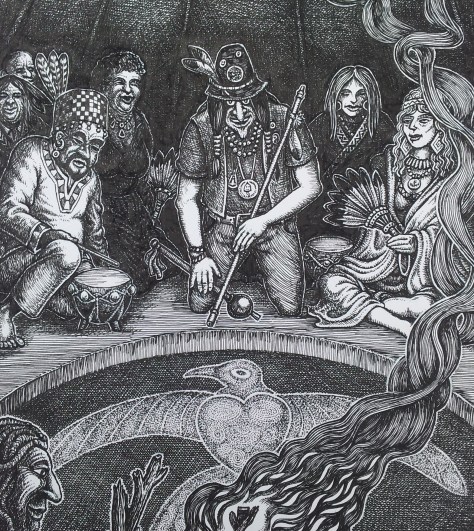
Medicine Circle by Pete Loveday from Getting Higher
Ketamine is one of the synthetic substances I talk about specifically in Getting Higher. This is for two reasons; the first is that ketamine is usually associated with stupefied folks sprawled out by the side of the dance floor covered in snot and smelling faintly of urine rather than refined spiritual pursuits. The second, is that ketamine is, as far as I’m aware, a molecule that has yet to be discovered anywhere other than inside human laboratories. My point is that it isn’t what you do, it’s the way that you do it, that matters. Artificially synthesized psychedelics, traditional herbs, as well as newly discovered botanicals – they all have their value.
I also place quite a bit of emphasis on having a good time. In many of our cultures there is the idea that spirituality is work, and religion is something you do out of duty. That fun is, at best wasteful and at worst sinful or destined to debilitate us. However if you’ve ever been to an ayahuasca session where the music transported you into an ecstatic state, or where the grin on your face the morning after the peyote circle just won’t go, perhaps it makes sense to accept that joy is good. The fact that we enjoy a good rave, a festival or simply getting high with friends is not the opposite of what I’m saying. The ‘medicine’ I’m speaking about could come as part of a delicious peak experience on the dance floor surrounded by good friends as easily as it could come from within a more formalized ceremony. We are allowed to have fun, we can have mirth and reverence and receive the ecstasy of these medicines with as much appreciation as we receive their ability to transform and challenge us. What nourishes our souls is good.
Getting Higher gives examples of rituals but these are just serving suggestions. What I really want is for people to discover their own practice. To do so by learning a few basics and then listening to the medicine. Sure it’s great if you can come and sit with a visiting American shaman, or nip over to Mapia for a couple of glasses or five of ayahuasca. But for other people, who maybe have access to the drugs though the internet but don’t have mentors who can be physically present, I hope this book can help them dream up wonderful, supportive and transformational ways to meet the spirits that they’ve summoned via incantations over the darkweb.
These are powerful medicines, so powerful that they have twice tried to break on through and radically reshape culture in the two previous summers of love. Drugs like LSD have caused huge changes in our culture and while it’s not possible to be empirically certain a good historical case can be made to support the assertion of Michael Randall from the Brotherhood of Eternal Love who says, in the film Orange Sunshine: “Today you see health food shops and places selling good organic food in every town; that’s because of LSD!” The use of entheogens can, has, and will, change the world.
Now remember kids ‘the medicine’ is the message, not just the drugs.
I’m an advocate for the medicine. I have experienced the fact that these drugs, intelligently used, are powerful methods for transforming us. They can transform us from damaged, alienated, grief-stricken and fearful people into thoughtful, caring, curious and joyous individuals. Critically ‘the medicine’ as a whole is the combination of psychedelic experience within a set and setting designed to enhance its entheogenic potential. The medicine is the complete psychedelic triangle of set, setting and substance. This is context engineering for chemically augmented awareness. We need this medicine, to heal us from our divisions that perpetuate the illusion of isolation, to allow us to transform our bitterness and form better relationships with ourselves, each other and the planet.
I want to nurture settings in which the self-administered and autonomously interpreted psychedelic experience is open to all who seek it. Imagine then what our species could achieve if we turned on the world to the medicine? The simple fact that we know these drugs help hot-wire our neurology, creating minds better able to work with complexity, to discover new solutions and appreciate new perspectives, should give us hope. Perhaps with sufficient ramping up of the simian wetware we can discover ways to address the challenges that face us as species? Perhaps we can boot our intelligence up to the next level? Many people have observed how individual people can be totally fine whereas groups of humans often exhibit much more stereotyped behaviors. Maybe if we have sufficient people operating with minds informed by the higher processing capacity of the psychedelic state we may begin to behave more mindfully as a species? And we can choose to explore inner and outer space together for ever!
But these are just a few wild speculations about sacred sacraments, the point is that the medicine – the set, setting and substance of entheogenics – certainly has the potential to be a great ally for our species. Overcoming the legal, economic, environmental, cultural and social problems associated these substances is essential work. This means supporting licensed scientific and medical research, and bearing witness to the value of the psychedelic experience, and demanding it as a point of cognitive liberty, an essential part of our humanity, and a legitimate spiritual practice.
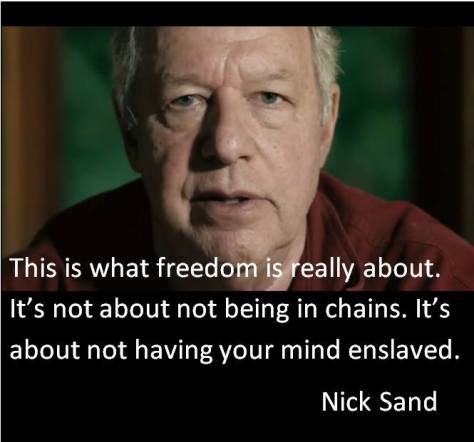
We need to realize that, as Nick Sand (Peace Be Upon him) says in The Sunshine Makers, “freedom is not about being in chains, it’s about not having your mind enslaved”. The intelligent use of psychedelics can liberate us from this slavery, the slavery of psychic distress and restricted cognition. Psychedelics can alter us and in turn our culture; they teach us both acceptance and the importance of intention, the value of challenge and of ecstasy, of self-awareness and of empathy.
So I say take your drugs and turn them into medicine for yourself, your community and all beings. Liberate yourself and others! Ahoy!”
JV


 The Blog of Baphomet