
Review: Acts of Magical Resistance by Phil Hine

While the beginnings of many religious traditions are decidedly focused on the salvation, liberation or empowerment of the individual, they rarely remain as such. Given time to evolve and gaze outwards, many religious traditions develop a greater sense of collective responsibility, where the impact of any apparent awakening demands a response to the “other” and the world around them.

In considering such development, contemporary Paganism is no different and this concise work by Phil Hine provides us with a pacey and inspiring overview of the evolution of the political dimensions of Paganism within the UK scene.


Phil begins by mapping some of the origins of political conservatism within occult and esoteric circles, with writers such as Dion Fortune casting doubts over the spiritual pedigree of those who involve themselves with worldly politics. Such messages helped shape the reluctance within the magical and Pagan circles well into the 1970’s and early 80’s often leading to an absence of challenge to the mainstream positions in a way that translated into activism. For Hine this shifted radically during the ‘Satanic Panic’ that hit the UK in the late 80’s and early 90’s, which seemed to catalyse parts of the Pagan and magical communities into adopting a new radical openness in seeking to challenge the lazy stereotyping and misinformation so widespread in the media.

This work features some inspiring flyers and snippets from ‘zines from this time period that help capture the dynamism and punk rock energy that inspired many Pagans to greater acts of openness and heroism. Phil helpfully tracks a timeline of magical resistance before the late 1980’s as it manifested in Pagan contributions to the Greenham Common anti-nuclear protests, PAN: Pagans Against Nukes, Stop the City and the contribution of the PaganLink Network. These movements alongside seminal works such as Starhawk’s Dreaming the Dark (1982) helped ferment a new questioning as to whether “we are content to be spare bedroom Witches” with a limited vision of what our Paganism has to offer the world.

Moving into the 1990’s Phil paints a vivid picture of the collective ritual workings of the Dragon Environmental Network, Thee Temple ov Psychick Youth and Queer Pagan Camp as they sought to bring people together to challenge both ecological threat and attempts to limit sexual liberty.  These collective actions fostered community and helped create a sense that change was possible. The book provides us with insights into large group rituals such as the ‘Heal the Earth’ working (summer solstice 1987) and smaller sorcerous rites born from his time in the Leeds squat movement where the “magic of need” brought together activists seeking change in their immediate communities. These aren’t simply feel-good pathworkings in the hope of societal change, with rituals such as ‘Unleash the Furies’ illustrating how occult technologies such as Goetic working can be used to name, contain and then redirect contemporary demons such as patriarchal abuse or homophobic violence.

While this work is inescapably a challenge for us to move our magical practice and perspectives out of our spooky-club ghettos, it also manages to avoid the grimness that can feel present in our often near-exhausted activism. What I really enjoy about Phil’s writing is his ability to remain playful and humorous even as he is trying to describe the realities of trying to bring about political change. In a similar way to his ‘Liber Nice’ in his seminal Prime Chaos, he frames many group rituals as having a Discordian and almost Dadaist potential in being able to disrupt and undermine the bloated misuses of power that so often lay at the heart of oppression. When we are able to ‘play’ via our protests, so we model and embody a freedom that can even act as an invitation to those who we are protesting against.

The book concludes with a rich and diverse section on influences and resources to inspire. Phil reminds us of our heroic forebears such as Annie Besant, Florence Farr and those Kali worshippers who invoked her potency in order to challenge British colonialism. These spiritual allies and suggestions all aid what Phil calls “A Space for Wonder”, that can help us when our activism and protest might threaten burn-out or compassion fatigue. How can our Paganisms and practices reawaken creativity, openness and a connection with others? This is surely one of the primary goals of our magic and as such Hine urges us to embrace Wonder’s “alienating presentness”:

“Wonder propels us toward the unfamiliar, to seek new relations, to revel in dizzying complexity and richness. Wonder pulls us into the world beyond a limited horizon, beyond the certain, the familiar, the possible.”

In our current times, Phil’s book is a real grimoire for a magical engagement with our lives, our struggles and our joys. Highly recommended.

Steve Dee

Buy Act of Magical Resistance by Phil Hine


Coming up next…

Baphomet Magic – March 13th and 20th, 7-9pm UK time live and recorded.

Ghost in the Machine – March 25th, 7-8:30pm UK time live and recorded.
Psychotropics & Western Magic – April 3rd, 7-8:30pm UK time live and recorded.

Aleister Crowley & Liber AL – April 8th, 7-8:30pm UK time live and recorded.
Breaking Convention, Europe’s largest and most diverse conference on psychedelic consciousness. 17th-19th April at The University of Exeter.

The History & Practice of Scrying – May 15th, 7-8:30pm UK time live and recorded.

Goetia Work in the Context of Chaos Craft


Introduction

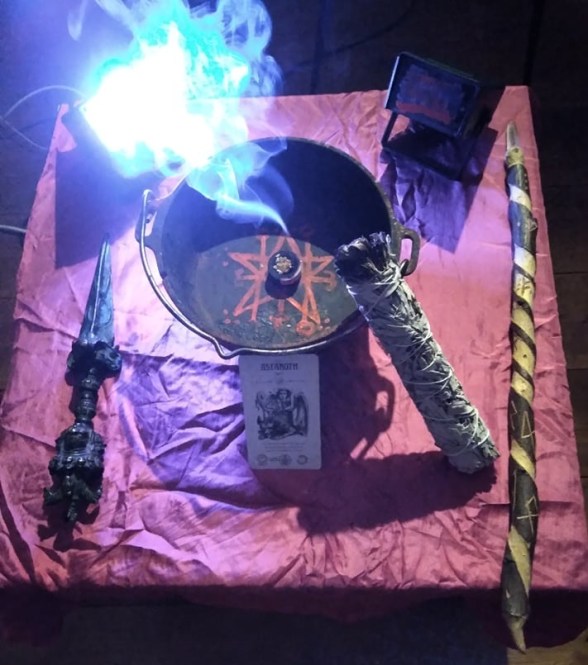
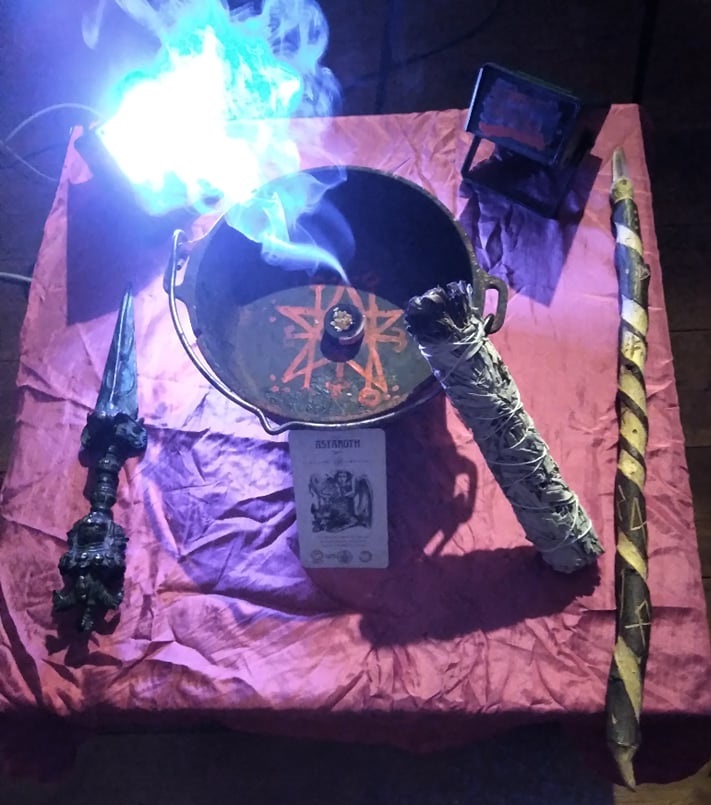
Having just convened for the second time after the lockdown with our coven we performed a conjuration of Astaroth – the third time that I have done goetic work in a group and we considered it to be a great success. Without revealing my exact method (I would like people to come along and experience my method for themselves!) we managed to each of us ask Astaroth a question and get a fitting answer. All of us were very happy with what we had achieved! Participants left feeling inspired and empowered.

Being a chaos magician I will freely construct my rituals in a creative way to hopefully achieve the desired result without worrying unduly about violating principles of tradition. I used strobe lights with the lenses painted over with colours and out of step with each other to induce an altered state of consciousness. I tested this at home with my friend in the kitchen one evening: they got scared and kicked me in the shin on the way to the light-switch accusing me afterwards of ‘pulling faces’! This told me that I got the desired result!

Paradigms

I tend to think that the entities in the grimoires are not inherently evil but am more inclined to think that we have a list of spirits here, many of them gods of ‘other’ religions, re-branded as ‘demons’ for which we have instructions for performing pujas in order for them to assist us in our lives. Many purists will think of me as being dangerously complacent! However, I have worked extensively with Astaroth within groups and by myself using various methods and have come to no harm by having this perspective. For me the word ‘evil’ is in itself dated and of little relevance in modern language, a word usually reserved for things we fear or don’t like.

Here we reach a point of clashing of paradigms and theories on how this kind of magic works and for that matter any type of magic. The psychological model based on Jung’s theories is a favourite for many. Ideas about the Shadow and archetypes with Jung believing that thoughts do not altogether take place inside the brain. Crowley himself was a veteran of this perspective when he introduced his Goetia publication by asserting that the spirits are actually parts of the brain. ‘Psychologizing’ magic has a history of at least 100 years. There is no doubt in my mind after reading Jung’s Red Book that Jung himself was a Hermetic magician since Philemon, Jung’s Daimon actually carried a copy of the 6th and 7th Book of Moses with him, which is a grimoire! He believed that thoughts have an external reality of their own, that would literally mean that ‘complexes’ can be equated with spirits by his way of thinking. How thoughts can be ‘external’ has not been clearly explained to my satisfaction, hence I am not fully subscribed to this theory or any other paradigm for that matter.

Whichever way you believe magic works: there is no complete theory which explains it flawlessly. Jung was a scientist and his theory on the paranormal is elegant and serves as a good springboard for magic until the moment when you dive in and actually do the work! Once the circle is drawn: all that stuff falls aside for a while and you proceed without a rational framework.

Approaches: Purist versus Pragmatist

Being a chaos magician, I am concerned with results rather than traditions. I don’t think it is necessary to quench my ritual knife in mole’s blood in order to get a good result when following instructions in the True Grimoire but if you are a purist which instructions do you follow and which ones do you ignore? Working as a gardener and I can tell you that I am proud of my Japanese pruning saw as it makes me look like a garden ninja however: even with this tool I would struggle to cut a wand thick enough with one stroke to put all the necessary signs on it as prescribed in the grimoires!

As for the virgin parchment: I recognize a life-force offering when I see one! If you cut the throat of a goat and pronounce the name of the spirit that you wish to conjure that is what I see, a life-force offering. This should be an important part of the ritual but for obvious reasons, it cannot be so. In the African Traditional Religions the use of blood is difficult to overlook. I have seen goats being sacrificed in India. It features in the Bible: Jehovah insists on it and punishes Cain for failing in this. The use of blood in religious and magical traditions is cross-cultural and can be found from South America all the way to Nepal. It is considered effective.

My argument is this: there are no purists in goetia work! You will never catch enough moles to quench that blade in their blood and you must not try to do so either!

Pragmatic Approach

Seeing as you are unlikely to be able to follow exactly the instructions as set out in the grimoires: what would be the best way to proceed?

Black and Hyatt in Pacts with the Devil give some good ideas on substitutions. For a life-force offering they suggest that the sexual act can be used and the resulting fluids be offered instead of blood. Crowley did so with great effect in the ‘Paris Working’. One’s own blood can also be used to great effect: using sterile diabetic lances, a few drops is enough in my opinion to get impressive results. Drop some in that incense for example! It would not take a creative genius to come up with really good techniques to make a powerful and effective life-force offering without injury to yourself or any other living creature! The ‘Vinum Sabbati’ that Kenneth Grant refers to in the Carfax Monograph I would consider to be the ideal.

Chaos magicians will dissect a ritual and see procedures that are common to many other acts of magic. Altered states of consciousness are useful and everything from incense and various drugs to spinning, over-breathing, sleep deprivation, fasting are used in magic around the world in various cultures and times. My ‘unusual’ approach to conjuration would not be considered at all unusual in this context. I like using a dutch-pot (cauldron) as the place where the spirit manifests: painting the sigil of the entity onto the floor of the pot. I have the charcoal read on there with the incense that has all of the special ingredients that you wish to add. This might be some heady incense and a few drops of blood/Vinum Sabbati that you have hygienically added.

Chris Bennet in Liber 420 argues convincingly that intoxicating drugs were used in spirit communications of many types – asserting that the incense used was actually exactly that. It would be a shame to reduce conjuration work down to a ‘controlled hallucination’ as it is not a complete theory that explains every aspect of the phenomenon, such as the paranormal effects, but it might be considered another way of opening a path to successful work in this area.

Our Formula

I would suggest the following formula for goetia work, like recipes in a cookbook you will not want to slavishly follow my suggestions and you might have strong opinions that will prevent you from doing so:

  1. Sacred Space: Circle and Quarters Ritual
  2. Cleansing of participants with white sage or preferred method
  3. Switch stobe-lighting on
  4. Invocation: Petition your patron deity to oversee this work
  5. Headless/Bornless Ritual: invocation of Holy Guardian Angel by your preferred
    method as ‘preliminary invocation’
  6. Lighting of specially prepared incense
  7. Repetition of incantation as per True Grimoire
  8. Chanting of name of spirit in step with in and out-breaths for 10 minutes
  9. Manifestation of spirit in cauldron
  10. Quizzing the spirit/making requests
  11. Banishing
  12. Closing of ritual and license to depart
  13. Chaos Magicians use the IAO ritual as a ‘re-centering’ rite after everything has been completed. You might wish to use voice-recorders during the ritual and share insights with participants after the ritual before going your separate ways.

Conclusion

I have directly used over-breathing and strobe-lighting to great effect in group goetia work as well as drumming, using my own blood and other unconventional methods. As a group we have successfully communicated with Astaroth: each member in turn and got satisfactory answers to our questions. I certainly had very vivid visual effects without using intoxicating drugs. There is no need to harm animals and there is no need to skimp on those techniques that help just because they are not in the book or form part of goetia tradition. Magic is a dynamic pursuit which in my opinion should evolve and change with time. Our method also needs honing and improving. I would like to do a great deal more to make our ritual more powerful and effective!

Frater Ananael (Priest of Chaos Craft)


Coming up next…

Julian will be teaching Street Sigil Sorcery on the 25th of November, 19:00-21:00 GMT. Join the workshop live or catch up afterwards with delayed viewing tickets.

Julian will be leading The Sun at Midnight, an online ritual as we approach the winter solstice on the 9th of December 19:00-21:00 GMT.