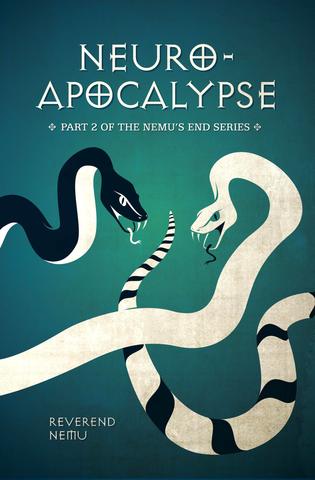
Neuro-Apocalypse,  by Danny Nemu – A Review

This work by the Reverend Nemu is a heady brew that plunges us into a world of deep Kabbalah. In this second part of a planned trilogy, he leaps headlong into the realm of neuroscience and the way in which language development shapes consciousness and human evolution. Like I said, it’s deep!
neuro-apocalypse

Danny’s writing is lucid and engaging and he cuts between personal travel log, biblical exegesis and riffing about the joys of neuroplasticity. It made me think that if Robert Anton Wilson knew his Bible better he’d probably have written like the good Reverend. Nemu admits that his textual interpretations are unorthodox, but he is a serious exegete who while paying close attention to cultural context also engages in creative use of rich mythic concepts.

As much as Danny clearly enjoys playfully interacting with how language has shaped him both personally and spirituality, he has a more far-reaching exploration in mind. Not only does our learning of new languages shape us as individuals, but the incoming of the logos into the grand narrative of human evolution is central to differentiating us from other primates. Danny transports us into the deep time of Eden’s Garden and treats us to a director’s cut of what was really going on with that wiley serpent of consciousness.

While some might find the radical juxtaposition of material disorientating, personally I felt that it induced a psychedelic state of awareness that felt resonant with the type of conscious brain-change that he was seeking to describe. Yes this work is at times dense and demanding of concentration, but the author does well to intersperse his theory with some entertaining experiential vignettes.  Danny provides us with some vivid personal biography regarding his experience of the ayahuasca community and then builds upon this in seeking to draw parallels with other forms of ecstatic and contemplative spiritual practice.
danny-nemu2-458x458

Serious exegete

I especially enjoyed his examination of what we might learn from the experiences of folks who are more atypical in their neurology (people on the autistic spectrum or who voice-hear) and what these lessons might mean more widely for human potential. While understandably speculative in places I enjoyed the positivity of this as a re-frame for mental health experiences that are so frequently problematised.

In many ways I experienced Neuro-Apocalypse as a deeply Gnostic work, as the Rev. Nemu allows us to accompany him on a roller-coaster ride through his rich personal mythology. While such journeys can be fraught with either narcissism or excessive eccentricity, I felt that Danny did a great job in remaining true to his personal vision while ensuring that we, as his readers, can glean riches that are applicable to our own paths.

Rev. SD

Surreal Christology (Part 1): The Haunting

Have you ever felt haunted? Haunted by an idea or a person who, despite all your best efforts, seems to be lurking at the edges of your vision and prodding your unconscious to give them a bit more space. These phantoms of our history often point towards past explorations and adventures that were left unresolved; untidy longings that may seem embarrassing when viewed from a more urbane present.

In all my recent writing about the Gnostics and other Christian heretics, the figure haunting me from the shadows is that old trickster Yeshua Ben Joseph (Jesus to his Greek speaking friends). It may well be a projection on my part, but in my mind Jesus and I are trying to negotiate a different kind of relationship. Those dusty half-truths from fan-boys of old simply don’t fit any more. Rather than taking shape within a dogma that does violence to either kindness or thinking, I keep getting glimpses of this Jesus in the dreamtime and the strangest of places. This is a decidedly Surreal Christology.

It is hardly surprising that Surrealism’s emphasis on the unconscious and the realm of dreams coincided historically with the birth of psychotherapy and fin de siècle occultism. For me, the sense of mystery and strange juxtaposition that are synonymous with Surrealism have helped me to explore aspects of my spiritual history that I had previously felt unable to reconcile.

In the “Art and Science” definition of magic according to Crowley, I will definitely acknowledge my own personal bias towards the art end of this equation. Surrealism as an artistic movement manages to capture the creativity and willed engagement with the unconscious that was later embodied so potently in the work of occult artists as diverse as Austin Osman Spare and Thee Temple of Psychick Youth. Such art revels in the conscious distortion of the familiar as we push up against the fuzzy edges of the known and the knowable (think melting clocks and fish on bicycles). Such an approach is radically subjective and relational, but uses images in a way that connects to shared meaning so as to provoke new ways of perceiving and understanding:

“Artist, you are a priest: Art is the great mystery and, when your effort leads to a masterpiece, a ray of the divine shines down as on an altar… Artist, you are a magus. Art is the great miracle and proves our own immortality.”

– Joséphin Péladan

Surrealist artists such as the fabulous Leonora Carrington (1917-2011) took this emphasis on the magical and alchemical a step further than most of her male forebears, and her work remains a potent example of the surreal genius engaging with the spiritual realm.

Ab Eo Quod 1956

Leonora Carrington Ab Eo Quod 1956

Whichever occult tools we think we may have mastered as we enter the faery realm of sleep, we soon realise that we are riding on waves of unconscious that are ultimately beyond our control. The esoteric skills of automatic writing and dream interpretation (both of which the Surrealists employed) may be effective vehicles for entering these waters, but we must still realise the limited control that we finally have over what creatures emerge from its depths!

I would highly recommend the use of Surrealist art (especially Carrington’s and Max Ernst’s) as an aid to meditation and reflection. The Surreal landscapes encountered via dreams and our art can be challenging and uncomfortable, but their jarring and vivid images can trigger awakenings more potent than if we were relying on words or reason alone.  

Max Ernst The Robing of the Bride 1940

Max Ernst The Robing of the Bride 1940

For me, my own departure from Christianity came following a profound psychological crisis in which I was no longer able to tolerate the exclusivity of that religion’s claims. My book A Gnostic’s Progress looks at this experience in greater detail, but it would be fair to summarise the direction of this journey as being inwards in search of greater, more authentic depth, a move away from faith based belief, and towards an acceptance of responsibility for insights gained.

This journey inwards was greatly aided by the works of Jung, and it was via his work that I encountered the richness of the Gnostics for the first time. Jung was also a person who was haunted. His desire for personal authenticity and integration drove him to break with Freud and he emerged from this crisis with insights that are truly profound. At points Jung’s haunting was quite literal, and his reception of the Seven Sermons to the Dead was accompanied by etheric and poltergeist activity: “The dead came back from Jerusalem, where they found not what they sought. They prayed me let them in and besought my word, and thus I began my teaching.” Sermon 1, 1913. For more insight on this critical chapter of modern Gnostic history, you may want to check out Stephan Hoeller’s excellent The Gnostic Jung.

In many ways my fairly persistent preoccupation with the Gnostics and heretical Christians is also evidence of my own ongoing struggle with the ghost of Jesus past. For me this is a relationship that feels markedly different to previous attempts at belief and certainty, for now my haunting is about the discovery of what the sacred flame of my own Christhood might mean for my liberation.

 The Madonna of Port Lligat

Salvador Dali The Madonna of Port Lligat 1949

SD