While scholars and practitioners may continue to debate the degree to which the transcripts of the Witch trials can be viewed as axiomatic in relation to what Witches actually did, they do seem to highlight the centrality of dreaming to the Witches’ path.
To travel to the Sabbat was to enter the realm of dreams. We might to choose to frame this as a form of astral travel or a salve-induced hypnopompic experience, but it seems that to be a Witch meant that the nighttime became a liminal zone in which the fuzzy edges of consciousness were utilized for the work of magic.
The nocturnal dream journeys of the Witch embody a cognitive liberty that refuses to be imprisoned, despite the efforts of the authoritarian oppressor. However they might seek to enforce their orthodoxies or to harm and torture the body, the spirit of the Witch struggled hard in refusing the limitation of their chains. For me these heretical heroes were seen as threatening due to the way in which they embodied a more authentic and visceral humanity more connected to the sexual and the wild.
The sabbatic revelries of the Witch were almost certainly located as much in the projections of their oppressors as they were in actual practice, and yet even here we can sense the potency and strangeness of the unconscious realm. The fevered imaginings of Malleus Maleficarum with its violent suppression, reflect a sadism born of suppression. I cannot help but see the reports of the inquisitors as a distorted mirror image of the type of freedom that they secretly longed for.
The depictions of the Witches’ Sabbat are often simultaneously sensual and grotesque. They are at once conclaves of perversity and yet in their depiction they often unconsciously capture a male gaze that holds both disgust and longing. Such images seem to reflect the sense of internal conflict at work in the inquisitorial eye, and the potentially queering, alchemical impact that such perceptions of perversity can induce. In her work Queer Phenomenology, Sarah Ahmed observes:
Perversion is also a spatial term, which can refer to the wilful determination to counter or go against orthodoxy, but also to what is wayward and thus “turned away from what is right, good and proper.” For some queer theorists, this is what makes “the perverse” a useful starting point for thinking about the “disorientations” of queer, and how it can contest not only heternormative assumptions, but also social conventions and orthodoxies in general. Page 78.
For me the archetype of the Witch is innately bonded to the queer, the twisted and the perverse. In its raw nocturnal sensuality, it challenges attempts at control, and it organises itself into cells of practice for those bold enough to seek their own power and self-definition outside of the bounds of convention. The possible/partial etymology of Wicce being “to twist or bend”, for me points toward the willful pursuit of a non-straight and less linear approach.
The Witch is the dream dweller par excellence and as such they provide us (whether Witch identified or not) with a form of surreal inspiration that when embraced allows the possibility of greater queerness and greater self-transformation. To gain access to this realm, we must dare the lucid sleep where we utilize the less-filtered reality of our dreams.
The character of the Witch within the Surrealist canon is probably embodied most vividly in the work of Leonora Carrington. We have already considered the centrality of her work in manifesting that strange space between dreams and waking, male and female, real and surreal. For me her work pushes hard against the attempts of orthodoxy to contain and control the power of the female imagination.
For Carrington, the Witch embodies the figure willing to bend and distort the known and the orthodox. The richness of her many years in Mexico provided her with a vibrant example of how to meld the Catholicism of her upbringing with her own, deeper magical impulses. Her time spent with Curandera and in exploring the mythology of pre-conquest beliefs of the Maya, inspired her own journey in synthesising both Catholic and Celtic/Native British currents; as Susan Aberth observes:
This combination of the heretical with the orthodox exemplifies the multiplicity of belief systems the artist is dedicated to preserving as part of the suppressed history of female spirituality. Page 126, Leonora Carrington: Surrealism, Alchemy and Art.
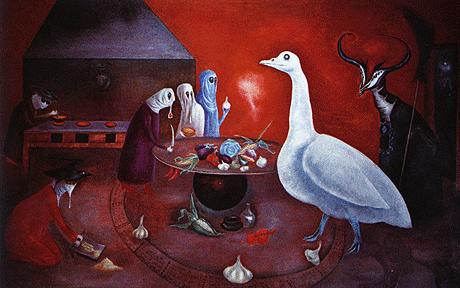
Grandmother Moorhead’s Aromatic Kitchen, 1975
In exploring the power of the Witch, Carrington depicts the magical circle and the Kitchen as being able to sit within the same space. For Carrington it feels that her work as a magician dissolves any dualism between artistic creation, nurture and sorcerous realms. When pursuing such integration the visible and invisible, the known and the occult inter-penetrate each other as a manifestation of a truly earthed divinity:
By transforming the domestic table into a sacramental altar Carrington creates a feminine sacred space that links worlds, providing access to multiple states of consciousness while collapsing the hierarchies that have prevented a more inclusive vision of spiritual possibilities. Ibid.
The nocturnal realm of the Witch is one in which the quiet of night’s darkness allows us more space to tune in. With day’s labour done, the hearth invites us to rest, engage and feel the edges of the coming dream-sleep. This is the place that the Witch beckons to; a place where the busy cognitions of bright sunlight are left to simmer.
Carrington’s work depicts a form of alchemy truly plugged in to chthonic power. Her Witchcraft rejects a false dichotomy between folk-magical practice and the depths of spiritual transformation. For her the Celtic Sidhe that inhabit much of her work are both the spirits of the earth and the holders of alchemy’s secrets. With the incoming of a Roman Christianity hell-bent on homogenization, the old gods choose to go underground and inhabit those mounds or “Sid” that still hold such allure for those drawn to the serpentine energy of the land. If we risk reconnection to such power, transformation becomes possible in a way that rejects false dualities, and allows creation from a place of deep rootedness.
SD

 The Blog of Baphomet