Thousands of years ago, Plato attended the Rites of Eleusis. He stood in the crowd, and had a deeply meaningful experience which set him, and us, on the road to the split of mind-body duality. He writes:
For, as has been said, every soul of man has by the law of nature beheld the realities, otherwise it would not have entered into a human being, but it is not easy for all souls to gain from earthly things a recollection of those realities, either for those which had but a brief view of them at that earlier time, or for those which, after falling to earth, were so unfortunate as to be turned toward unrighteousness through some evil communications and to have forgotten the holy sights they once saw. Few then are left which retain an adequate recollection of them; but these when they see here any likeness of the things of that other world, are stricken with amazement and can no longer control themselves; but they do not understand their condition, because they do not clearly perceive. Now in the earthly copies of justice and temperance and the other ideas which are precious to souls there is no light, but only a few, approaching the images through the darkling organs of sense, behold in them the nature of that which they imitate, and these few do this with difficulty. But at that former time they saw beauty shining in brightness, when, with a blessed company—we following in the train of Zeus, and others in that of some other god—they saw the blessed sight and vision and were initiated into that which is rightly called the most blessed of mysteries, which we celebrated in a state of perfection, when we were without experience of the evils which awaited us in the time to come, being permitted as initiates to the sight of perfect and simple and calm and happy apparitions, which we saw in the pure light, being ourselves pure and not entombed in this which we carry about with us and call the body, in which we are imprisoned like an oyster in its shell. So much, then, in honour of memory, on account of which I have now spoken at some length, through yearning for the joys of that other time. But beauty, as I said before, shone in brilliance among those visions; and since we came to earth we have found it shining most clearly through the clearest of our senses; for sight is the sharpest of the physical senses, though wisdom is not seen by it, for wisdom would arouse terrible love, if such a clear image of it were granted as would come through sight, and the same is true of the other lovely realities; but beauty alone has this privilege, and therefore it is most clearly seen and loveliest.
Plato, Phaedra, 250 a-e.
Plato can rightly be regarded as the auctor of Western philosophy. His vision of the soul yearning to soar free of the sepulchre of the body has influenced countless generations of those whose world view forms the scaffold of our own individual versions of the body/mind division.
However, he was wrong. Limited by the dichotomy of the Greek language comparing this on one hand, that on the other, he was blind to the multitudinous steps betwixt cup and lip, from objective (out there) to subjective (in here), and slipped up.
I recently read two things posted in close succession on my facebook wall. One was the news of publication of research on the physiological effects of LSD on the brain’s blood circulation. The other was a report on how vision works, how the incoming signals from light striking our retinal cells is smoothed out by the activity of the brain.
Before I draw my tentative conclusions, I’d like to examine these two scientific findings a little more closely.
- LSD, similarly to other psychedelic substances such as psilocybin, seems to affect the brain’s blood flow adversely. In contrast to the expected extra activity, stimulating extra colours and shapes, instead the fMRI scanner showed a loss of blood flow (and therefore activity, in its gross sense) in many areas of the brain. Something is not happening which usually does.
- Light falls on the cells of our eyes, causing the photo-pigments within the eye to change shape. This chemical change affects the transmission of an electrical signal to the brain. Once the signal has been ‘sent’, the photo-pigment regains its previous shape, and awaits another external input to fall upon it and allow the process to repeat. This takes a measurable amount of time, which if always perceived would cause issues with evaluating the true colour of any thing. To allow a consistent picture of the colour, the brain averages out the inputs received over some seconds, approximately 15 according to this study. A sensible way of overcoming the refresh rate of our mechanistic system.
It occurred to me that this constant activity of the brain in smoothing out these sensorial flickers could be part of what ceases during the low level of blood flow observed when in a psychedelic state. If so, then under the influence we would perceive a world with waves of intense/fading colours, especially if the gaze rests upon an object meaning that colour perception is our main focus of attention.

Freudian
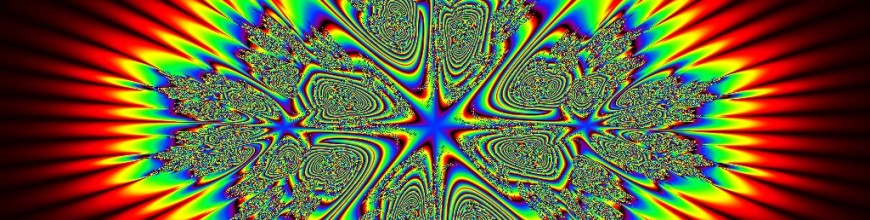
And this seems to be borne out by personal observations. 1P LSD is currently legal in the UK (although probably for only a few more weeks), and having taken one blotter recently in auspicious circumstances I waited to see if my theory might bear fruit. Looking carefully at a painting, I saw the colours appear and disappear clearly, fading in and out of my awareness. Greens, reds, blues, and the mixtures of these, became visible in turns, creating a shifting texture of shape as different elements of the composition revealed themselves in turn.
The painting was a modern one, depicting a hand and forearm. As the colours ‘moved’, the arm came alive. Later, I stood on the doorstep of the house and watched the trees in the front garden shift and sway from the inner breeze originating from my eyeballs’ pigments changing shape.
The experience was profound. Aware intellectually of what was happening at a basic level of my own biochemistry, added to the wonder I felt at the sight, just as the knowledge that the stars are gigantic balls of gas lights years away adds to the magic of the immediate view of them as twinkling pin pricks of light.
There are likely to be analogous effects on other sensory inputs; sound, bodily sensations such as temperature, kinaesthetic awareness, proprioception, taste and smell. So psychedelics, named after the apparent mind-manifesting effects, may actually reveal instead a lack of ‘mind’ as we currently understand this terminology. The reducing valve theory of Huxley has already gained acceptance with regard to integration of brain centres. This visual phenomenon of visible colour waves could provide an easily accessible concrete example of its application. Psychedelics may well reveal the building blocks of our raw state of perception. This could explain that sense of familiarity many people have commented on, the coming home. For really, we ALWAYS see the world this way with our sensory apparatus, the non-psychedelic reality being constructed post-here&now by constant activity within our filtering brain.
Thus, I suggest that the iconography of ‘higher’ levels of consciousness, of the ideal realms beyond our mundane reality, is unhelpful. Rather, we could use linguistic approaches emphasising the physical ground of our existence as those worthy of most awe, exposure to direct lived embodied awareness as the basis of our spiritual awakenings. Shifting our attention downwards, to the felt foundation, could resolve the vertiginous sickness of the last two millennia spent trying to find the Real in the cosmic distance. The ‘other dimensions’ beloved of so many entheogenic gurus may turn out to be the real world, whilst our normal awareness describes for us a practically useful fiction, a steady state narrative within which we see and move.
Ego dissolution, changes to the serotonin system and other physiological effects of classic psychedelic drugs are under investigation. As further results are published, I anticipate greater insights into how our Newtonian mechanistic body, and our idealist Platonic mind, could swirl together beyond divisive labels of classification; this has profound implications for spiritual thinking, panpsychism, and the imminence of the divine. By directly experiencing the bodymind as One Thing, seeing with full cognitive and intellectual awareness even one aspect of how our marvellous complex neural processing creates useful simpler narrative consistency, we may come closer to a unification of this apparent duality into a tangible philosophy.
Previous attempts at describing the numinous have placed it somewhere other, often above us, in higher otherworldly spaces accessible only to those who can climb above others. Top-down hierarchies have given us dry channels to literally non-existent heavens, whilst a model of underground networking provides far more resilience, sustainability, and dare I say it, a better legacy. I posit that instead of shouting our prayers to the stars, we ought to listen to the ground when seeking deeper wisdom. Conceptualise our ‘altered states of consciousness’ as the apocalyptic, revealed, awesome foundation of our beliefs, as the bedrock, the floor of our magick. Sky-dwelling supernatural beings have had their day, and as they fall, the earthly body answers our entreaties. Rise!
Dionysus, god of ecstatic visionary states, Plato’s inspiration, has held the key to this doorway of perception for thousands of years. As the source of philosophical musings, in vino veritas, he seems a fitting deity to honour in naming this observation of mine, regarding the revelation of what is actually seen in these states:- The opening of Dionysus’ Doorway to a truly visionary way of perception.
NW
 The Blog of Baphomet