Wow, what an amazing endeavour! I’ve been vaguely aware of this project since its inception nigh on four years ago at Arcanorium College, but only really as a bystander. I must admit I was slightly sceptical about the whole idea, as it looked to me like a bit of a mish-mash of pantheons and concepts. What I should have remembered though was the parable about the Kingdom of the blind, where awareness of a small part of an elephant does not permit each person to see the whole animal.
Now I do see the elephant, and oh my goodness, what a sight.
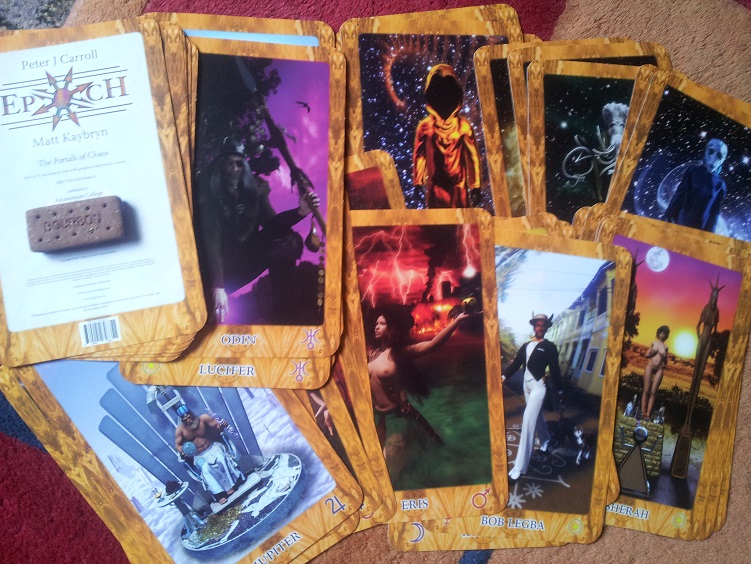
(Bourbon biscuit included for purposes of scale)
The first thing that strikes you upon opening the parcel is the high quality finish of the whole package; the book cover design and the artistic stylings within are superb. Good quality paper, sumptuous hardback covers, clear printing throughout. The overall look of the pages is spacious, encouraging the reader to turn the pages at a relaxed pace. The illustrations (I believe ‘lavish’ is the approved word) are varied and often stunning, and the large (9″ x 5 & 3/4″) cards display amazing details. This is a book to savour and enjoy.
As for the text of the book, Pete has really come up with the goods here, three grimoires contained within the covers; with additional chapters on tarot history, the development of deities over time, cosmology and aliens, and a little quantum non-locality (well he had to get a bit of physics in somehow).
The grimoire chapters deal in turn with Elements, the Gods, and the third is billed as ‘an update’ to the Necronomicon. Each gives clear descriptions, and ways to approach working with, these entities. The third grimoire, which describes the Elder Gods, is advised “for use by highly experienced magicians only”.
A note on terminology: The Esotericon (the book) and Portals of Chaos (the 54 cards) together form The Epoch (Esotericon and Portals Of CHaos).
This project has developed over the last three or four years both at Arcanorium College, and in correspondence and conversations between the creators and others. Whilst I have been on the fringes of the creation process, it was only upon reading the finished article that I appreciated the epic scope and importance of this project, which is nothing less than a renovation of the Tree of Life, with attendant notes on deities and plenty of magickal advice.
The Chaobala which emerges looks at once familiar and a tad heretical.

Hold infinity in the palm of your hand…
The Esotericon builds the details of this new map from the ground up, from Earth to Azathoth. Starting with sizeable, in-depth introductory chapters on aeonics and cartomancy, all life is here.
The project of The Epoch is to present a new synthesis of magickal thinking and practice, a paradigm incorporating deities and concepts old, recent, and a touch of new/fusion gods (Bob-Legba looks like a handy god to have on one’s side!). Pantheons from several global religions are drawn on, which will appeal to the 21st century Chaos Mage. Much of the book has a slight tongue in cheek attitude, presented straight faced yet with a twinkle in the eye of the author and artist. However, this does not detract from the solid core of research and experiential knowledge brought to bear. I really liked the personal style of the writing, this is Pete at his best, playing with serious fire.
The first grimoire of the Esotericon talks of matters elemental, and to my mind proves the least satisfactory chapter of the book. I expect to find more in this on further readings, but compared to the other sections it lacks a certain something… perhaps it simply describes simple concepts, and thus has a flatter feel to it? Tatvas are after all the hardest of objects to visualise due to their simplicity.
Baphomet stands as the link between the Elements and the Planetary gods. To my mind, the depiction of this deity has issues; the mountain of skulls looks odd, although sHe has got definite presence. In retrospect I could have contributed more feedback to the development of this picture. Mind you, my antipathy could arise as this deity is the one most precious to me, and with a strong identity to my sensibilities, so any representation is unlikely to satisfy my own image of Hir…
The second part of the book provides a theoretical explanation of why the process of synthesis begun by Mathers and promoted by Crowley needs bringing up to date. It deals with the history of gods and the associated paradigm shifts, give a concise overview of the general subject, and explains the way the deities in the Portals have been chosen. Eight planetary deities and 28 bi-planetary deities (eg Mercurial+Venusian; Pandora) are described in the following grimoire, a kind of field guide to the gods/goddesses, with identifying features and suggestions for what areas of human endeavour each suits best.
This forms the main core of the Esotericon; 36 deities are described and illustrated, based on the eight planets (seven classical ones plus Ouranos) and the various combination pairings thereof. Most are familiar (e.g. Thor, Hera, Jehovah), whilst others are less so (Asherah, Ma’at, Vulcan) and some newly coined (Apophenia, Paradoelia, Choronzon). I only found myself making faces at a few of the depictions; Dionysus looks rather feeble and doll-like, while Lucifer doesn’t quite come to life. Mind you, even the Book of Thoth tarot has a couple of duds in, so this is really nit picking of me… The vast majority of the illustrations are amazing. My favourites (atm!) Thoth, Apophenia, and Baron Samedi. The detail and resolution of the computer art is astounding, and in the vast majority of cases brings a wonderful quality of truly magickal life to the figures and their surrounds. A hyperreal quality pervades these, and the cards really do look like portals into Other Realms.
Just as Baphomet links the realm of elements to gods, between the planetary gods and the Elder gods we encounter Nyarlathotep acting as bouncer to the starry outer space alien cosmological deities.
The text of the Necronomicon grimoire is strange and has a quality of writhing whilst trying to make sense of the odd letter shapes, most fitting for such a powerful paradigm. Spooky to the max, Mr Carroll goes fully occult here, with warnings to the magician to acquire knowledge of banishings and considerable magickal experience before embarking upon this section, and apposite vocabulary (wands are anointed with unguents, races fall from stoical despair beyond reason to existential emptiness, and multitudinous probability waves of the aethers cavort in riotous splendour). I love the cartoon/graphic novel style renditions of the magician as various Elder Gods, hooded robes with very peculiar shapes emerging from the orifices of said garment!
Detailed instructions to both evoke and invoke 6 of the Elder Gods are provided, for those brave or foolhardy enough to try. I enjoyed the nod to RPGs, with the reference to the value of Sanity Points when working with this grimoire.
The Portals of Chaos, the cards which are an intrinsic component of the package, are beautiful. Measuring 9 x 5 ¾ inches, they are made from quite thin card (so they are a bit bendy) which have however been treated to feel like playing cards, to give them a surprisingly robust feel. Having handled them and had a bit of a play with them, I expect them to stand up to a reasonable amount of careful handling (although I would love to have the ability to purchase a spare set in the future). Given the low cost of the Epoch these come simply protected by cellophane, so you may want to make yourself a nice box of some sort to house them.
The images are incredible, each must have taken many days of work building up the digital paintings, and I would love to see some of them available in larger poster size as I get the feeling there is even more background detail which cannot be seen easily at this scale. Many of them would work well as meditation or devotional pieces. While the style may not appeal to all, with some figures having a look of manikins, this has grown on me over time and reminds me of those clay figurines from early human history, and allows for a conscious appreciation of the images as representations of Archetypes, as most decidedly non-humans. Having said that, many are so realistic that it is hard to believe they are painted, not taken from photographs. Odin looks straight at you from his Portal, and Juno looks so real I want to ask her round for a cup of tea and a heart to heart chat. (Only four of the figures are based on photographs of people, and I must declare my own interest here as I am honoured to appear in the guise of Ma’at). There is a fair amount of nudity, and bare chests are standard, so The Epoch probably falls into the category NSFW…
The Esotericon gives guidance on how to work with these cards. Evocation and invocation are advised, prior to any potential divination work (a procedure which presents practical issues due to the intentionally large size of them). These altar cards are intended to prompt you to work with the elements/deities, to increase the scope of your personal pantheon, in preference to asking for a mapped out future. As such they are cards for magicians, not fortune tellers.
All in all I heartily commend this book and cards to both the prospective and experienced magician. While a few niggles exist to it not attaining perfection, the enormous scope of the theory expounded within, coupled with the extraordinary pictures (which are better than anything of this ilk since Freida got down with her paintbrushes), provoke many thoughts as well as providing a neat summary of some complex ideas. Simultaneously a history and a prediction, it casts a spell covering spacetime and beyond, allowing your magick to have results.
Sometimes, a book arrives which might inform and entertain, or it may evoke feelings of admiration and awe at the crafts involved in the process of its production, or it could challenge you to revise your underlying concept of the universe’s structure. This book does all of those things. I could mention a couple of spelling errors, or quibble about a few disagreements I might have regarding particular deities’ mythologies, but given the strong personal authorial tone that would be churlish of me. This is a genuine Magician’s grimoire (or three), and I commend it to you heartily.
NW
The Epoch is available online direct from Arcanorium College’s shop, or you might find it in your local occult bookstore. For those in the US, Weiser Antiquarian Books will be stocking it. This is a deliberate ethical decision on the part of the production team, wanting to avoid the monster that is Amazon and suchlike.

 The Blog of Baphomet