For a while, before the office opens, I’m sitting in a hollow on the cliffs, overlooking the sea. I plan to meditate and sing and do some yoga for an hour or so. This will ensure that I’ll be in the right frame of mind for work. Below me is Boscastle harbour. I am sitting on the eastern side of that long inlet, a snaking chasm of rock, half barred by two gently curving sea walls (built in the 16th century). Behind this there are a few boats, some sand and seaweed. On the seaward side there are great cliffs. In undercut hollows, carved by the restless waves, blow-holes form, squirting jets of spray back over the rising tide. This is a deeply magical place, for me and many others. Boscastle is the beautiful, sometimes dangerous confluence of the River Valency and River Jordan. It is one of those deep wooded valleys (‘coombes’ we calls ’em in Devon) that are typical of the north Atlantic coastline. It is also the setting for the Museum of Witchcraft & Magic, where for one week in June I was the ‘Magician in Residence‘.

Beautiful Boscastle
The Museum of Witchcraft & Magic (MWM) is a collection that is locally adored and internationally recognized. If you’re not already familiar with the amazing range of things they do (from supporting international academic research, to commissioning new artworks) then please take some time to look around their online presence.

Lurid old skool Baphomet
I’d been aware of the Museum for many years (if nothing else through those brilliantly lurid photos of Baphomet in occult coffee table books of the 1970s). But it wasn’t until fifteen or so years ago I went there for the first time. These days I’m closely involved with the Museum, including as Chair of The Friends of the Boscastle Museum of Witchcraft, a registered charity that supports the museum, in particular with its mission to educate and engage people. One aspect of engagement is to encouraging people to visit spaces like MWM. Visiting museums, especially places of the quality of MWM, can be a powerful, authentic, moving experience. Sure you can see many items from the MWM collection using their online database. However the physical experience of walking down the path, towards the wild Cornish sea, turning right and there, nestled against the rock, is the Museum of Witchcraft & Magic – that embodied experience takes some beating!
MWM’s work includes supporting the increasing appreciation, in academia and wider culture, of the influence of occultism (as I mentioned here). They’ve recently loaned objects to some internationally important shows, such as Victoria and Albert Museum’s exhibition, You Say You Want a Revolution. There are the many ways in which the MWM collection is relevant to wider culture. One of my own interests in this field is in the social phenomena of witch hunting as a form of scapegoating. The way in which communities, of many different sorts, go about hunting and killing ‘witches’ says something very important to all of us. In order to understand, mitigate and perhaps transform our scapegoating behaviour, we have to understand how it happens. Collections such as that at MWM can directly help us do this by bringing us up close and personal with objects that are the anchors for stories of prejudice, misunderstanding and punishment. (You can see some examples of the educational resources I helped to create, enabling young people to explore these issues on the MWM website. If you’re a teacher, especially of teenagers, you may like to check these out).
Inside MWM there are many wonderful things; the material traces of many expression of occulture. The galleries themselves are a cunning interplay of dark and secret with bold and well-lit spaces. The standard of presentation is second to none (and I’ve worked in many museums over the past 15 years). This excellent curation isn’t surprising given that museum director Simon Costin is something of a creative genius.
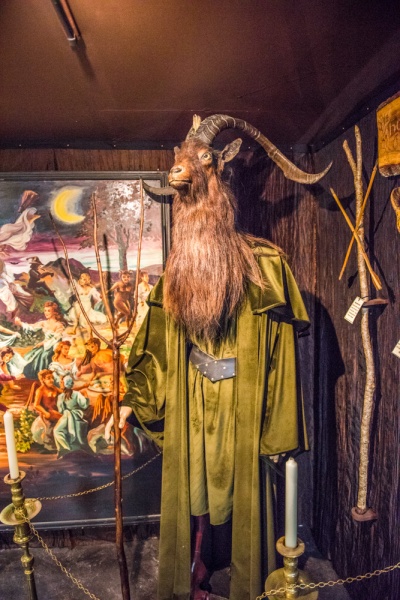
Tasteful modern Baphomet
(Talking of Baphomets, it was also during this week that I helped transport a rather famous Baphomet mask from London to its new home at the Museum. But more of that later…)
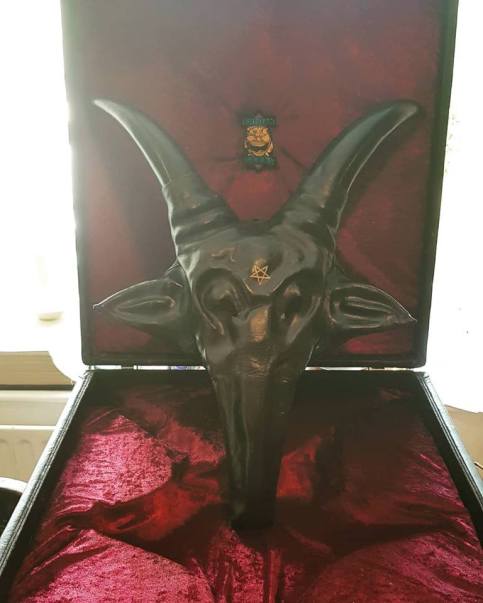
Baphomet, last seen in public on The Fourth Plinth in Trafalgar Square
For my week in residency I got to hang out in the library. This is, as you might imagine, another wonderful space. There are wooden desks, a gigantic witches ball in the window to repel the evil eye, and many, many books. I set up my office here; runes, two decks of tarot cards, crystal ball, special magic A4 white paper for sigils, sage smudge, some magical pointy things from the Himalayas – and we are good to go!

In residence
I’d imagined that I could spend much of the week writing and maybe doing a spot of research. In addition to an amazing range of books in the MWM library it houses hundreds of files containing everything from facsimile editions of Gerald Gardner’s original Book of Shadows, through to collections of obscure short-run occult ‘zines from the 1980s. However my research plan was not to be. Rather than reading the books I spent most of my time that week doing tarot readings for visitors.
This was both enjoyable and an honour. People often open up in a divination session and place their trust, to some degree, in the diviner. I encourage this, as an important benefit of having a reading is the confidential, candid, even confessional opportunity that this setting provides.
When people come to me for a reading I explain that I can’t divine the future with any great certainty. I usually joke that were this one of my special powers I’d divine six numbers, win the lottery and spend all my time on holiday. (Actually the problem with this analogy is I do generally to get to spend my time doing what I love, but anyhow…). Instead I explain that my role is primarily to work with clients to explore how things are for them, and to look at what possible futures and courses of action might emerge from their present circumstances. This makes the whole process about discovery; the reading becomes a space for mutual investigation and reflection. The querent is not the passive recipient of advice, but an active agent in their own narrative. For while there may be some circumstances where our options are limited. we do usually possess some degree of freedom; this realization is often a key outcome. Cultivating this awareness of freedom, in a realistic way, and exploring the options for change, are for me what tarot readings are all about.
Now I won’t lie, even within this broadly psychological paradigm of divination things with a distinctly parapsychological flavor do happen. For example, my usual practice is ask the querent to draw three cards. On the basis of these I begin a story, then together we explore how this might relate to their situation. Sometimes, especially when I’m on a roll and have been doing lots of readings over a short period of time, I say things in this opening section that the client responds to with surprise. ‘How could you have known that?’ they say. Then there are moments, perhaps halfway through reading (sometimes accompanied by a sense of having something speak through me, or some sense of ‘absence’) where a rush of words comes out. Again the querent may be impressed; I’ve perhaps articulated the problem we’ve been discussing in a radically new way that helps them see a totally new picture, or perhaps I’ve revealed how one character may be acting and what can be done to make things better. These intuitive insights may be surprising, including to me. But however spot on my words are I always bracket what I say. I explain that one reason we call this stuff ‘magic’ is because none of us (perhaps least of all magicians) really known how any of it works. I acknowledge that this is how things may appear in this moment, in this reading, but that the future is uncertain and new information and possibilities may well arise. I may be ‘inspired’ but I’m also quite clear that my impressions may be wrong or incomplete in any number of ways. Sure listen to the oracle, but take it all with a pinch of salt.
I’m pleased to say that I got really nice feedback from some of the folk I read for during my residency and I’m glad they found the sessions useful. For me whether a reading is heavy on the psychological exploration, or has significant parapsychological moments, isn’t what matters. What is important is that the consultation provides an opportunity to empower the querent; allowing them to find their own way in the world. This is the magic of it.
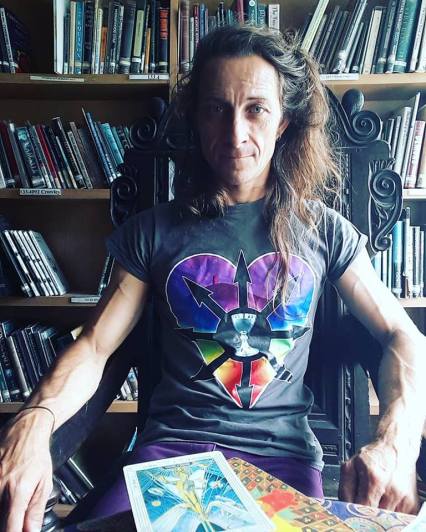
In the magicians chair
An additional delight of this week was to be able to spend time with many of the members of my extended family, enjoying this magical landscape and each other’s company. (Which is why each morning on those rocks I gave thanks to the Great Spirit – whom I call Baphomet – for those lovely people and the magic in my life.)
I’ve recorded a few thoughts towards the end of my residency about the role of the proverbial village witch on my Youtube channel too.
Many thanks to the wonderful people at the Museum for welcoming and supporting me during that week, and to all those people who came to see me over those days; may the royal road rise to meet you!
Blessed Be
Julian Vayne
PS Our next Deep Magic Retreat at St Nectan’s Glen will take place from 27th September-1st October 2018 For more details please visit our Facebook page.
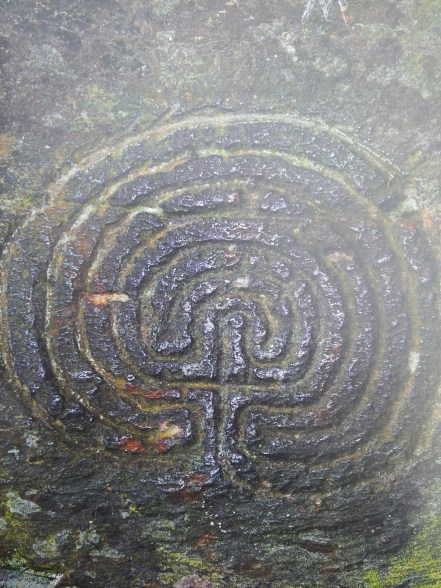
Labyrinth at Rocky Valley, where the river that runs through St.Nectan’s Glen meets the sea.


 The Blog of Baphomet