
In my own explorations of Gnosis, one of my friends whose work I have found consistently inspiring has been Dr. Lloyd Keane. What follows is an interview that Lloyd graciously agreed to with regards his own initiatory work:
- Could you tell us a little about your own magical background? (How you got into it.)
I hate this question. Answering it brings up some pretty embarrassing moments and yet those moments lead me to where I am now so it can’t be all bad. Still…ugh.
My magical background began with three books: The Black Arts by Cavendish, Modern Magic by Kraig, and Wicca: A Guide for the Solitary Practitioner by Cunningham. At that early time I was also a member of A.M.O.R.C. So basically I was a very sincere and dedicated White Lighter. Theological thrillers such as The Omen, The Exorcist, and The Prince of Darkness inspired me too. And of course Star Wars was a huge influence! I would have to say it was the notion of forbidden and really super real knowledge symbolized (and commodified) by all the books in the local occult shop at the time that really dragged me in. My journals from that time are remarkably naive and yet utterly sincere. I have been practicing some form of “magical” tradition since roughly 1987-88.
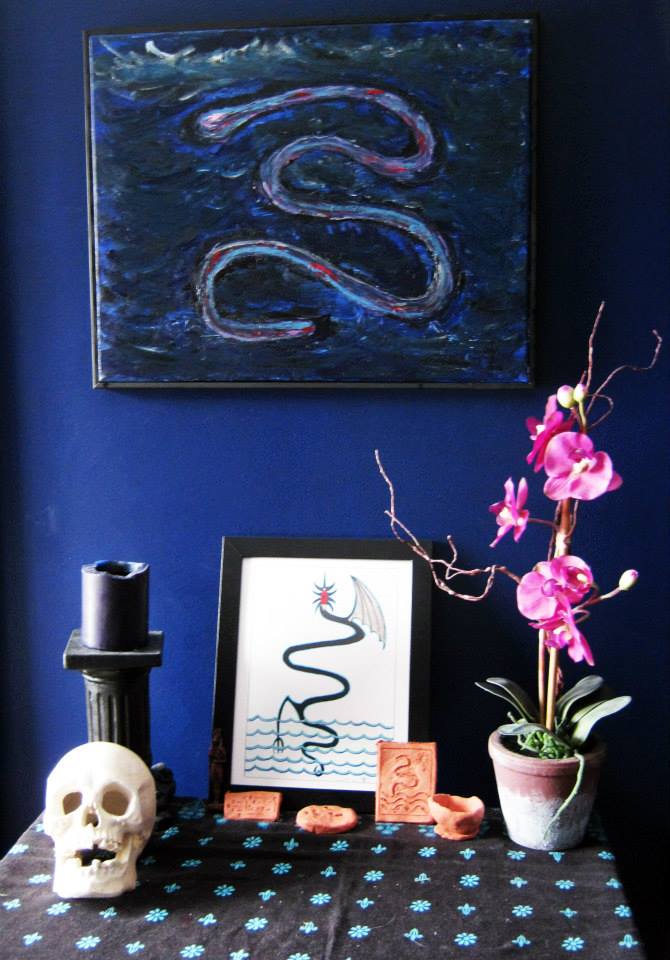
Mixed mediums
- You’ve worked in a few different traditions, could you tell us about those and your current affiliations?
Well as my answer to your first question clearly indicates I was setting myself up for all manner of problems. In a strange way Wicca provided me with an emotional outlet for my ceremonial/ritual magic, and the ceremonial/ritual magic provided me with intellectual curiosities like Kabbala and alchemy. Really they both reflected my yearning for Mystery. Later I developed a deep love for Crowley’s writings and Thelema (or rather my mystical non-threatening, non-orgy, non-recreational drug version of Thelema), as well as a connection to Irish pagan revival and Asatru (or rather my mystical non-believing, non-kindred, giant loving version of Asatru). Again, Crowley’s Nuit as well as Odin and the Etins all reflected Mystery and vastness. Off the top of my head I’ve been a member of A.M.O.R.C., two online Golden Dawn groups, B.O.T.A., an associate member of the OTO, a Probationer in a lineage of the A∴A∴, the Troth, and the Rune Gild. I also worked closely with a friend and mentor in Wicca for at least ten years. In some ways this reflects a haphazard approach to Initiation and in another way it demonstrates my systematic search for something that I could not find from any of these organizations and traditions.
One day something snapped in me. Something had changed. I was going to leave an offering to Thor (Odin was far too spooky) and I thought to myself, “This is it? This is what I’ll be doing when I’m 80!?”. I was in an existential crisis and two websites grabbed me by the throat: the Church of Satan and the Temple of Set. I loved the ridiculously and seriously playful aesthetic of the Church of Satan. It was so different from anything else I experienced up to that point. However, the Temple of Set website was, at the time, this strange blue colour. It had an inverse pentagram (or a properly proportioned pentagon… however you want to see it), and the monolith from 2001. Top that off with a quote from Plato and I was utterly confused and fascinated. There was something deep in that imagery.
After much hesitation (and rewriting my application) I applied to join the Temple of Set and I’ve been a member since then. I’m currently a Priest of Set, a Master in the Esoteric Order of Beelzebub, and a member of the Order of Tiamat.
- Much of your current practice makes use of visual art and music, can you describe some of these explorations and why you find these methods so helpful?
That’s a really good question. I’ve always been a doodler and I’ve always played around with artistic creation; however my work in the Temple of Set helped my focus my understanding and use of art as an Initiatory tool and form of expression. One of the things that makes the human animal unique (as far as we can tell) is the drive to create. We create things that have no overt, ontological, purpose. This drive to create is stimulated by what we could call the Black Flame. Taking that metaphor, this substance, this flame of isolate intelligence, can (and I would say should) be applied to creating Initiatory works of art (of whatever form or format). I also strive to inspire others to connect with and work with that Flame. I may not be technically advanced in my art but I often communicate and transmit my meaning very well. It can become entertainingly annoying when highly talented artists email me to say that something I created inspired them to begin creating again. Great. So glad I could be of service now go create something that I could never create in a million years. At least that inspires me to keep going. My music is the same thing. I must create. I go squirrely if I’m not drawing or manipulating images, or playing music. Often creating things helps me work through ideas or issues I’m dealing with as part of Initiation (for me Initiation and living one’s life are synonyms). I am able to understand or approach Initiatory issues from various angles by creating something concrete from the stirrings of subjective inspiration.

Dark, deep doodling…
- Many of your explorations touch on themes around depth, vastness and awe, can you tell us why such themes are important in your own initiatory work?
I think all those aspects are part of Mystery or Runa. At least on one level I think that it’s part of it. Mystery has been with me from a very early time. However, often my experience of Mystery was filtered through other people’s interpretations. I was told Mystery was a God(s)dess(es), Angel, HGA, ancestors…everything except what resonated with me. Depth, vastness, and awe are core facets of the experience of the numinous and that experience of the numinous is another way of describing the experience of Mystery (keeping in mind that there are varying degrees of the experience of the numinous). Another important facet of such themes is that they help to act as a cosmic eliminator of occultnik douchebaggery. I get so tired of people saying how they are living gods (or demons or angels) or how their HGA is uber divine, or that they are an incarnation of Crowley. Just sit still for a moment. Contemplate how vast our solar system is. Then think of how utter miniscule it is from the perspective of the nearest supermassive black hole. Really in the grand scheme of things we are pretty insignificant. I have found that encouraging that sense of awe and dread is a good way to reset my own hubris. Not that I have such problems. Obviously I’m beyond such pettiness.
- How do these ideas connect to your work within the Esoteric Order of Beelzebub?
Actually it’s interesting, I find that my work within the Esoteric Order of Beelzebub (EOB) and within the Order of Tiamat both reflect the ideas of vastness and awe in different ways. For me EOB is about exploring the Black Flame. It is about engaging with substance, energy, and purposefulness, and it is about cultivating independence, inspiration, and invention. In this case the deepness and awe comes from experiencing ourselves, who we really are when we are free from what other people have told us we are and are not. EOB uses the term “Cosmonaut” to refer to its members. This is a playful title but it is also very poignant. We are explorers. We want to wander out into the vast expanse of our being and see what we can discover and we bring that knowledge back to share with our fellow explorers. Well at least that’s this Cosmonaut’s perspective!
The Order of Tiamat approaches deepness and awe through dread. In this case we can see Tiamat, mother of the eleven monsters, mother of the Abyss, as something so utterly beyond comprehension as to lead to existential dread. Lovecraft very much captured this idea of dread. The Mesopotamians had a word of it: Melammu. This is the sense of the numinous that their gods were said to exude. By working with this sense of awe we can come to integrate it into our own Being.
The exploration of vastness and the full awareness of our place in the cosmos alternates throughout my art and my approach to Initiation.
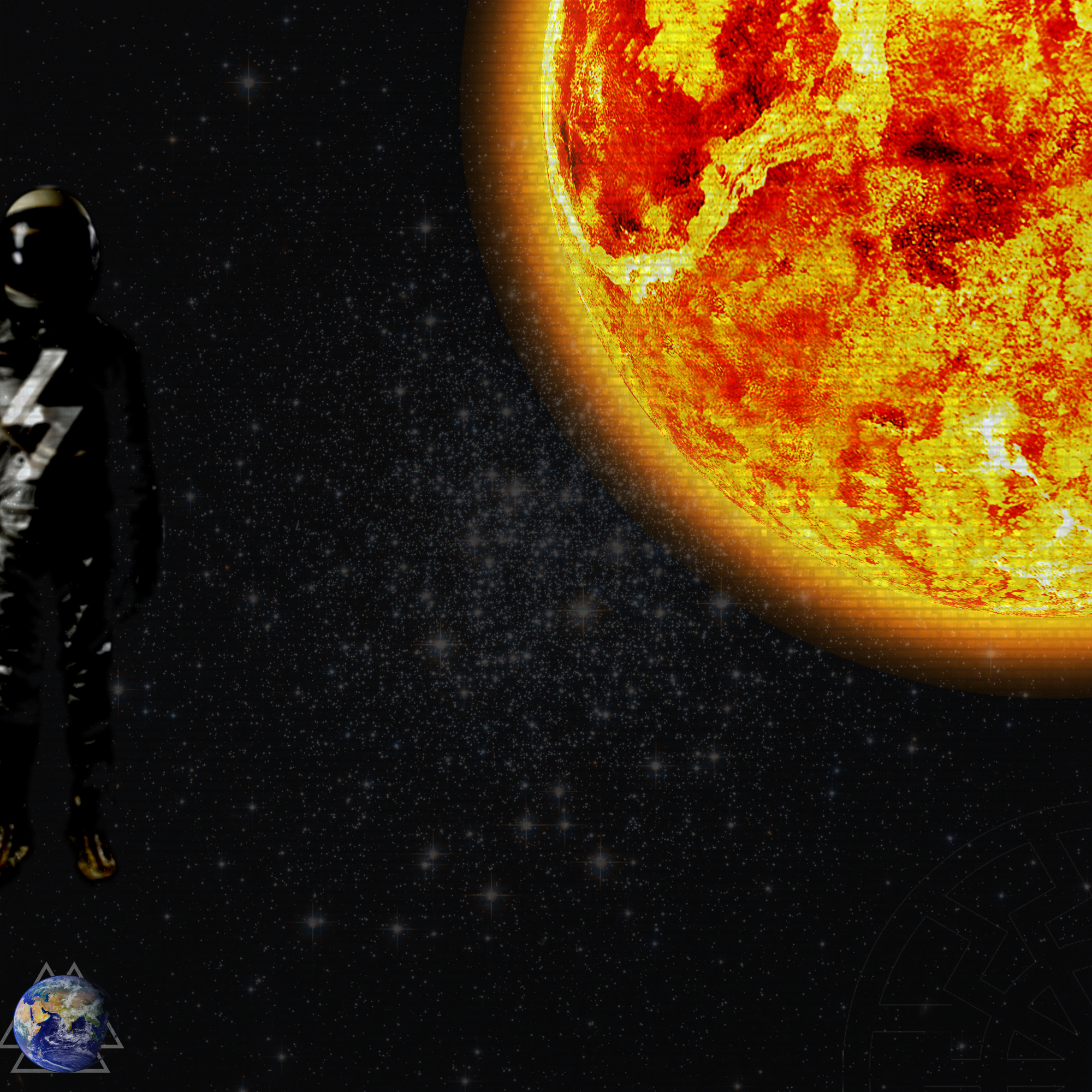
Sowilo
- Many people view the god Set as having strong stellar/cosmic connections, can I ask how such links are important in your own magical work?
This is a difficult question. I don’t work much with how the ancient Egyptians apprehended Set. There is a great deal of evidence linking Set with stars and stellar traditions. I guess I approach this aesthetically or metaphorically. The stellar roots of Setian thought are distinct from say Thelema or witchcraft or Wicca, for example. With Thelemic religion we have the solar phallic, in your face, Ra-Hoor. In Wicca, at least a good number of traditions within Wicca, there is an emphasis on the moon, the Earth Mother, the Goddess. Set has warlike aspects of a solar god but Set is far more alien and unnatural. Again metaphorically speaking, Set is not bound to an earth or lunar perspective. Set is not bound to a solar perspective. Set dwells behind the Constellation of the Thigh (Big Dipper). Set’s playground is the deep vastness of space. I often think of this wonderful quote from The Stars my Destination (by Alfred Bester):
“Gully Foyle is my name
And Terra is my nation.
Deep space is my dwelling place,
The stars my destination.”
To me this quote summarises my work as a Cosmonaut and as a Setian.
- What direction do you see your initiatory work heading in the future?
Another great question. Thank you.
I’m actively working to refine and articulate my own approach to Setian Initiation. This is a difficult, though necessary, task and it is just beginning. This process will have a major impact on my art and my understanding of awe, deepness, and Mystery. What that will look like in the end I can’t say for sure. For now it is in the Yet to Be and when I get there I will let you know! (For more information about Lloyds work click here.)
(Questions asked by SD).

 The Blog of Baphomet