
Queer: A Graphic History reviewed

Queer: A Graphic History by Meg-John Barker and Julia Scheele Icon Books 2016

I’m sure that like many a humanities undergraduate out there, I have had my academic bacon saved more than once by the Icon series on contemporary thought. Their pithy illustrated guides on topics and figures as wide ranging as Wagner, Jesus and Lacan, often provided an accessible doorway into some otherwise tricky territory. Histories were condensed and made vivid, and previously mind-bending theories were made moderately less so.

queer1

It was perhaps not surprising then that when I caught wind that one of my favourite authors Meg-John Barker was co-authoring an Icon book on Queer theory with illustrator and zine-smith Julia Scheele, I was more than a tad excited. I have already penned some reviews of Meg-John’s recent books on Relationships and contemporary mindfulness practice:

http://enfolding.org/book-review-rewriting-the-rules-an-integrative-guide-to-love-sex-and-relationships/

http://enfolding.org/book-review-mindful-counselling-and-psychotherapy/

and I find their level of both openness and insight deeply helpful and inspiring.

Writing about Queer theory was never going to be a simple task! Not only does it touch upon some highly complex philosophical ideas and movements, it’s very existence as a concept is reliant upon fluidity and a desire to defy concrete definition. (I recently wrote something about these ideas here, looking at the way in which Queer theory might inform magical practice, and there are considerable overlaps in relation to the subtlety, fuzziness and process dependent sensitivity that both seem to thrive on.)

In the course of the book the authors deftly distill some of the primary concepts of Queer theory as follows:

“Resisting the categorization of people
Challenging the idea of essential identities
Questioning binaries like gay/straight, male/female
Demonstrating how things are contextual, based on geography, history, culture etc.
Examining the power relations underlying certain understandings, categories, identities, etc.”

Meg-John and Julia then spend time exploring what the implications of such ideas might be for topics as diverse as identity politics, contemporary sexology and the shape that relationships and concepts of family might take.
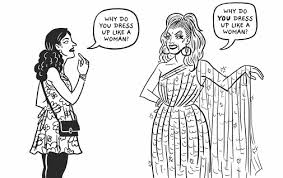
queer2

I’d imagine that writing a book like this might be a bit of a challenge: “How do I make it pacey enough to be engaging and yet detailed enough to capture the complexity of what we are trying to describe?” Frankly I think that the authors have done a great job. Partly this is due to it being a big comic book that Julia has done a great job in illuminating.  Visually Queer is great to look at capturing great portraits, humour, sensuality and struggle.

Conceptually it touches on historical forebears (such as the existentialists) and engages heroically with much of the complex postmodern philosophy that has birthed much of the Queer revolution. The sections dealing with the ideas of Michel Foucault and Judith Butler are especially vivid and helpful, primarily as I have tended to find their work pretty heavy going.

Given that Queer theory seeks to explore the reality of what we do rather than being fixated on fixed identities, it is of little surprise that the authors spend much of this work exploring the ways in which Queer theory has shaped activism on both the societal and personal stages.  Meg-John especially is noted for their excellence in taking complex ideas and challenging us to think about what this means now: how will this promote compassion and a willingness to hear the subtlety of our unique stories?

One of the things that I love about this book is the way in which Meg-John keeps popping up as an illustrated character within the text. Engagement with Queer theory and activism is something that they are deeply involved in, and their presence in the text, dialoguing with us, seems to embody something of the open process that the authors are inviting us to.

Curious readers might wonder why I was so keen to review this book on a blog about Magic.  Apart from wanting to bump up a friend’s book sales, Queer identity is not only vital to me on a personal level, but it also profoundly shapes the way that us Baphomet folks practise our chosen spiritual path. As creative ritual explorers, our magical practice is highly relational (we enjoy working with others), context dependent and focused more on process than some imagined endgame. In short, ours is a profoundly Queer Magic and dynamic works like Queer provide great fuel for this journey.

SD

Smells like Queer Spirit

Being the parent of two teenage humans can often prove to be quite thought provoking in terms of trying to articulate what I actually “believe” in terms of my own metaphysics. My eldest helpful summarised my spiritual path as being “some sort of weird druid, meditation thing”. Credit where credit is due, that’s probably not far off!

While I have had some past attempts at spiritual brand loyalty, they have often ended in consumer dissatisfaction. My path has always been a blurry one, a fuzzy inexact ramble along a path that is much more about exploration and the privilege of travelling with some rather excellent companions. I can understand why others like certainty, and given the current scary state of the UK, I can appreciate why such apparently vague, postmodern and Queer perspectives don’t appear to be muscular enough to confront our current difficulties. But hey! It’s not my fault, I blame Magic.

Queerness and Magic are a bit of a chicken and egg thing. It’s hard to know whether Magic’s strange ways are innately attractive to the fey, liminal shape-shifters within a culture or whether it makes the curious even Queerer; as a lover of strange loops and circularities I’ll take both ☺

rainbow loop

Queer loop

To engage with Magic is to engage with the whole of life. It is art and it is science, it is both acceptance and change. It is many things, but I’m pretty sure that it demands a heroic pursuit of curiosity and a willingness to question almost everything we thought was true of our lives and selves, as I have said elsewhere:

Whatever else Magic may or may not accomplish it aims to transform our own awareness so that we become more effective. By self-willed mimetic infection, the change that we seek becomes more likely as we sensitize our perception to themes and opportunities.” (Deep Chaos part deux)

To enter the circle or to cast a spell means to lift anchor on what we thought we knew about ourselves. Whatever scripts and stories that we may have inherited about what our lives should look like, are called into question as we are sailing more uncertain seas

Many find the descriptor “Queer” problematic because of its historic associations as a homophobic slur or because it is viewed as attempting to summarize the complex terrain of “non-straight” identity (LGBT+) with a single (albeit complex) word. I certainly don’t wish to imply any form of flat-land homogenization of people’s lives and politics. Language and self-identification are important markers and means for both self-understanding and collective response. Part of why I view my own magic as Queer (as well as being that of a Kinky, Bisexual and gender fluid person), is the way in which Queerness for me embodies the role that we as magicians have as edge-dwellers who question oppressive catergorisation and help pull our cultures forward.

Queer is by definition whatever is at odds with the normal, the legitimate, the dominant. There is nothing in particular to which it necessarily refers. It is an identity without an essence. ‘Queer’ then, demarcates not a positivity but a positionality vis-à-vis the normative.” David Halperin  Saint Foucault: Towards a Gay Hagiography

michel_foucault_by_ivankorsario-d5qvsbt

Queer discourse

While some may  view the conscious deconstruction of category as being overly hip or laboured, for those of us who find liberty within Queer’s punk rock attitude, Queerness challenges us to experience relationship and uncertainty in new ways. Rule books that rely on clear categorisation and the safe assertion that problems are located in “the other” can longer be as true. While the urge for individual emancipation and freedom seem innate to the human project, a Queer awakening might also attend to the complex tendrils of connectivity between self and other. Indeed our liberty may ultimately be within context as much as it about liberation away from it.

Part of my own current context is as a human who lives in the United Kingdom. Recent weeks have been a bewildering and deeply saddening time for many of us who (despite its many imperfections) view remaining in a larger Europe as being an important factor in seeking to reduce ignorance, hatred and less effective communication. Whatever economic arguments that “exit” advocates might have been able to proffer, for me my identity as a magician and Queer limit my ability to embrace the lax, childish worldview that Britain’s current difficulties can be located in those other people over-there.

Whichever framework one employs in trying to understand how Magic works, most magicians seem to rely on concepts of connection, alliance and symbiosis. Over 20 years of frontline social work may well and truly kicked most naivety out of my system, but I still know that my own Magic seems to be maximised when I have the possibility of exploring creativity from a position of flexibility and relative fearlessness. For me it’s hard to reconcile such freedom and connection with a siege mentality that imagines safety behind a balsa-wood drawbridge.

In recent times I have been working with the Goddess Sophia and the way she is made manifest in Gaia. In offering devotional practice to Gaia-Sophia, my coven-mates and I have been seeking to promote greater connectivity and Wisdom. This prayer is still on my lips:

“Praise to the Wise one,

The Connected One,

The Whole one,

The Holy One!

Gaia-Sophia!”

Sublime Strange Attractor-

Illuminate our intuition and give us neither-neither genius!

Help us to spin our webs of connection with silver and gold

Help us to seek Wisdom and apply its insights with kindness.

We give thanks to you and to each other

For this time of nurture and deep listening!”

SD