I was at a museum private view recently when a colleague from a partner organisation told me that she’s been looking me up on-line. ‘I didn’t realise you were a chaos magician,’ she remarked, and then ‘is it quite dark?’
I’m pretty lucky in that I’m out (as a Pagan and occultist) at work and am employed within a sector in which religious or philopshical beliefs (that don’t conflict with our policies about equality of opportunity, anti-racism, an LGBT-postive agenda and so on) shouldn’t be a problem. In fact in an area such as Northern Devon (where over 95% of the population identify as ‘white British’ of which the vast majority describe themselves as ‘Christian’) my own beliefs perhaps add somewhat to creating a more diverse culture.
In my brief explaination of chaos magic (CM) to my colleague I touched on ideas such as fractals and chaos mathematics (self similarity at different scales and the analogous observation that different spiritual traditions exhibit similar techniques of praxis even where their exoteric credo may appear very different). I mentioned the idea of Khaos in the ancient Greek sense of the term; the unknowable void from which arise the many formed manifestations of the universe.
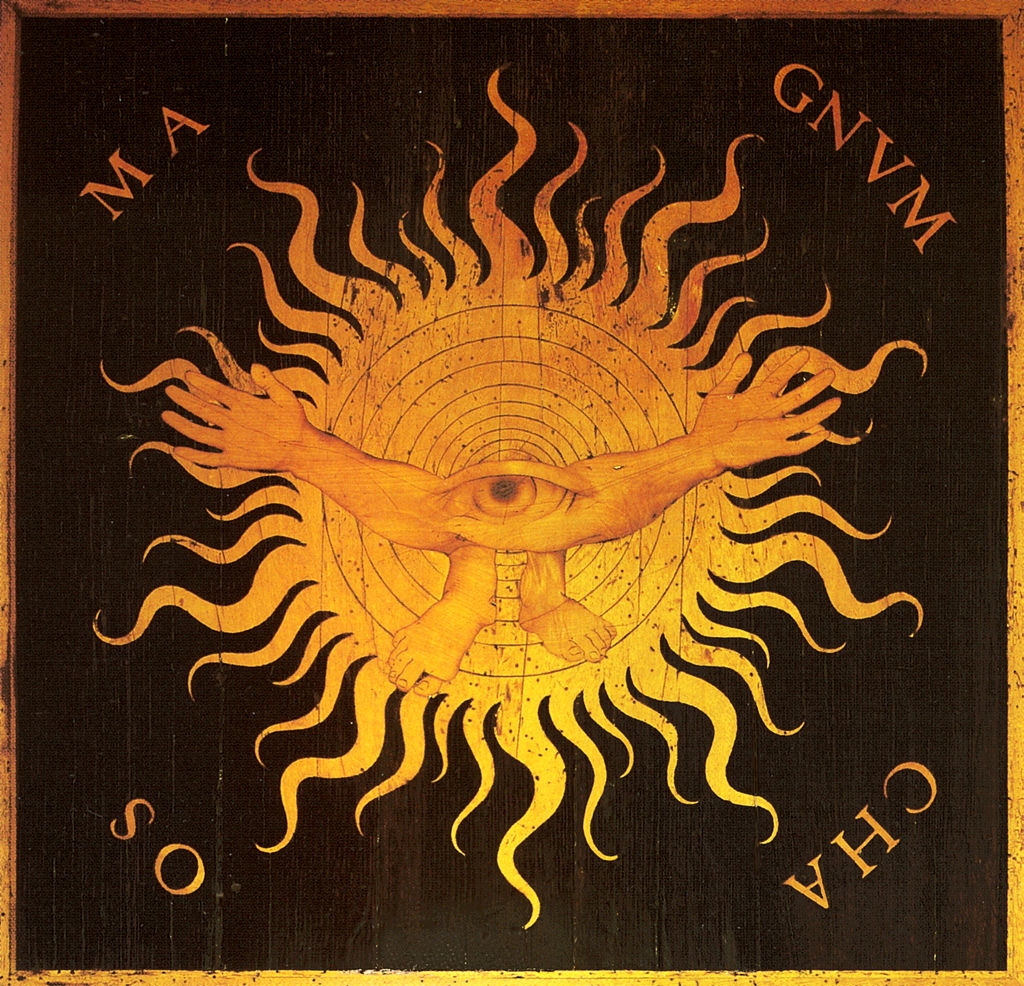
Santa Maria Chaos
CM can also be described in terms of its historical development, a particular approach of style of spiritual endeavour. One that developed from a confluence of late 20th century ideas; ceremonal magic, neo-paganism, Discordianism and more. As a style it was influenced by the punk, do-it-yourself approach; an intensely personal quest to discover magic for ourselves rather than having it filtered through the theology of Thelema or Wicca or whatever.
The use of the term ‘chaos’ does (in its modern sense) suggest, as my colleague had surmised, a certain darkness. But what in practice does this mean? One way of understanding this might be to consider CM as having a particular flavour, a style in the sense that there are styles of clothing, of music or martial arts.
As humans there are different trends that appeal more or less to each of us at certain points in our lives. As a younger man I experimented with dressing in punk, chapish, goth and other styles of clothing (and these days I’ve added museum professional, Freemason and crossdresser to the list). So while chaos magicians (in terms of their practice) might draw on different paradigms or expressions of spirituality (or other methods of esoteric investigation) there is, never the less, a certain style or flavour to something we designate as ‘chaos’ magic.
Of course humans being humans it’s pretty common to find some people (mostly those who are rather new to occultism in my experience) asserting the primacy of their own preferred style ‘CM is just superficial punkery’ or ‘Wicca is just fluffy faggotry’ or ‘Thelema is only for Crowley fan-boys’ etc etc. Yet more experienced practitioners tend to realise that while there are differences in forms of occultism these are outweighed by their similarities. Even apparently über-radical-traditionalist styles of magic (such as the rites described by groups such as the Order of Nine Angles or various forms of Traditional Witchcraft), when one drills down into the guts of the practice, one finds methods for changing consciousness, magic circles, spooky barbarous words and songs etc etc. As they say in the Orient: Same same but different.
Another way of thinking about the relationship between esoteric styles is that of music. Music comes in different genres. It typically consists of sounds (and the absence of sounds) placed into relationships and while it may be challenging to specify exactly what music is we can all recognise the various forms in which it appears (ie what it does).

All those are just labels we know that music is music
As a former graphic designer one of my favourite ways to consider the relationship of different magicultures is as styles of lettering. A chosen font tells us something about the aspirations and sense of self of any given tradition. It also tells us how that tradition (especially in these days of self-publishing) would like to present iteself to the world. Thus the word ‘chaos’ in the example below is a bit alien/futurist/goth – this is a youthful font, wild and certainly ‘dark’. Then we have ‘Druid’; folkish and friendly. ‘Shaman’ is strong, ‘ethnic’, perhaps carved, delighing in the simplicity of only upper case. ‘Thelema’ is classic, authoritative; perfect for a religion with a sacred book and reams of texts catalogued into classes A, B, C etc. ‘Witch’ suggests a wildness (the letters don’t sit evenly on the line), perhaps a slightly retro feel with those serifs, and a human-scale sense that this writing may have been produced by hand.

Many faced magic
Taking this method of analysis a little deeper we can focus our attention on just one sector of occulture and see how fonts reflect the various flavours which that style contains.
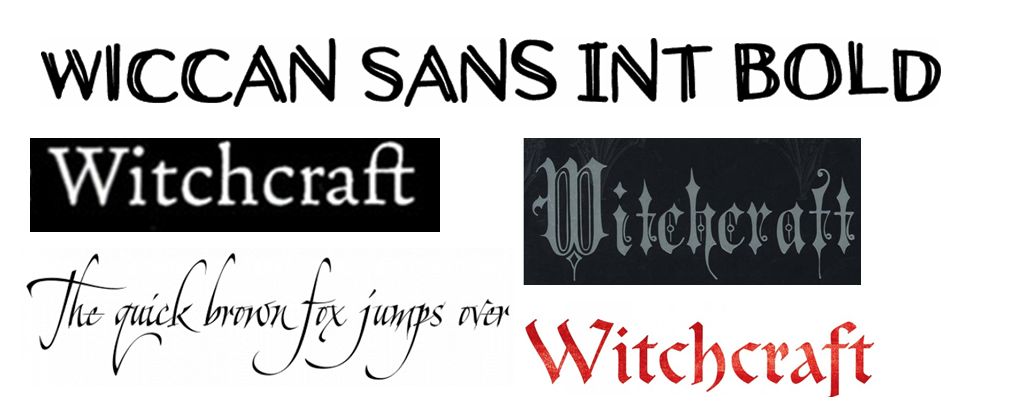
Mysterious writes
The first font (and yes it is actually called ‘Wiccan’) again suggests something very much at the human-scale, hand Crafted and simple (and the moon like ‘C’s may subtly allude to the the nocturnal aspect of witchcraft). The next reversed out text is more authoritative but maintains an olde worlde feel (the ‘W’ and ligature of the ‘f’ and ‘t’ put one in mind of early modern type). The more elaborate grey text on black goes for that spooky vibe. Based on an imagined late medieval Gothic illuminated lettering, this text has an additional sprinkling of fairy-dust scroll work. The lines ‘The quick brown fox’ is the kind of font one finds in the seminal book Witches by Erica Jong (illustrated by Joseph A. Smith) and similar texts. Again human-scale, romantic and with a suggestion of days of yore. Meanwhile the red lettering reprises the above observations, providing a font that is old skool, hand-written and gothy. By taking examples of fonts like this we can discern the things that appeal to people who like witchcraft.
Take a browse round the library, the bookshop or on-line and one can easily see how the fonts we choose reflect our identity and the spells we hope to cast (through writing) on the world.
So when people ask me ‘what is chaos magic?’, especially if they know something about occulture, the letter style analogy is one I often use. What we are all doing, in our different ways is ‘magic’, the wrapper we choose for our practice, like the selection of typefaces, is about the style we find most evocative and inspirational (at any given time) as we make our journey into the Mystery.
JV

 The Blog of Baphomet