Journeys into Deep Space – a review of ‘Black Horizons Perspectives’, by Dr Lloyd Keane

Books on magic and spirituality are often full of people on journeys. Some folks head into the desert (like the Hero of The Alchemist by Paulo Coelho), while others head up mountain paths or take to the sea in ships. To pursue change or self-discovery one moves from where we are now in the hope that our travelling will somehow shift our sense of confusion and supply us with meaning. Such metaphors can be helpful when employed skilfully, or they can turn into a mammoth cliché-fest that is essentially without real content.

lloyd2

Lloyd Keane wants you to take a road-trip with him into deep space and he is completely unapologetic about how weird this shit is about to get. As a Jung scholar and Master Cosmonaut within the Esoteric Order of Beelzebub (an order within the Temple of Set), Lloyd is used to traversing some fairly strange internal terrain. Having known Lloyd for the past seven years, I can attest to his dogged commitment in pursuing the type of initiatory magic espoused by the Temple of Set and his willingness to do so using both the creative and intellectual tools at his disposal.

In Black Horizons Lloyd introduces us to the insights that he has gained in working with the concept of deep space travel as a means of understanding our processes of inner awakening. The Esoteric Order of Beelzebub makes significant use of the teachings of Gurdjieff within their school and those acquainted with these ideas will be aware of the way in which space travel is used to convey a sense of strangeness and the potential challenges connected to such journeys.
lloyd1

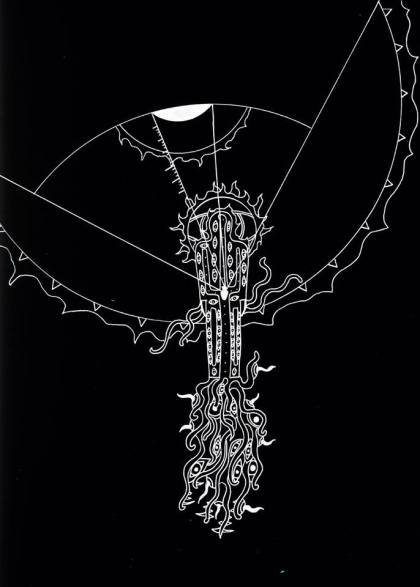
Explorer by Lloyd Keane

As we well know, getting lost in space is easy to do! While Lloyd makes no attempt to spoon-feed the reader he does provide some meaningful markers that the budding cosmonaut might use in attempting such treacherous voyages. While not being overly prescriptive in trying to dictate what stages of exploration must look like, he identifies a process of initiatory change in the following terms:

  1. Tyro – How do we stir our inspiration and desire as a means of fuelling our journey?
  2. Seeker – Having left the launch pad, how do we actively engage in the early stages of exploration and creativity while avoiding potential pitfalls?
  3. Explorer – How do we begin to express what we are experiencing so as to create a powerful feedback loop for self-transformation? Here we begin to dig-in to engagements with dark-matter and the deeper dimensions of internal exploration.
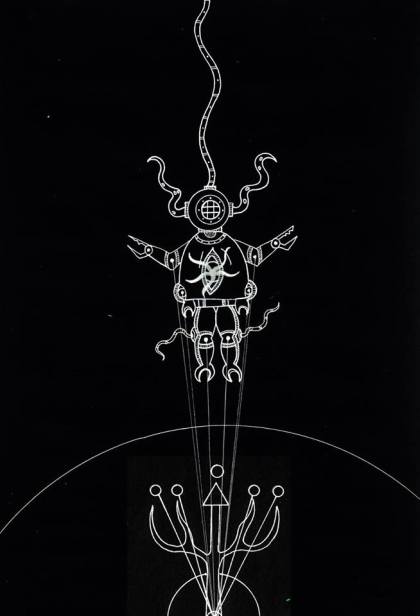
  4. Watcher – How do we begin to exemplify these transformations so that they impact upon others? For me this is the challenge of integrating insights gained and continuing our alchemical work within the more mundane aspects of our lives.

What I find so refreshing in his approach is his willingness to side-step the well-trodden paths of occult language and metaphor in helping us gain new perspectives on accessing our own process of Xeper or becoming. While having been deeply immersed in the language of Hermetic Kabbalah and Thelema, Lloyd has been able to use the black flame of his own creativity to access new insight into the challenges and potential rewards that such work offers. As a testament to his own process of inspiration, the book features numerous examples of Lloyd’s weird and inspiring art work.

Through the structure of the work described, Lloyd asks us to experience the very real and existential dimensions that we experience in the face of mystery and the vastness of deep space. Rather than trying to minimise the sense of terror that we might encounter, he encourages us to actively explore our sense of awe in the face of darkness and the unknown. As we embrace the type of bravery that allows us to remain open and curious in the face of vastness, so the initiate begins to cultivate a new sense of poise for engaging with their life.
lloyd4

Watcher by Lloyd Keane

Throughout this work, Lloyds style is clear, humorous and for a Left-Hand Path magician, refreshingly self-effacing. At the end of each of the 4 main sections he provides suggestions for further reading and inspirational films with which to fan the flames of our own work. While not being dictatorial about rituals or technologies that one must use, this work is full of intriguing suggestions and Lloyd provides us with some helpful vignettes of his own ritual work within the Temple of Set.

I would highly recommend this work for those interested in gaining an intimate and honest reflection upon a Priest of Set’s initiatory work, and how a contemporary magician can creatively evolve new, future-oriented metaphors for exploring the path of human transformation.

The book is currently available via Lulu

Here’s a link to Lloyd’s personal website:

http://www.lloydkeane.com/

SD


Working with Recent Ancestors

In my recent re-exploring of the Ma’at current, I have been struck by the importance of how we work with concepts of balance and time within the magical project of personal and collective alchemy.  As already considered, for me part of the genius of Nema’s work is the way in which the scales of Ma’at seek balance in the present by consciously engaging with the future (as embodied by N’Aton), and the history of our primal drives (the forgotten ones).

maat-scales

The moment of Truth

As part of my day-job I run a small family therapy clinic that aims to help groups of people consider how they communicate with each other. When I sit with families of all different shapes and sizes (some formed by biology and others by intention), I try to invite them to be curious about how they connect to each other and also whether there are ways in which they would like to improve communication. Part of what we do together is to adopt a detective-like interest in the often unspoken principles that shape our interactions. When these principles are applied to the practicalities of daily life they often become manifested as ‘scripts’ that determine the way people relate to each other. As with scripts in a play, we are often given rules about a whole range of things (such as who cooks the food and who resolves the arguments) that have been handed to us by previous generations. These scripts are often shaped by deep-seated beliefs regarding gender, illness and success, and within families we can be warned against departure from these via cautionary family legends regarding disasters that will befall us if we do.

In exploring with people why they think this type of therapy might help, our initial piece of work is often focused on trying to bring these previously buried beliefs above ground. One tool that we can employ to unearth this material is a genogram, or family tree. By mapping out the members of a family through three or four generations, we can begin to gain a picture of how styles and stories have been co-created over time. The scripts we inherit aren’t necessarily a bad thing, but often the people who attend family therapy are doing so because these scripts are no longer functional and are causing people to get stuck.

This is a process of externalisation where (at least for that moment) we consciously consider a difficulty as if it were separate from the group or individual reflecting upon them.  When we can name the scripts at work and the principles that might lay behind them, so we can create a small sense of space to explore within. In being able to stand slightly Meta to these narratives, we can begin to consider the possibility of improvising new styles of interaction that allow different types of behaviour to be considered.

sigil

Genogram, or Sigil; or both?

As you are reading this description of this style of work, I’m hoping that you as magically curious folks are beginning to spot parallels with some of the ritual processes that you are engaged in. Magic that has a focus on the initiatory transformation of Self almost inevitably has to engage with some of the baggage and conditioning that we have inherited. If my magic is focused on allowing more liberated and peaceful versions of who I am, then I will need to begin a process on naming those inherited scripts/thought forms/entities that I experience as limiting. Whether we describe this conditioning in terms of Tantric Kleshas (shells) that need breaking down, or as parasitic entities that need to be ritually contained, by magically externalising them, we create the possibility of engaging with them in a more creative manner.

This process of trying to understand repeating patterns of behaviour and how they have been manifested within an individual’s history has also been helpful in my own work with my ancestors. At the beginning of our monthly Zen Hearth we consciously honour “Our Gods, Our Ancestors and the Spirits of this Place” and like many people not every ancestral relationship is an easy one. For me, being able to take one step back in trying to understand the origins of difficult dynamics has allowed me to gain some insight on any positive values they have passed to me. This does not absolve anyone of abusive behaviour, but it does provide a potential opportunity for gaining a new and wider perspective.

For me the therapy room and the magical circle have a number of similarities. Hopefully both provide the opportunity for safe exploration, the gaining of insight and the potential for healing. Both of these environments invite us to take risks, but hopefully the scaffolding of solid theory and good practice allow us some degree of confidence in stepping out. In my experience, both work well when there is a high level of transparency about the process being undertaken and sensitivity to the dynamics of power at play.

Part of why I continue to describe myself as being as a magician as well as being a bit of a mystic, is that in contrast to some forms of mystical encounter, I work hard at naming and understanding the process of what I do. Yes emotional and/or mystical stuff may occur as a result of my framing of my ritual activity, but the scene setting and conscious structure of the work allows me a more conscious process of integration. I have lots of builders and crafts’ people in my family line, and although many of them might struggle with the strange path I have followed, I hope at least that they can appreciate my attention to detail!

SD