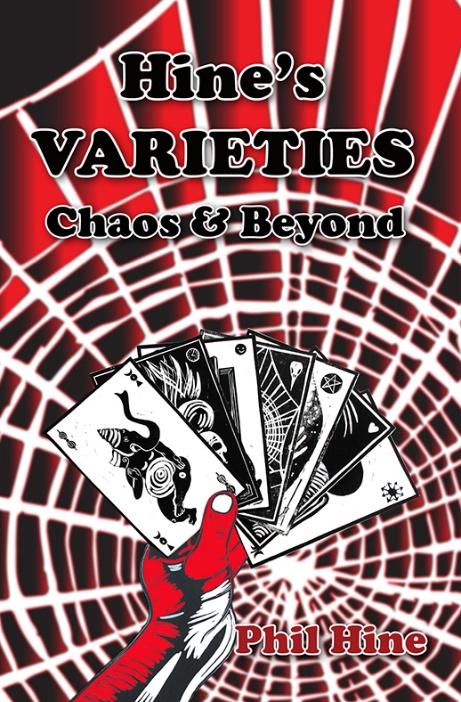
Review: Hine’s Varieties Chaos and Beyond by Phil Hine

C:\Users\DaviesSte\AppData\Local\Microsoft\Windows\INetCache\IE\BL9634F0\Hine's-Varieties-front-cover-w-bleed.jpg
Cover by Strutz & Hine

As a latecomer to Chaos Magic in the mid-1990’s, Phil Hine’s Condensed Chaos provided an excellent guide to the Neophyte Steve Dee. Having been spiritually burnt out by my previous struggles with belief and attempts at religious faith, the iconoclastic approach of Chaos Magic articulated in that work felt like an invigorating breath of fresh air.

In this latest collection spanning over 40 years of magical practice and reflection, Phil has brought together not only a rich smorgasbord of his writing that has previously been featured in Zines, collections and his on-line presence, he also intersperses these pieces with illuminating snapshots of magical autobiography and reflections on his inspirations at the time they were written. In addition to Phil’s written work, the book also features evocative linocuts by Maria Strutz at the beginning of each of its major subsections.

He provides us with a vivid recollection of his own beginnings in Magic that reference the impact of Austin Osman Spare, Theosophy and some bold experimentation with the pantheon of HP Lovecraft. Early occult group work came in the form of a rather bumpy experience with a Wiccan Coven, and we also see him giving his playful and non-conformist streak expression via more experimental work with the Discordian Goddess Eris. Things clearly lit-up during his involvement in the vibrant Pagan/magical scene in the North of England during the 1980’s and his involvement with the enigmatic Lincoln Order of Neuromancers provides a Segway into the books first major section containing writing on Chaos Magic.

Even with the passing of time, Phil’s writing from this period still contains both a vibrancy and a relevance. Pieces such as the channelled Erisian Stupid Book and the brutally honest Fracture Lines provide clear insight into the magician both at work and struggling with the emotional realities of being a human being. In Cthulhu Madness he challenges the sanitised safety of our overly psychologised magic and our attempts at control. “Real Magic is Wild” insists Hine and yet he also asks us to use on whole of our beings in balancing magic and mysticism, work and play: 

“Chaos Magic is a process of mutation…the deconstruction of Identity from the beleaguered Ego into the legion of Selves requiring only self-love”

In his section on Paganisms, we find Phil in full activist mode using both his writing and group ritual to challenge the hysteria of alleged satanic child abuse and the ecological threat posed by industrialisation. This a Paganism unbolted from the politeness of social conservatism and in his writing for Pagan News we see a clear embodiment of the magician-shaman as social disruptor. In his Must we Love the Golden Bough? I sensed the beginnings of Phil’s role as erudite historian of religion and critic of Western Occultisms lazy reliance on the Universalistic assumptions that reflect an insensitivity to cultural context.

Phil’s section on Practice provides some rich anecdotes and some very down-to-earth principles for magical practice. He provides valuable thoughts regarding the power dynamics present within the student-teacher relationship and how the paradigm of mentorship might provide a less lopsided model. I was especially struck by his piece on Leaving Magical Groups and was aware of the parallels in my own experience of how such departures can have long lasting impacts on friendships, personal psychology and the shape of on-going spiritual work.
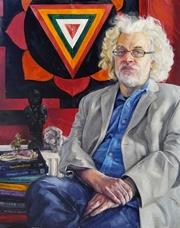
Image result for phil hine
Phil throwing down some organic Tantra   Portrait by Asa Medhurst

Somewhat organically Hine takes us with him on a voyage into his exploration of Tantra. We are treated to tales of his meeting his Guru, involvement with the AMOOKOS tradition and a description of a deeply personal embodied Kundalini experience. Phil openly wrestles with what it might mean to let the complex traditions of South Asia speak for themselves and inform his efforts to create a “hybridised Tantra”. Through a number of nuanced pieces of writing he invites us to become detectives with him in trying to experience the complex layers of meaning of Tantra’s twilight language rather than coarsely pillaging concepts around rebellion, antinomianism and sacred sexuality. However these concepts are present, they need to be able to speak on their own terms.

His sub-section on Sexualities was a personal favourite of mine, as Phil provides a robust challenge to much of the heteronormativity and phallo-centrism that is still present within certain quarters of western occultism. In exploring the fluid and evolving concept of Queer Paganism we encounter Baphomet as an “unfinished” deity who contains “a multiplicity of shifting planes and horizons”. These aren’t merely theoretical constructs but rather profound explorations of when the personal is the political and pieces such Sodomy and Spiritual Fulfilment and Biography of a Kiss provide us with some truly tender insights on how we unfold in becoming more human.

The final two sections of the book are given over to Histories and Fiction and in this juxtaposition we see Hine in both his most incisive and playful modes.  In his analysis of the work of Lobsang Rampa and Elizabeth Sharpe’s writing on The Secrets of the Kaula Circle we have Phil in full religious historian mode challenging us to stay sensitive to context and to appreciate the complexity of contributions within the timeline. In Fiction (probably the section that appealed to me least), we see the blurring of the lines between story and history and the weird tales described could quite feasibly be chapters from his own biography.

In his writing on Masters, Mentors, Teachers and Gurus Hine advises us to let go of our fixation in seeking parental authority figures and to “seek friendship instead”. Finding such magical mentors can take time but I feel that Phil has provided us with a warm and authentic version of this albeit in print. This collection provides us with a rare, raw and at times hilarious insight regarding what it might mean to be a magician in the 21st century. While playful and irreverent it also contains a moving story of the search for meaning, the fluid nature of identity and also a desire to find the Goddess in all their multiplicity of forms.

Highly Recommended!

Steve Dee

Book Launch of Hine’s Varieties

At Treadwell’s Books, London on 13th February.

Details HERE


Deep Magic Spring Retreat

Cultivating Connection

Last few days to secure your place at the early-bird price. Details HERE

Using Magic to Improvise the Self: Explorations in Chaos Mysticism (Part 2)

In my last post I spent time thinking about the potential parallels between acts of creation at both a large and small scale. How might the way in which we view the origins of the Universe shape our perception of self and experience of being a human?

My own view is that the creative, cut-up style of Chaos magic provides us with a position of dynamic agnosticism that allows us to engage with the questions we grapple with. At a cosmological level I was keen to embrace an origins story that reflected a “fragmentary beauty and partial truths: a cut-up formed from moments of inspiration and hard-won life lessons…a custom job, slowly stitched together and arguably unique.” In this post I hope to explore the way in which such an approach can help shape the way we engage with the work of transforming the self.

As we seek to explore potential models of self, the Chaos magician (or at least this one) tends to exercise a degree of both skepticism and down and dirty pragmatism. Yes a specific model may provide a language with which to access new insights, but how do I take these lessons into the realm of my magical work so as to bring about lasting initiatory change?

Under the sway of Postmodernism, Chaos magic tends to be far more interested in the self as a process rather than seeing it as a fixed entity. Think more of a dynamic shifting river bed rather than a still pool of unfathomed depths. Rather than initiatory work being located in some far off idealized future, this “self as process” paradigm challenges us to experience the work unfolding in the moment as the primary location and focus of activity.

Most of us come to magical work in order to experience change. We may have felt trapped by the old, outdated scripts and principles we were adhereing to. If we were simply content with these we would not have entered the Temple of the Mysteries. Whatever the techniques or traditions we favour, my hunch is that we are seeking methods and frameworks within which to improvise new understandings of self.

I have previously written about how the artistic technique of cut-ups provide us with powerful insights into the shifting nature of both consciousness and identity. The dynamic and improvisational spirit of this approach captures well the experience of many and potentially provides a more fluid map for developing a more playful approach.

Cut-ups also happen at a cosmic level and the Mesopotamian creation myth Enuma Elish (lit. “when on high”) vividly depicts this. It tells the story of a struggle between the elder gods of primal chaos and the young upstarts embodying consciousness and order. The great primal Mother Tiamat is eventually slain by the heroic warrior Marduk who then forms the material universe from her draconian remains. This speaks powerfully of our own journey in pursuing the goal of self-creation; we may desire the coherence and direction of the ordered and linear, but if we fail to recognise the vital potency of the chaotic, our path is likely to become arid.

When we begin to pay more attention to the terrain of self, it can feel both challenging and potentially disorientating. Too great a sense of fragmentation and we risk both good mental health and the necessary cohesion needed for day-to-day functioning. Embracing fluidity and multiplicity can feel highly liberating, but we can also risk feeling distress if our experience of subjective complexity runs contra to older expectations regarding having a unified experience of self. Shouldn’t I be more consistent, less conflicted and frankly have my shit more together?

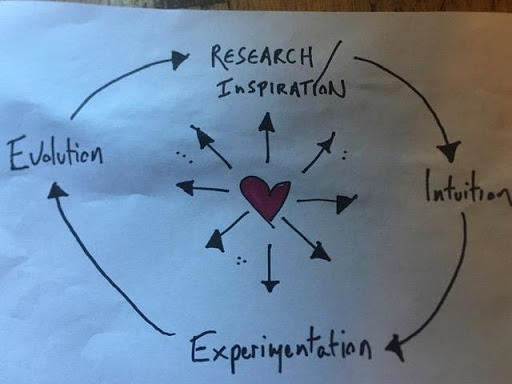
I hope you are beginning to spot how tricky it can be to find metaphors that help convey the complexity and mystery of the work that we are trying to do! In my own attempt to map-out some of my own exploration of what I experience going on:

In this circularity I have been trying to spot the links in my own chaos magical process and role that intuition plays in inspiring the form of play and ritual improvisation that takes place in the laboratory space of the magical circle. While my intuition can definitely have an unexpected and non-linear quality, the foundation for such gnostic insights has come by means of research, reading and the consumption of prodigious quantities of art.

When we dare to improvise, to step outside of the known and fully rehersed we can feel like The Fool in the tarot daring to step out. While that image is both powerful and inspiring, we should be cautious about taking it too literally! To improvise is not to disregard health and safety concerns or rely on blind-optimism, rather it allows us to trust in our own cultivation of poise and the possibility of what can occur when we relinquish the tightness of our control. 

Such states of being are often associated with “flow” and the outcome of mastery and we know that these experiences often result as a result of concentrated discipline in acquiring the basics. We would rarely expect to be able to play an improvised guitar solo without hours spent playing scales, and yet in our magical work we imagine that the possibility of mystical experience isn’t enhanced by regular spiritual practice. 

Perhaps with a new year and new decade beginning, it’s time for all of us to revisit magical bootcamps like Liber MMM (or others of your choosing), in order to reconnect to daily practices that allow the possibility of more creative experiences of both ourselves and our connection to others.

To conclude here’s a beasutiful quote from the preface of Viola Spolin’s excellent Theater Games for the Lone Actor:

“In the present time a path is opened to your intuition, closing the gap between thinking and doing, allowing you, the real you, your natural self, to emerge and experience directly and act freely, present to the moment you are present to.

You, the real you, must be seen. There are many facets to your basic persona unknown even to you , that you may come forth, appear, and become visible. You, the unique, invisible, unknown, must emerge, be seen, and connect!”

Steve Dee


Deep Magic Retreat

Cultivating Connection

Our 2020 springtime retreat will take place in April (17-19th). Please join us for this magical adventure, exploring the connection between Nature and ourselves!

This weekend will give you the opportunity to engage with a remarkable landscape in which humans and other species live and work together. Through group practices and solitary exploration we will discover how we can bring together spirituality and practicality. Using a range of artistic, ceremonial and meditative processes developed specifically for this site, we will re-engage with our humanity as a harmonious part of Nature. The key themes for this retreat will be regeneration and relationship; bring your curiosity, your open mind, and a willingness to participate.

Ragmans Lane Farm is nestled in the Wye Valley on the edge of the Forest of Dean, in an Area of Outstanding Natural Beauty. An hour from Bristol, Birmingham and Cardiff, the 60 acre site is one of Britain’s most well established permaculture and organic farms. Ragmans has hosted numerous courses over many decades with teachers including Starhawk, Patrick Whitefield  and Bill Mollison.

Accessible to novices, and beneficial for experienced practitioners, these days of practical deep magic will give you plenty of opportunity for personal transformation, learning and fun.

We will be staying in a superbly converted 400 year old barn, with three dormitory style areas (6 beds, 2 beds and 3 beds). The barn also has a comfortable sitting room, and a large dining room/kitchen, both perfect for socialising. The retreat includes full-board accommodation with delicious home-cooked vegan food, much of it grown locally, some at Ragmans Lane itself!

We will be using a separate meeting hall for indoor ceremony and practices, as well as several beautiful outdoor spaces. 

The retreat runs from Friday 17th until Sunday 19th April. 

Cost £300. Early Bird £250 (until 14th February).
PayPal contactdeepmagic@gmail.com

If you have any questions, or want to know about alternative payment options, please email us at contactdeepmagic@gmail.com