Occulture and the New Left

The terms Right and Left-hand path are perennial favourites for discussion. Indeed I first went into print on this subject over quarter of a century ago. Since that time the development of the internet and the emergence of neo-Paganism as an overground spiritual practice have radically altered the occultural landscape. During this period powerful words such as ‘tradition’, ‘witch’, ‘satanic’ and many others have continued to be defined, re-defined, re-claimed, pwned, used, lost and generally kept in ‘play’ in a way that would make Jacques Derrida proud. This process of (re)definition emerges in a fascinating way today in relation to Right and Left-hand paths (RHP and LHP) and particularly the Left-hand side of this duality.

I’ve not long finished reading the recently re-printed Lords of the Left-hand Path by Stephen E. Flowers and this, plus the ubiquitous debates on Facebook, have made me re-examine these terms again. The origins of them are well known, as is the history of their adoption by western occultism, but what’s of particular interest to me is the discussion about who ‘owns’ the term LHP. There’s no shortage of folk who want in on the use of LHP. Indeed teh modern interwebz must be creaking under the weight of data generated by the various competitors in this ‘darker than thou’ contest, from the cerebral Temple of Set to calls to violence of The Order of Nine Angles.
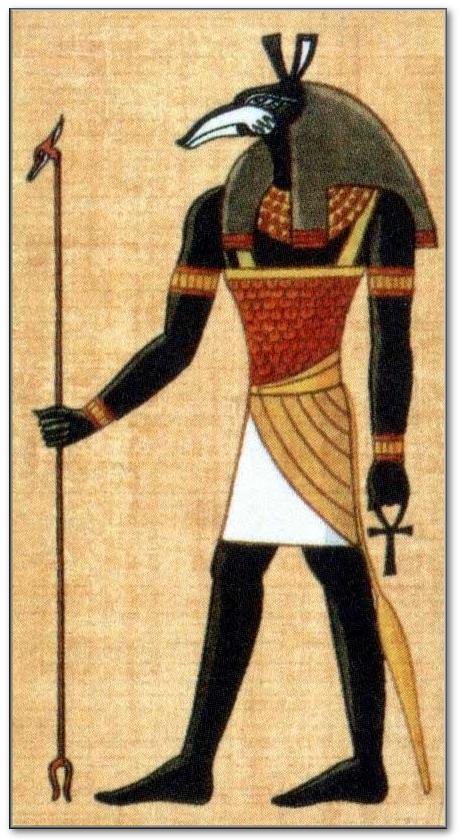
Poster boy of the antinomian classes

Poster boy of the antinomian classes

Traced by Flowers’ book is a now well established contemporary conception of the LHP which has as its keystone a belief in an ‘isolate’ self. The suggestion is that the RHP is the path of transcendence, of practices that attempt to merge the individual identity with God/Goddess/Universal Mind/Whatever. In contrast to this the LHP seeks to make the Self a God, to glory in the ‘unnaturalness’ of the human existential attitude and to develop or reveal a self which is unchanging and eternal.

Lords of the Left-hand Path spends a fair amount of time ‘testing’ various figures and doctrine in history to see if they are ‘LHP enough’. Flowers takes the work of Crowley and holds it up to scrutiny through his Temple of Set-tastic frame of reference. The Beast gets the big thumbs down and, like a character in a game show, gets booted out of the Black House. Gurdjieff is a “more pure practitioner and teacher of the left-hand path than Aleister Crowley’ and so wins the title ‘Lord of the Left-hand path”. (I can see it now; the crowd goes wild! Or at least does some funny movements in unison.)

One thing I find interesting is that this understanding of the LHP is quite different to the historical use (in places like India) of that description. But words change their meaning all the time and so this isn’t to suggest that these ‘neo’-LHP groups  shouldn’t use this phrase.  Modern Pagans cheerfully rifle their way through the storehouse of images, language and ideas recorded in pre-Christian societies for spiritual building materials, and as humans we all adopt and transform the network of meanings in which we find ourselves from the moment we acquire language.

It might be easy to stereotype the neo-LHP practitioner as male, probably childless, the kind of bod who rather likes the aesthetic if not the praxis of totalitarian states. Who digs Julius Evola, Ayn Rand and libertarian politics. Who opposes gun control, enjoys the pomp and circumstance of esoteric titles and grades, who thrives on intellectual debate using a formalised lexicon of terms, and generally feels themselves to be part of a tiny, but terribly significant elite.

But just because we can parody something doesn’t mean it should be brushed aside. The neo-LHP asks some really good questions and has a great deal of relevance in the modern age.

For example; how do we forge communities of autonomous empowered people? What are the dangers of giving ourselves up to the transcendental Other?

Take the last point. National Socialism, and the horrors that its application as the Third Reich unleashed upon the world, was a movement  founded on the submergence of individual identity. The great trance induction rituals of the Nazi rallies were brilliant operations to instil compliance with the total war machine. At its most intelligent the neo-LHP asks us to recognise our individual ‘isolate’ intelligence, to fight against being submerged into such collectives, to think for ourselves and question authority – to, as Gurdjieff would say, wake up.

The challenge for those who identify with the neo-LHP movement is to keep lines of communication open with the wider esoteric community. Not to withdraw into an isolationist position where their insights cannot inform others. (Un)naturally, this is tricky when those beliefs can tend towards a view of one’s own superiority over the ignorant mob.

Thankfully there are some excellent examples of neo-LHP magicians out there, questioning our desire to become part of a Star Trek style Borg and reminding us all as practitioners that we are living in a time when our explorations of spirituality, however gently Pagan, have only been made possible by the radical ideas of the few.
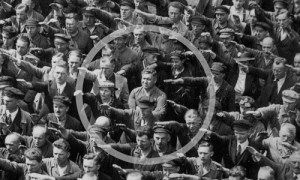
Like Lucifer says, 'Non serviam'

Like Lucifer says, ‘Non serviam’

JV

How to Cause Trouble with Magick

A few years ago, a group of activists from the Anarchist anti-racist, anti-statist network No Border decided they wanted to close down the Rhein Mann region airport in Frankfurt, Germany. They did this by starting a social media rumour that thousands of activists were going to descend on the airport in protest at Lufthansa airlines using their planes to deport people deemed to be “illegal”. The power of the rumour alone was enough to get those in authority in a panic. They locked down the airport, defined by protestors as “the border within” and the activists achieved what they set out to do without actually doing anything. This was my first experience of the magickal use of information – the digital becoming real and affecting change; fiction becoming fact.

Trouble at the dark satanic mill...

Trouble at the dark satanic mill…

The activists then stepped out from behind the screen and set up a border camp; pitching tents to create a multi-layered protest space in order to make the invisible border of state control visible. Another example of the virtual becoming real, and a deliberate revelation of those hidden physical spaces and invisible power flows that define our lives: the officers and offices that make the decisions to remove people are in our streets, the internment camps are deliberately placed where few can see them – resistant, carnivalesque border camps make these highly visible, they cannot be ignored. Prior to this, activists had carried out a “virtual sit-in” denial of service attack at Lufthansa’s website and distributed printed material which mutated the corporate PR message to emphasise the horrific conditions that people were being subject to: grabbed in the middle of the night, bundled into police vans, tied into airline seats and vanished off to interzone. When the police intervened, the activists vanished from where they came from – the autonomous spaces of Germany and the rural networks of Central and Eastern Europe. Almost to a letter they followed William S. Burroughs famous dictum of 1. Disrupt 2. Attack 3. Disappear. They also used Burroughs riot feedback loops to get the results they wanted.

For me, there’s something about this form of politics – a cultural politics that intervenes in both the physical and virtual spheres – that is highly magickal. Think about it – we have the manipulation of symbols (sigilisation of corporate logos), ritualistic frameworks (often in the camps themselves people use drums, make-up, costume and voices to subvert the space) and strong intention underpinning this along with the raising of energy which is discharged into the heart of the machine.

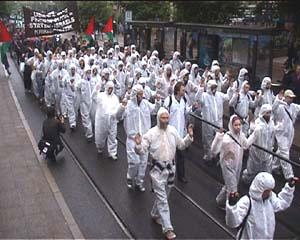
Just as importantly, there’s an almost cybernetic flow between culture, civil society and the body. The body is putting itself in the way of the information flow along with other bodies. Something that Italian activists Tute Bianchi were writing about a decade ago and which manifested itself in the White Overalls Movement – individuals joined together and padded their bodies to create lines of offence (bodies without organs) that could break through police lines during demonstrations in Genoa. This relied heavily on journalists reporting events and acting as a vortex or gateway to the (indy)media landscape – a virtual/real feedback loop that kept many (but not all) protesters safe.

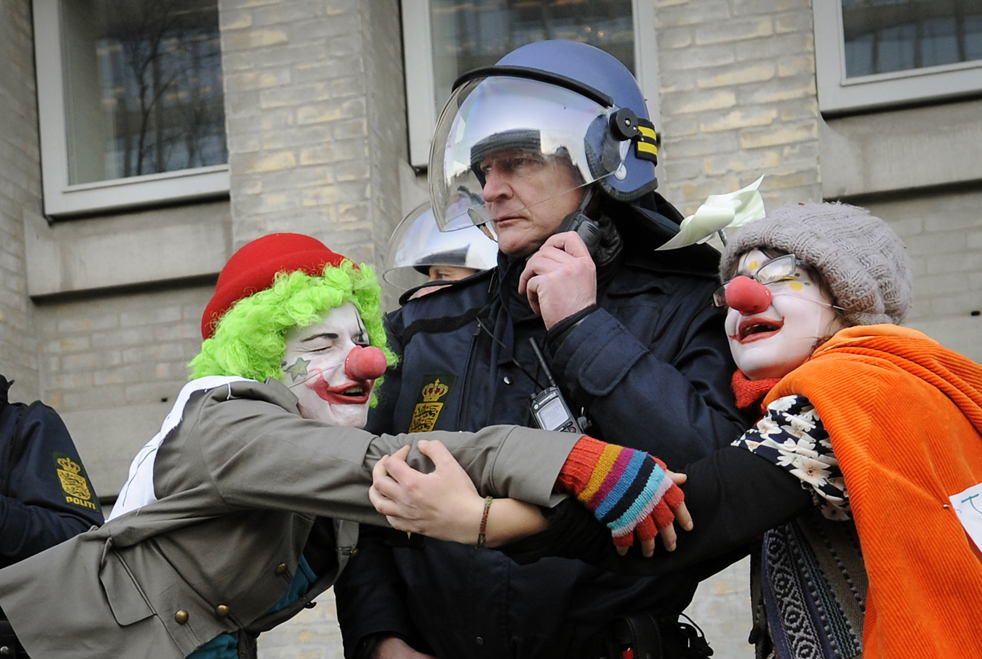
 On 16-12-2009 I am outside the Bella Centre in Copenhagen at the Reclaim Power Demonstration. We are surrounded by tooled up riot police, standing inches away from us. It is silent apart from bursts of radio which send out crackles and sparks of language-virus. An Italian rasta-punk starts chanting “OM” and thirty of us join him. We turn the OM into a continual drone standing stock still, directly facing the police, looking into their eyes, only moving when we breathe in. The Insurgent Rebel Clown Army run up and down between us waving feather dusters and eating bananas – dancing on the boundary of freedom and force. There is no aggression or confrontation from us, but the OM is definitely a resistance. The police are visibly unsettled, they are unsure how to deal with this one, it’s not in the public order vocabulary. We carry on for about 30 minutes, harmonising and drifting, the situation de-escalates, they relax and begin to smile, they then back off. No-one is hurt. Today.

Clowns and cops @ Copenhagen

Clowns and cops @ Copenhagen

These political interventions arise from sorcerer-activists (those who improvise symbolic actions, create protective circles/rituals and immanent organisational networks but who also remain on the outside of mainstream discourse – shamanic shit-kickers if you will). Julian has already written about the temporary autonomous zone and “the changing concepts and use of space in modern magic” in the “Two Worlds and In-between” chapter of Magick Works. This chapter name-checks Hakim Bey, S.L. MacGregor Mathers, Li’l Al Crowley, Doreen Valiente, Pope Pete Carroll, Starhawk, Cabalistic sorcery, (z)-cluster and the Temple of Psychick Youth in an exploration of the boundaried limits of liminal space. However, in my magickal and political practice I am equally interested in Matt Lee‘s notion of the sorcerer-activist as a borderline or “continuously changing series of edges”. Here, communication is a form of contagion, infection or mutation of multiplicities – borderlines are “the constant critical areas of becoming” with the borderline edge serving as a reminder that there is another place that exists in memory: another world is possible.

Things have not always been this way, things will not always be this way. The autonomous zone/space then serves as one form of borderline – a critical becoming that enables a way of escaping bodily limitation through the desire (or intent) for a different world. It’s in this resistant desire that the playfulness, hope and humour of magickal-politics emerges. Shaun Frente discusses this in Generation Hex in the planning of a mass-party-as-spell which involved “parties within parties within the party…we leaked out rumors of a made-up drug that was floating around the party (actually dandelion root capsules)…when the police came to raid the affair (we knew they would), we passed out flyers informing the crowd that the cops were a simulation, but that any resistance might meet with a simulated arrest indistuinguishable from the real thing…” (p.175)

So, next time you cast a circle for ritual, remember that what’s also happening is an expression of psychic autonomy, something that Antonio Negri would call assigning and creating your own value and then defending those values from capitalism. The ritual space then is an “opportunity to withdraw from exchange value,” a brief experience of use value and an expression of mutual aid and “independent productive force”. Spaces free from hierarchy (if wanted), spaces that block capital, connect histories and enable organisation and spaces of hope, play and resistance. 

Use your magick to bite back at everything that ires you. Use your magick to bring the world you’d like to see into being.

TP808

Further Reading

William S Burroughs – The Wild Boys

Matt Lee –  Memories of a Sorcerer

Jason Louv (Ed) – Generation Hex

Antonio Negri- Books For Burning: Between Civil War and Democracy in 1970s Italy

Julian Vayne – Magick Works