Numbers. Strange artificial squiggles, the first writing, all around us in the urban environment. Quantity exists everywhere, tis true, but numbers, as the signs, the representatmens of quantity, they are a different game.
The Babylonians started it, counting grain by the sack load coming in and going out of their storehouses. Precious metal tributes from their allies/enemies (Orwell’s conflation of these concepts demonstrates nothing new under the sun!) flooded in and the treasure keepers had to maintain lists of the top 10, so they would get prime spots in the next procession.
They also used numbers when they realised that days could be counted too, to keep lists of stars, the times when dragons appeared above the horizon, and scorpions sank below. Now they were really on to something; the wheel of the year handily divides into 360 (give or take) bits, and geometry adds to the range of complex puzzles that make sudoku look like the child’s play it is.

A Babylonian Old Moore’s Almanac
Stars and moons in their revolutionary aspects as seasonal time pieces, give us an undeniable cue for group/community agricultural annual practices. One suspects that previously the sign of a full moon fulfilled practical roles such as signalling the right night for a good feast, as it continued to do up till the invention of electrical lighting. For many people and places the full moon still acts as lamp in this instance even today.
But back then the authority of the heavens telling when the work in the fields had to occur, was an apposite metaphor for the overseers. If a man could foretell the future days, of blood red eclipses, and exactly which nights a star spangled character peeped over the horizon, then they surely knew the ways of the gods. They were the mouthpiece of heaven, and what they said was the lore.
So numbers, and the art and science of manipulating these signs, gave great kudos to the priests.
Fast forward a bit, to the time of oceanic navigation (well actually oceanic navigation has been happening for thousands of years but for an easier story, we will ignore those mysterious adventurous Pacific voyagers). Tides and moons rise and fall, in the northern seas some tide ranges are enormous (tens of metres). Knowing in advance when spring and neap tides are due gives the knower a distinct advantage over mere mortals, allowing cargoes and vessels to move efficiently and safely. Counting days and sleeps until tide timing and moon phases coincide with weather and daylight hours allowed to plan for the continued livelihood of the crew, and increase the possibilities of trade and travel.

Low tide

High tide
Numbers had added importance now, arithmetic as a methodology vital to the functioning of travel, exchange and making a living had arrived to stay. Architecture, design, biology, chemistry, all found ways to use the practical application of precise figures.
I have railed before about the primacy of number in science, a trend championed by that obsessive Isaac Newton, who wasn’t interested if you couldn’t make a graph out of it.

Newton sees numbers, Blake sees Newton and more…
In his time as president of the newly minted Royal Society, he steered the fledgling entity of science into a career of counting quantities, to the detriment of quality. Numbers that go up remain, many centuries later, the yardstick by which we measure everything.
Mercantile culture seized this vision of reality as numbers, the elevation of numeric quantity over quality suited the marketplace just fine. Far easier to understand, to make definite decisions, to attract investors. Numbers that go up! (Unless they go down.)
Similarly, reducing a social issue to a simplistic snapshot of statistics, instead of the stories beyond the graphs, gives those who tend towards wanting clear answers clear conclusions rather than otherwise messy and complex situations.
Mapping dualities onto one another has been a habit of humans since they learned to tell their right from their left. Levi Strauss took this to the ultimate level, with his tactic of pairing comparisons.
I would like to draw up one of these charts for you:
| Raw | Cooked |
| Emotional | Intellectual |
| Verbal | Calculating |
| Moon | Sun |
| Home | Work |
| Pretty | Clever |
| Complicated | Decisive |
| Love | Money |
So, in which columns of these dualities would you place the pair Man Woman?
I hope that like me, gentle reader, you were able to say that you know men and women who fit equally into either column, and even mixtures of the two apparent ‘polarities’. However I fear that (eke like me) you were aware that the initial impulse was to see one of these lists as dualities associated with the one gender.
Leaving aside the false nature of dichotomy and ‘opposites’ itself, the way we think on the fly often approximates to making these types of associations. Without the conscious awareness of such inbuilt convenient quick reference tables, we can easily fall into the trap of mistaking them for some kind of reality. In a situation where a snap decision needs to be made (snake, lookup table says = danger), they can prove immensely useful and allow us to react faster than we can think properly. Reflex thinking like this is awesome in an emergency situation.
However. When we have time to reflect, and mull over our courses of action at leisure, often we see in hindsight that we had other options, fight or flight from that bear has other possibilities suddenly; climb a tree, spread out your coat to look big, lay down and play dead. Which of those works with bears… um I would have to think about that before I could work it out… The prevalence of mathematics with its two dimensional descriptors of the world (numbers go up vs numbers go down) supplies us with a poor model on which to hang real life. Even with the orthogonal axes of 3D choices added, the basic premise is still dual in nature, merely negative or positive steps summed together.
We usually tend to think of the sexes as being two. One of these is Woman, representative of the Goddess of Nature, animalistic and ‘in touch’ with the cycles of life (as unfertilised incubator), menstrually ebbing and flowing, with the tides, with the moon.
The average (mean) length of time between menstrual cycles is indeed, according to wikipedia 29 days, like the moon’s cycles (although, the ‘normal’ menstrual range varies by nearly the length of the cycle (22 to 43 days). That is a fairly wide spread of numbers and can cover the potential range of one woman’s personal average cycle length from, not just the variation in regular cycle length of all women. In ‘normal’ (evolutionary timescale) reality, it is thought by many that a woman would have few periods during a lifetime; either pregnant, nursing or not weighty enough to have regular predictable bleeds.
I therefore question the identification of the female menses with the moon’s monthly visits; it is an approximation at best for a few women, and for most of us probably not an exact synchronisation for more than a few cycles at a time.
So to believe that the natural way is to bleed in time with the tides, leaves a lot of women disenchanted with the notion that they personally have anything to do with Mother Nature (as they ‘should’). Counting the days until the regular (there are in fact some reprobates who bleed in an untimely fashion, known as the ‘irregular’) red spots appear, we go through agonies of fear at what this means if a day or two late: Pregnancy? Menopause? Illness?
Are we women who draw down the goddess if our defining periods of bleeding and fertility are not 29 days apart?

Triple goddess
This version of what it is to be a person of the female persuasion does not resonate with me. Where is the rest of my life in this Maiden Mother Crone categorisation? This triple aspect goddess has a role for sure, however to define myself primarily in these terms does not sit well with this child of the 60s, who was told to think outside of stereotyped gender roles, and to value many other characteristics, applicable across the range of possible human sex-based definitions.
The need to count, to discover the divine Laws behind signs of such import, provides some amazing results. Newton’s project to reveal the hand of God in all of nature’s patterns, has given us bridges, engines and space travel.
But did he go too far by expunging from science, from ‘reality’, all that could not be counted?

Er, is the answer one? No, two!
As our exercise above demonstrated , there need not be a wholly positive or negative descriptor of anything, and the predilection for counting everything, seeing only the regular as correct and the irregular unpredictable unclassifiable as somehow wrong, can lead us into reflexive reactions when instead a more measured approach might provide different results.
This mechanism of preferring simple either/or choices when in a state of panic could explain the way that the differences in socio-economic thinking recently described (see Wikipedia) gets utilised by political parties. An unstable and urgent atmosphere pushes the decision making system of the individual into a snap reflex action based on immediate evidence.
Encouraging a more nuanced approach gets stereotyped into an intellectual liberal wishy washy indecision; where do you stand on immigration, benefits, bringing back hanging? Yes or no? (Or, in a less stressed environment, maybe we might think, perhaps we need more information and a list of alternative approaches…?)
By encouraging a lack of debate over alternatives and restricting the presented courses of action to given simple easy to grasp binary options, the small c conservative status quo quashes dissent.
Whether these contrasting and complimentary (both have their uses) ways of weighing up information are intrinsic to the human species, cannot be ascertained easily without control groups of differing cultural backgrounds. Perhaps, you might like to try the thought experiment of mapping the idea of left/right brained thinking (where each hemisphere is supposedly either creative/holistic/spatial/artistic, or analytical/linear/verbal/scientific) onto this, if one were to go along with the dualistic listing and direct one-to-one matching approach described above.
My take home message from all of this messy thinking is, that statistics rarely fit to reality. Just as the average number of legs per person in any given country will be less than two, the average length of biological cycles cannot be meaningfully reduced to a single number, and those who vary from the average are not abnormal… an obvious statement yet one packed with allegorical significance.
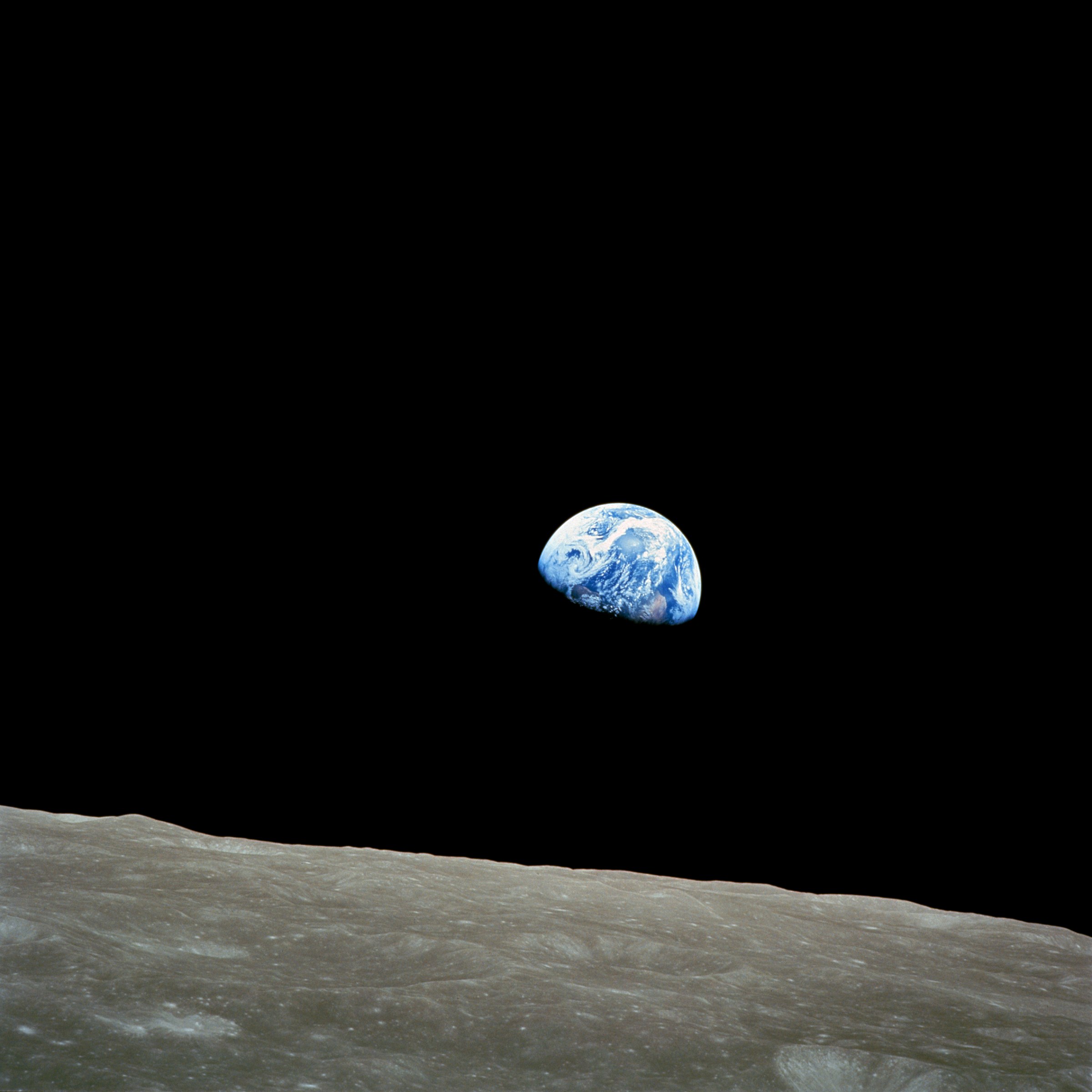
Earthrise
So what on earth does this have to with magick?
I have been asked repeatedly for years, by several people, about the idea of collecting evidence or reports demonstrating the overall rate of successful results magick. This would give us, I am informed, a nice measure of whether doing magick is a worthwhile occupation.
Leaving aside the incredibly tricky issue of defining ‘success’ in these circumstances, the statistics of success still don’t supply us with an answer to the basic question. I could succeed in only 10% of cases but that 10% might include a particularly spectacular and life changing spell. Or the converse of that, 90% success, with only minor consequences. How does this analysis affect my world, my magickal conduct?
Magick, like much of life, cannot be reduced to a linear scale of numbers or values that go one way or another. A balance sheet approach to life leaves us bereft of almost all which makes it worth living; a love life cannot be judged on the number of lovers, the number of years spent in love, or by comparing scores of various attributes. A day is neither good nor bad when we reach the end of it, as what looks like a fail can often pave the way to opportunities, and a win could lead us into further enjoyment or, to a crash back down to earth. If we expect to either epically win or fail, we leave no space for the complexity of life’s rich tapestry, pulsing with moments of sheer awe, of solid everyday satisfaction, of unexpected uncertain outcome events, those ordinary outside description times which we flourish on using, transforming, when given half a chance.
Approaching magickal practice with defined results in mind gives aim and purpose to our behaviour. The process of deciding on those aims gives opportunity for reflection on the implications, the motives, the ramifications. The underlying history. How we subsequently assess the results of our practices (was it worth it?) can often become a deeply meaningful process, in itself taking us around the loop of reframing or wider understanding (overstanding), of the specific action, and also how we think about it.
Ramsey Dukes once challenged his readers to accept every occurrence they experienced (for a limited period of time), as a message directly to them from the heart of Chaos. As a paradigm, this challenge resulted (in me) with a more conscious willingness to listen, to understand, to reflect upon, and to keep looking even after I had already got a story from the apparent facts. Creative people continue to seek for alternatives even after finding solutions, the search for diversity of choice, of looking beyond the adequate.
(I have to add that it also taught me the immense value of being able to apply shallow thought, where cake is simply an enjoyable foodstuff, rather than a total minefield of extended meaning.)
This need to seek for ever more unknown, more Mysteries to understand, whilst aware that one may never reach that understanding; this is the Great Work.
Reducing that epic quest to a series of Wins or Fails, by quantifying our progress with a scorecard, seems to me to miss the mark by some miles…
NW
“Understand now that in yourselves is a certain discontent. Analyse well its nature: at the end is in every case one conclusion. The ill springs from the belief in two things, the Self and the Not-Self, and the conflict between them. This also is a restriction of the Will… Ultimately, therefore, the problem is how to destroy this perception of duality, to attain to the apprehension of unity.”
-Aleister Crowley
 The Blog of Baphomet