I’ve not long finished reading Ruth Addams excellent devotional work A Gift of Maggots. Ruth is the main voice in the work, though there are great contributions from other writers notably Raven Kaldera. A Gift… contains poetic invocations and personal accounts, plus a decent helping of esoteric and exoteric history, about The Big B (as I like to affectionately call Baphomet).
One of the main strands in the book is the exploration of Baphomet as the deity of perverts, monsters and freaks and how in some respects this can be read as hir being the god of transgendered people, transsexuals and the disabled. This is an aspect of Baphomet that gets mentioned in The Book of Baphomet but A Gift… takes this interpretation of The Big B as its core project.
The position of trans-people in English speaking culture (transvestites, transgendered people, transsexuals) and indeed anyone who falls in some way between the (imagined) binary duality of male and female, is something which many people have worked really hard to change in the last few decades. Along with male homosexuality there have been, and are now, a wide variety of people (some trans, some not) calling for a wider cultural acceptance of the natural fact that sex and gender are fields of action rather than discrete poles.
Anyone who has spent any time exploring the area of gender fluidity, either through academic writing or personal experience, will acknowledge that physical sex (let alone the complexity of behavior) can be a wildly diverse thing. There are all sorts of intersex, hermaphroditic and more beings who are perfectly natural outpourings of the life force on this planet (which I call Baphomet). And of course The Big B hirself is emblematic of this.

Baphometic gender bending
A Gift of Maggots reads very well alongside Raven Kaldera’s book Hermaphrodeities which, as the name suggests, explores the various gender fluid archetypes in mythology. In that book Raven also presents a brilliant range of interviews from all kinds of fascinating people; male to female transsexuals, female to male transsexuals, people who have been born with various intersex bodies at birth, and those who have shape-shifted through surgery and hormone pills, into another form.
Slowly but surely the issue of widening gender away from just male/female is coming to the fore. I recently spoke to a Sister who was telling me about a colleague who had a child that, right from their early years, identified with the ‘opposite’ sex. This young person, blessed with a supportive family, had started their transition to another gender while still in the compulsory school system. What my Sister was amazed by was that, when the child returned to school with a support worker who spoke to the whole school, the child was accepted and there wasn’t any bullying over that issue . More broadly there are various campaigns and organsations active in this work, such as those HERE and HERE.
Such changes in culture are hard won. People have died over this issue in the same way that people died over the legalisation of male homosexuality or women’s enfranchisement as citizens with voting rights.
This is why I find certain aspects of the glamorous ‘outsider’ mindset, that some members of the esoteric community still cling to, so difficult deal with.
There’s a story line which goes something like this; we the <insert name of group> live outside of society, we’re not part of the ‘mainstream’, we revel in our radical rejection of the status quo and (this is the clincher for me) all attempts to integrate our way of being/fucking/dressing/doing magick within wider culture are dispiriting tactics to water-down and recuperate our radicalism into the hum-drum drone of grey-face capitalist TV culture. Of course the details of the story line will vary, but I’m sure you get the idea.
The first thing to say is that the protagonists of such views are often people who are very unlikely, because of the way they appear to others, to really be excluded from very much anything at all. So while this sense of what is, at bottom, a victim self-image may be delighted in by first world, able bodied, white middle class men, it’s unlikely that many black, disabled women in apartheid South Africa were actively happy to be full-paid up members of these ‘outsider’ groups.
An important a priori, within the story of those who delight in their own oppression, is that culture is a monolithic thing. Whereas culture is, as any fule kno, a continuously morphing changing space which is actively being created at all times. Sure they can be dominant discourses (or strands, or whatever metaphor you prefer) at work, and sometimes these need to be opposed quite directly. However by conceptualizing ourselves as ‘the outsider’ in toto we are not fighting but rather withdrawing from the real fray. One must either run to the hills, or go down fighting in a beautiful but untimely pointless blaze of glory while attempting to smash The System.
Such a position is deeply dis-empowering. What if gay men had been unwilling to fight for their rights but instead spent all their time wallowing in their outsider status? Speaking as a bisexual male who enjoys cross-dressing I’m really glad they stood up to be counted, if nothing else so that I can claim that identity without fear of losing my job and indeed in an environment where the law is of the land is on my side.
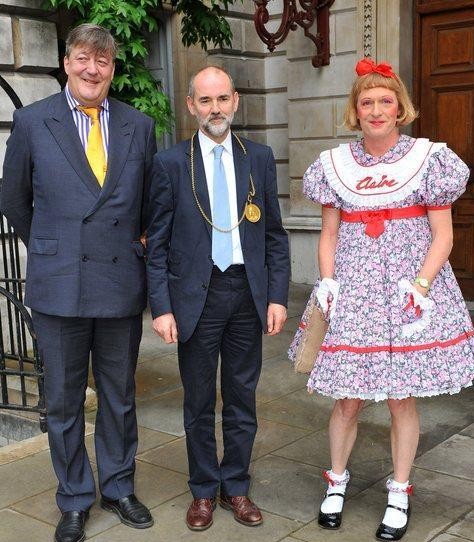
In the words of Terence McKenna (Peace Be Upon Him): We’re not dropping out here, we’re infiltrating and taking over.
The outsider, the destabiliser of culture is important, and if you read the interviews in Hermaphrodeities, one can see that this role is quintessentially as an agent of transformation, both of the self and of society as a whole.
Sure one might argue that things, for example modern Paganism, may get watered down when absorbed into mainstream (whatever that means these days) culture. But this is also not the whole story. Carving out the freedom to write ‘pagan’ on your hospital admission form is important as much for what it says about our ability to tolerate difference as it does about the perceived nature of Paganism. I pray that in the future claiming the right to use entheogens in ceremony will likewise be accepted, just as in much of the west difference in sexualities and gender forms are increasingly accepted. Social transformations can be radical and deep. Overturning the laws of western culture about sexuality and sexual identity has been an enormous change, likewise reshaping the status of women in those cultures. This is real magic set in the real world, rather than a retreat into ancient beliefs or modern exotica, wrapped up in apocalyptic visions that would make Jehovah proud.
Cultures can certainly be bland-ified, but they can also be radically changed and become more permissive, accepting and tolerant. It’s up to us, especially if we identify as witches, pagans, magicians and the like, to transform society into what we Will, and that only comes with engagement.
Not easy, but no-one said The Great Work would be.
JV
 The Blog of Baphomet