
Our Heroic Selves

In recently reflecting on the way in which Punk has inspired my own process of awakening and self-understanding, I’ve also been prompted to consider how such self-actualization also asks us to question the norms and rules we inherit. Whether via my exploration of the Gnostics or the Thelemic-Tantra of the AMOOKOS work, the path of magic for me has always been linked to a project of self-sovereignty and a desire to explore what “Peace, Freedom and Happiness” mean as I live this life.

In our pursuit of occult heroism it can be easy to imagine that any sense of progress will inevitably entail some form if icy, isolate uber-human state. While our insights will often require that we question those norms adopted by both family and wider society, the deeper challenge may be to consider how we can radically reimagine and express our relationship with others.

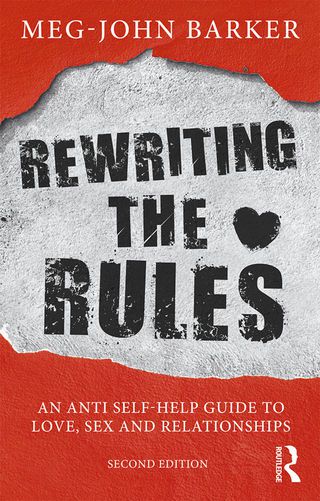
One of the most helpful books that I’ve encountered in recent years that reflects on our connections to others is Rewriting the Rules by Meg-John Barker. As the second edition of this book is about to hit the marketplace, I thought I’d share with you a review I wrote for the first edition that I published on Phil Hine’s fantastic blog…

“All of us inherit sets of rules and scripts about how we think we should behave and who we should be in relationships. Such beliefs often have their genesis in our families of origin, the cultural trends we imbibe and the shaping provided by our own experience and emerging sense of identity. In the process of trying to make sense of the pain and dislocation that many of us experience in seeking closeness and relationship, it can be tempting to “buy into” a set of apparent certainties. Recent trends in self-help literature have tried to make of the confusion by playing “The Game”, “The Rules” or by mapping gender difference according to planetary allegiance. While I can understand the impulse of such books in trying to find a cure to what ails us, I must confess to being highly unconvinced by their over-simplicity and gender stereotyping.
rewriting-the-rules

Rule book

In their book Re-writing the Rules Meg-John Barker provides a refreshing antidote to such works and a highly thoughtful and compassionate book that they describes as an “anti-self-help book”. For Barker the starting point in developing more healthy relationships comes not via seconding guessing the maneuvers of the desired “other”, rather it comes via a relationship with self in all its complexity. Self is presented as both an on-going process of change and also as a plurality of differing aspects that dialogue with each other. Barker’s insights are offered in spirit of openness and wondering-an attempt to explore the right questions rather than providing pat answers.

Part of the helpfulness of this work lies in the way in which the author focuses in on the nature of human relationships and current dominance of discourses around romantic intimacy. Barker skillfully weaves in both contemporary cultural references and philosophical acumen in critiquing the centrality of both heterosexuality and genitally focused intimacy. We are invited to move from a position of certainty and polarity, to one in which we seek to cultivate sensitivity to nuances and subtlety. Sexual minorities are not exempted from the danger of losing touch with our desires; the demands of identity politics often asking for a degree of labeling and certainty that some may feel less than comfortable about.

The structure of each chapter begins with a thoughtful reflection on the issues under consideration e.g. the rules of attraction, the rules of gender and then moves on to an exploration of the current set of beliefs that many of us find ourselves operating under e.g. “Relationships should be sexually and emotionally monogamous.” Barker then gently begins a process of questioning and deconstruction that ask us to re-evaluate. Meg-John’s own background in mindfulness practice and existential psychotherapy seem very evident during this process given the acute sense of awareness they display and the degree of compassion towards self and others that runs throughout.

The richness of this work defies detailed description in this context, but the chapters on sex, gender and monogamy resonated deeply with some of my own personal exploration. The chapter on sex examines the way in which insights from the Queer and Kink communities have challenged not only the linearity of “foreplay as a starter, intercourse as the main event”, but also the centrality of genital sexuality itself. In thinking about how gender effects how we do relationships together, Barker artfully unpacks Judith Butler’s thinking on the performance of gender and how we might loosen the tyranny of binary thinking.

One of the most enjoyable aspects of this book is the depth of its meditation on the nature of friendship. The chapters on the nature of love and commitment rightly question the qualitative distinction that we make between how we relate to “Friends” and “Lovers”. How might our relationships improve if we let go of the assumptions we make and unrealistic expectations that we often demand of those we have sex with?

Given the centrality of existential psychology within the book, themes regarding endings, loss and transition are thoughtfully and thoroughly addressed. Barker is highly aware that in times of pain we may naturally seek to retreat and defend ourselves, with this in mind they provide many helpful exercises and strategies with a view to developing greater presence, flexibility and compassion. As with the other discussions in the book, the aim of such work is not to prescribe a new “hipper”, queerer orthodoxy, rather it seeks to explore how we might experience a greater sense of freedom, both for ourselves and those to whom we are connected.

I highly recommend this work to anyone interested in a philosophically and spiritually engaging examination in how we challenge and re-write the stories that we have inherited about how we “do” intimacy. Meg-John has managed to produce a book that is at once contemporary, engaging and entertaining, while at the same time providing depth and vivid insight.”

Steve Dee

The Hardcore Bard

“Do you know yourself, do you know the others? Can you pull the weight that rides on another’s shoulders? Once you’ve lost yourself to the acceptance mask, well could you find yourself, it’s not a simple task. Self-inherence, freedom. Comes from within.  Take a different track. It’s time to see what you are made of. Can you expose yourself? Can you peel away another  layer? Will you make the time, the time to take control? Because only you can save yourself, only you can save your soul….come on, can you let go, can you, be you?”

Caboose by Snapcase (1997 Victory Records)

One of the criticisms that I often hear levelled at Druidry as a path is that it’s a bit polite! Having spent a fair amount of time hanging out with Chaos magicians, Thelemites and Left-Hand Path folks, when I discuss my connection to the Druid path, the question is often asked about what it has to offer in terms of methodology beyond its very public rituals and solar orientated aesthetics. In circles where darkness, intensity and the spilling of bodily fluids are potential measures of commitment, it could be easy to dismiss Druidry as being overly ordered and lacking in changed focused techniques. In my view such a reading is superficial and fails to account for subtle currents of inspiration that allow for a slower more sustainable form of personal evolution.

bard

A Hardcore Bard at Work

While works such as Ronald Hutton’s excellent The Druids highlight the struggle that modern Druids might have in uncovering what their ancient forebears actually did, we still have a rich body of both Celtic lore and the last two to three hundred years of reconstruction to draw from. While some may look down on the pseudo-masonic and Christian influence on the Druid revival, I personally feel that it holds some truly rich examples of the human spirit seeking to explore Mystery beyond the confines of the prevailing religious orthodoxies.

One of the aspects that I love in most forms of reconstituted modern Druidry is the way in which the grades of Bard, Ovate and Druid are seen as interacting with each other. While most contemporary Druids view these roles as being a progressive hierarchy, it is important to acknowledge that some present-day adherents elect to remain as a Bard or Seer (Ovate) if they feel that this best captures their calling. For me the adoption of this three-fold scheme is less about moving through a stage in order to reach the next level, and more about an essential group of experiences that make the stage of the journey possible.

The work of the Bard often involves a reconnection to the spirit of creativity. The three drops of inspiration (Awen) that Gwion Bach ingested from Cerridwen’s cauldron, catalysed a process of alchemical change in which he eventually became the great poet Taliesin. Gwion’s transformation was far from easy as he was forced to adopt multiple animal and even vegetable forms in order to escape the pursuit of the dark Goddess in the form of Cerridwen.

The process of re-contacting our inspiration and creativity often involves a descent into the roots of our unconscious. Without this journey into the rich loam of our dark dimensions, our art and creativity risks a thinness that robs our work of its true magical potential. As I considered in my last post, we need to utilize the mirror as a tool for self-examination in meeting the challenge to “Know Thyself!” Our dreams need to be attended to and I have gained much benefit in revisiting old magical journals in order to comprehend the repeating patterns and ideas that revealed the deep drives that were shaping my magic.

In thinking about Bardic inspiration one could easily lapse into the stereotype of a harp-strumming longhair wandering through sun-dappled forests. As awesome and evocative as such images are, my own reconnection to Awen took a far noisier form. Dear reader I confess that I was a childhood metal head and that my own desire for increasing musical heaviness drove me into the sweaty tattooed arms of hardcore punk.

Any attempt to define musical genres will always be fraught with purism and border skirmishes, but broadly speaking, hardcore Punk (especially in its North American form) tends to integrate the rebellion and aesthetics of Punk while also capturing the heaviness and speed of more extreme Metal. Alongside its distinctive musical style, Hardcore often sought to convey a message of positivity, self-actualization and a desire to question societal norms regarding the food we eat, the drugs that we take and the things we consume.

Within the world of Hardcore, themes connected to the spiritual search are rarely far below the surface. Whether in the Heathen brutality of bands such as Neurosis or the Krishna-based longings of Shelter or 108, the desire to find both discipline and vision have driven artists down some intriguing by-roads.

As with any musical movement advocating change, there is often a distance between these ideals and the actual scene that espoused these goals. Although Queercore and the Riot Grrrl movements have gone some way in challenging the homophobia and misogyny within the Hardcore scene, it would be naïve to deny their presence. At it’s best however bands such as Fugazi, Quicksand and Neurosis have been able to maintain integrity and the evolution of their musical sound.

Each of us will have our own aesthetic styles and artistic media from which we can draw the waters’ of inspiration. As much as I love musical heaviness, regular readers of this blog will also be aware of my passion for both dance and Surrealist visual art. What feels important is that we give ourselves permission to embrace a holism in which the sacredness of all things is allowed to disrupt any secular/spiritual dualism. For me as a Postmodern Bard, my own journey to find inspiration, vision and discipline has enabled me to appreciate the way in which Hardcore at its best embodies these qualities and plays an important role in sustaining the flame of alchemical transformation.

I’ll end with some with some great lyrics from the Neurosis’ track “Burn”:

“You lie in the snow, cold but not dead
Stare into the sun, long since its last heat

Feel the freeze burn skin
Salt your open wounds
A burning desire clears your eyes
A willful air fills your lungs

You choke your first breath of wildfire and oceans depth
Climb out of your hole, see your spirit take form

This world of cold stone gives nothing in return
To those who sleep while the restless burn
There are those few driven to flame
Most are content to drown in the wake of dreams

The trail lies overgrown
Across the years fade out of light
Ever growing dim to an age in the dark
Grasp from your soul and don’t let them steal your eyes”

From The Eye of Every Storm  Neurot Recordings 2004

Steve Dee