
Exercise: Sculpting Your System

One of the techniques that I often employ during my own systemic psychotherapy practice is that of the sculpt. Sculpting is a tool for making an external picture, or ‘sculpt’, of an internal process such as feelings, experiences, or perceptions.  It can use body postures and spacing as a demonstration of relationship patterns of communication, power, closeness, and distance.

Sculpts can take many forms. They can involve the placement of individuals in proximity to each in order to capture something of their relationship with each other, e.g. “You’ve chosen to stand behind your son, does that mean that you feel protective of him?”; or they can utilise objects like buttons or rocks to map out the things that are important to us in our lives. Work with sculpts was pioneered by the brilliant Virginia Satir (see her book Peoplemaking). Satir was one of the three therapists of excellence on whose work Richard Bandler and John Grinder based their development of Neuro-Linguistic Programming.
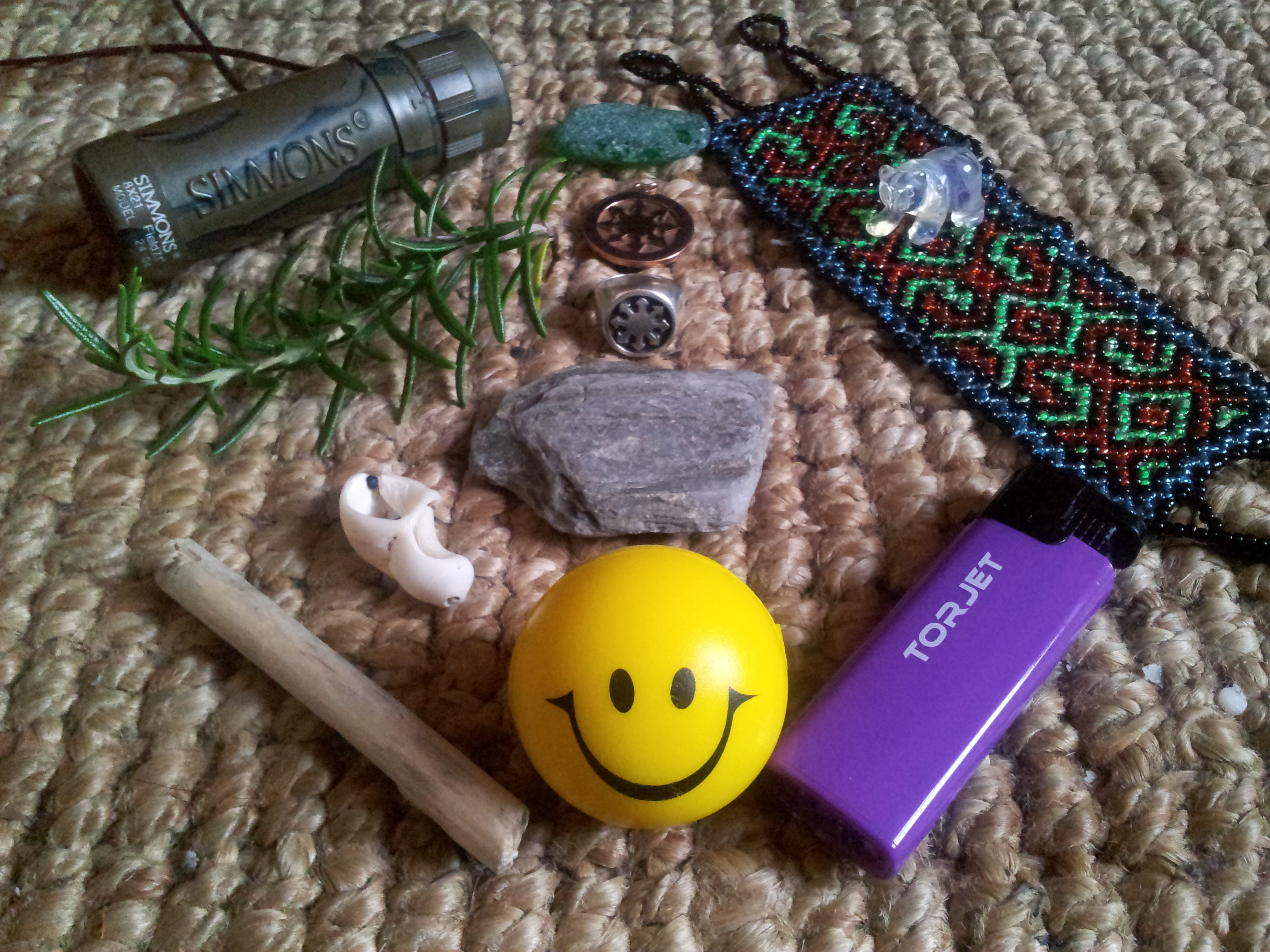
things

Many things

For this exercise I’d like you to find a collection of small objects that you feel can represent the people or interests that are currently important in your life. You might chose something fairly abstract (buttons or rocks), or you might use objects directly connected to a person such as a feather or a chess piece. Make sure you also choose something to represent yourself.

Once you have collected your objects and placed the object representing yourself in the centre of your working space, begin to place these objects in proximity to yourself and each other. Perhaps a sister is currently somewhat distant (she’s a smooth black button, very prim and proper), whereas the uncle you’ve reconnected to (the small toy golf club) is quite close. Don’t limit yourself to family or even people. Pets, hobbies, spiritual beliefs, the deceased and your games console can all be represented within your personal universe. Part of the aim of this exercise is to enable us to gain a new appreciation of the elements within our personal universe and to consider whether there are aspects we wish to change.

Often when people use this technique in therapy, the next step is to consider what you might want to move, introduce or remove from the sculpt. As people move objects closer or further away from each other, the therapist might explore what could need to change for that desire to take hold more objectively. Maybe I need to ring my sister to have that tricky conversation or, if I want those cigarettes out of the picture then I need to get to a chemist. This can be a highly helpful exercise as we think about what might prevent change and also the things we thought were important but forgot to put in there.

Perhaps it needs stating that this can be a highly poignant undertaking that one should not feel rushed in doing. We are always very conscious within a clinic session of allowing people to disassemble their own sculpts and allowing them to keep a specific object if they feel the need to.

Given that recently I have been thinking about the main players within Gnostic mythology and their inter-relationship, for those of us following an esoteric path it can also be interesting to use a sculpt technique to depict our relationships with our gods, spirits and other spiritual allies. Many magical folk already do this unconsciously via the construction of altars. When we look at these spaces, we can see the way in which we perceive our alliances and also how we want to communicate them to ourselves and potentially others. As Julian and I have reflected upon in these two podcasts, altars often act as anchor points for our spiritual lives, by which we return to these spaces to reconnect ourselves with the values and worldviews that are important to us during a given time.

Another exercise of potential value is to create a sculpt involving the spiritual forces that one currently sees as being present in your life. You may wish to use small objects again or you may choose to utilise statues and magical tools that are currently integrated within altars or working spaces. When I have done this for myself, I have noted with interest the distance between those things  I assumed were important and what I actually found myself putting in my altar/sculpt (in my case there wasn’t a chaos star in sight!).
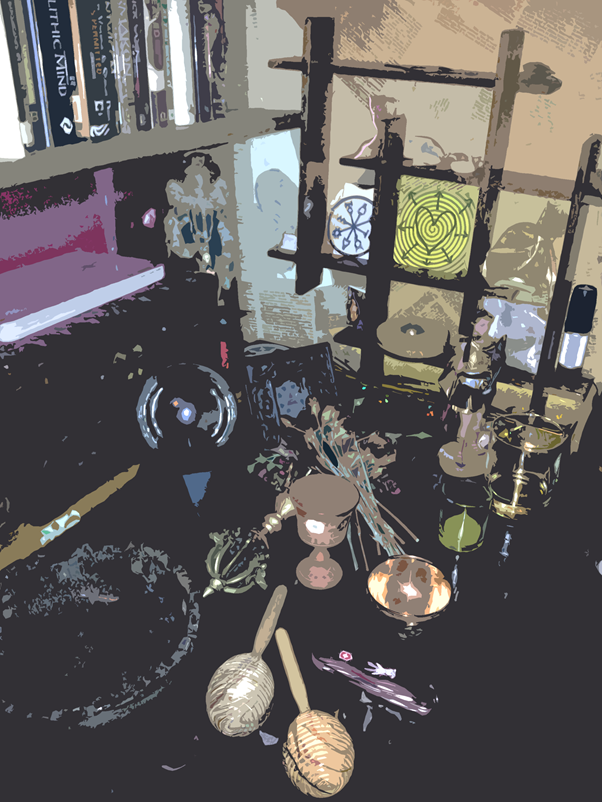
One star in sight!

One star in sight!  (Behold, an altar yesterday.)

After we have created this altar-sculpt; take time to reflect on what its significance might mean for you. Following your reflection you may want to shift, introduce or remove elements of what you have depicted in physical space. The very act of doing this can be an invocatory act as we acknowledge those spiritual realities that we wish to see more present in our lives. As we consider the new map we have created, it can be helpful to make notes of these changes, as these shifts may provide us with directions for further more in-depth ritual work.

My own experience, both therapeutically and in a more ritual context, is that sculpts can be a highly effective tool for helping us access the less linear aspects of ourselves. They can help promote more visual forms of processing and allow a greater sense of playfulness in that you can’t really do it wrong! Anyway I hope you have fun with it and find it helpful. 🙂

SD

Magick – contains Mild Peril

Sometimes we find ourselves in dangerous and difficult situations. From illness that may develop inside ourselves to threats from violent outside forces. These situations shake us up, both literally and metaphorically. Then we may experience times of repose, peace and ease. Between these imagined extremes there is the range psychic states and circumstances that we inhabit. Looked at from the perspective of our life-stories these ups and downs, these turnings of the Wheel of Fortune, may perhaps make us suspicious of concepts such as ‘altered states of awareness’ since that idea assumes a ‘normal’ state of awareness. In reality our ‘I’ is always in a flow state and in a particular, on-going, context.

Systems such as religion exist, in part, to provide us with psychic assistance as we encounter the slings and arrows of outrageous Fortune.  While the research is by no means the last word on the subject, there is evidence to suggest that spirituality itself provides a protective function in terms of individual mental health.

This psychically protective function of spirituality is developed within the many practices that emerge from the esoteric aspect of religions, and from approaches such as shamanic training and occult praxis. This is done through the production of situations where the individual is faced with a limited and more or less sanitised version of one of the life experiences that as humans we all share. A simple example is the use of fake death scenarios. This may be part of a formal initiation ceremony, a shamanic style de-fleshing and re-birth or similar practice. We act out ‘as if’, as Spare and Hans Vaihinger  would put it, we are facing the fact of our death.

Doing this kind of ritual, where we battle with imaginal beings, experience death, or otherwise mimic the actual travails of life is what I like to call (in homage to the bonkers British certification system for films) the gnosis of ‘mild peril’. (Though the phrase ‘contains mild peril’ is now being phased out because, following consumer research it ‘…turned out to be rather more esoteric, with apparently only (the) British Board of Film Classification examiners knowing what it means”.)

Mild peril; be it the point of the sword placed against the chest during a Wiccan or Masonic initiation, or the heat that one may choose to endure in sweat lodge, is an important part of many occult practices. Part of the skill of the practitioner, especially if they are working in a group setting, is to create a ceremony where there is tension, difficulty, and after the ordeal or other process is accomplished, resolution and empowerment. Sometimes mild peril rites may be static (one might for example undertake an all night vigil, perhaps outside in remote powerspot), they may also be active (one may be asked to spin, whirling dervish style until trance and/or exhaustion is achieved). Mild peril, like safe, sane and consensual erotic play needs to be carefully approached so that while there is risk it is managed intelligently.

a moment of Mild Peril

a moment of Mild Peril

For those of us who are engaged with esoteric practice the use of mild peril is important stuff. While we may perform rituals that are all about nurturing and supporting ourselves we also need to challenge ourselves too if we are to genuinely engage in the Great Work. One key function of mild peril is that it shakes us out of our complacent and repetitive behaviours. We all have these ‘programs’ within the construct of who we are and that’s not a bad thing in itself. Much of who we are is this repeated series of automatic routines that run with little or no conscious intervention, from the movement of food through our guts to the way we behave in certain social situations. However we also need ways of breaking out of these patterns, especially if we want to understand ourselves from a new vantage point. Failing to do so reduces us to a simple stimulus-response pattern of action. We become creatures rather like the story of the Sphex wasp from Mechanical Man by Dean Wooldridge mentioned in  Douglas R Hofstadter’s classic Gödel, Escher, Bach:

“When the time comes for egg laying, the wasp Sphex builds a burrow for the purpose and seeks out a cricket which she stings in such a way as to paralyze but not kill it. She drags the cricket into the burrow, lays her eggs alongside, closes the burrow, then flies away, never to return. In due course, the eggs hatch and the wasp grubs feed off the paralyzed cricket, which has not decayed, having been kept in the wasp equivalent of a deepfreeze. To the human mind, such an elaborately organized and seemingly purposeful routine conveys a convincing flavour of logic and thoughtfulness-until more details are examined. For example, the wasp’s routine is to bring the paralyzed cricket to the burrow, leave it on the threshold, go inside to see that all is well, emerge, and then drag the cricket in. If the cricket is moved a few inches away while the wasp is inside making her preliminary inspection, the wasp, on emerging from the burrow, will bring the cricket back to the threshold, but not inside, and will then repeat the preparatory procedure of entering the burrow to see that everything is all right. If again the cricket is removed a few inches while the wasp is inside, once again she will move the cricket up to the threshold and reenter the burrow for a final check. The wasp never thinks of pulling the cricket straight in.

On one occasion this procedure was repeated forty times, always with the same result.”

A cricket in more than Mild Peril

A cricket in more than Mild Peril

Of course humans too become easily trapped into Sphex-ish behaviours; addictions, thoughtless patterns of behaviour, ranting away on teh internetz about a tiresome obsession – repeating activities less like an autonomous person and more like an automaton; a sad broken record. In these cases circumstances it may be very hard for the individual to find a way out of their behavioural loop. Luckily as a social species we may have others to help us. People with friends and, for folk in more difficult circumstances, support workers or mental health professionals can help us snap out of Sphex-ish behaviours. In a magical context the performance of practices as simple as ritual purification (ceremonial bathing for example) or as dramatic as Sun Dance style endurance ordeals are all ways of changing our set and setting. The use of mild peril, where the blood is set pumping, adrenaline levels spike and we become hyper alert can, if properly managed, be a great way to break those patterns that can trap us in a groundhog day of repeated pointlessness.  In this way, unlike the Sphex wasp, we don’t get flummoxed by our cricket being moved and instead break out of the tedious routine game and into something richer and more rewarding.

JV