
This week I took my Third Degree initiation and became a Master Mason, which was nice.
As someone who has already gone through Wiccan, OTO, IOT and other initiatory rites I found the Masonic initiation process fascinating and deeply moving. As anyone who has been paying attention to the history of esotericism knows, many key elements of contemporary ‘western’ initiatory ritual (being blindfold and bound, actual or symbolic nakedness, a challenge with a weapon at the threshold of the sacred space) along with much of the specific language (such as ‘The Charge’, the formal presentation of ‘working tools’ and phrases such as ‘So Mote it Be!’) are derived from Freemasonry.
For those of a salacious (or insane) persuasion Freemasonry undoubtedly conjures up fantasies of a baby-eating, one-world governing, lizard brotherhood. The truth is rather less outré. Freemasonry exists primarily as an inclusive (ie multi-denominational) ritual structure at the core of something which is essentially an affinity group based on mutual aid. That’s why there were so many Freemasons (and indeed other organisations such as the Antediluvian Order of Buffaloes, the Ancient Order of Druids and the Ancient Order of Foresters) in early modern Britain. These groups provided their members with financial and social support in times of trouble before the creation of welfare state and social security systems. (Which, it’s worth remembering, is a valuable all-inclusive structure: One my ancestors fought for having endured exploitation by the plutocratic class during the times of enclosure and the industrial revolution.)
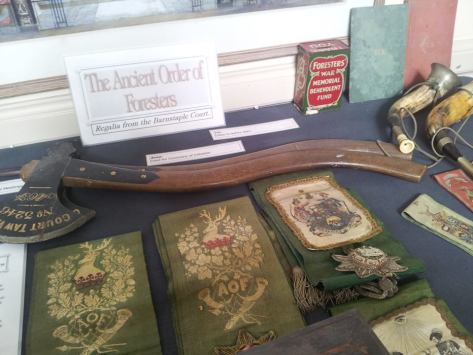
Woodland regalia
The rituals within Freemasonry, whether they are the Three Degrees or the side-degrees (such as The Royal Arch) are typically initiations. This emphasis on initiation is continued by the Masonic-Thelemic mashup of practice provided by the OTO, and indeed this focus on initiation found in some styles of Wicca. (In its most curious manifestation this shades off into, in my view, a bizarre emphasis by some ‘hard Gard‘ practitioners on maintaining an imagined lineage of practice back to Gerald Gardner who, as any fule kno, along with Crowley, made up Wicca in the first place, predominately out of his own head.)
Freemasonic rituals are learnt by heart, and this is key to the practice. In a chaos magic sense the ‘esoteric tech’ being deployed is that of achieving memorisation, while at the same time, keeping the ritual sounding fresh and alive (especially when these words are spoken to the candidate during initiation).
The corpus of Masonic ritual texts is extensive, with much of the material being contained in The Blue Book (which naturally comes in many variations depending on the Lodge, region and nation in question). Unsurprisingly, given the period in history in which this system was developed (the United Grand Lodge in Britain is about to celebrate its 300th year anniversary) the art of memory is central to the system. I’ve met Freemasons who have memorised The Blue Book completely and, when examined, can recall the text, in any order, with >97% accuracy. Now that’s certainly one way to ‘build the temple’ (or pyramid, see below) of practice!
While Freemasonry relies on the cultivation of exact memory my own practice is usually quite different.
Another day, another initiation; This time with me as one of the initiators.
I was approached by a magician from London who asked if he could undergo an initiatory process within the envelope of Chaos Craft. His motivation wasn’t so much to be part of ‘our club’ but rather to use an approach to magic he digs (ie that witchcraft meets experimental magic vibe) as part of his own self-transformative process. Sometimes an initiation isn’t into something, as much as it is about a process; a desire for a ceremonial act that both recognises where we are at, and instigates a new cycle of change and development at an individual level.

Challenging times
Our candidate having completed his preparatory work, bravely made his way from the big city to deepest darkest Devon. That evening we read through the ritual, a variation of the one given in Chaos Craft. Since our candidate had also read the rite (and because we tend to favour an open source approach) we took a little time in my kitchen to run through the ceremonial plan with him present:
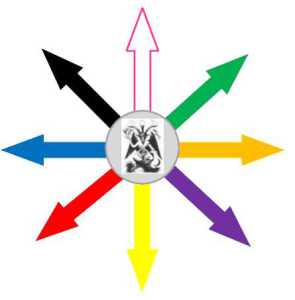
“So, we make the space. Do some stuff to open, maybe the chaosphere banishing.”
“What 8.1?”
“Or is it 1.8? Anyhow, yeah, up and down once, then 8 thingies at each direction widdershins”
“Then say some stuff about the wheel of the year and pull in the powers from each direction…”
Our informality was obvious. In our group (in this case me, Nikki Wyrd and Steve Dee) we’ve worked together for so many years we can use a simple short-hand. But as I explained to our guest and candidate:
“Don’t worry, we talk about this like it’s throw away stuff, but we’ll be using some serious focus when we’re in the temple.”
(And we did.)
Star system
At the end of the Chaos Craft initiation the new initiate is asked to declare an identity for themselves with a (magical) name and (personally chosen) title. In advance of the rite I could see our candidate diligently reading through this section of the text (and generally looking for those places in the order of ceremony where he had to say stuff), so I explained:
“Each piece of text here is a guide to what might be expressed at this point in the ritual. Don’t worry about the exact words. Think of the writing more like place-holders for what we hope will be expressed in each part of the ceremony”.
This free-form approach to ritual is much more common in (for want of better words) ‘shamanic’ styles of work, in contrast with the rote-learning Hermetic-Masonic styles of ceremony. While shamanic style rites may require memorisation (many archaic cultures have great traditions of learning stories, geologies and songs by heart, and the Chaos Craft initiation itself requires the memorisation of a Barbaric Invocation) the emphasis is on what I call ‘saying what needs to be said in the moment’. The words on the page are like guidance notes; serving suggestions for what happens as the ceremony unfolds. In terms of the esoteric tech this is a method-acting, spontaneous approach.
Obviously contrasting these approaches isn’t a value judgement; memorised ritual has it’s place, as does a more improvised style. And a good blend of both approaches is what the successful occultist aims to cultivate. Like Crowley says:”The Magician must build all that he has into his pyramid; and if that pyramid is to touch the stars, how broad must be the base!”
May your pyramid touch the stars!
JV

 The Blog of Baphomet