The Typology of Magic

I was at a museum private view recently when a colleague from a partner organisation told me that she’s been looking me up on-line. ‘I didn’t realise you were a chaos magician,’ she remarked, and then ‘is it quite dark?’

I’m pretty lucky in that I’m out (as a Pagan and occultist) at work and am employed within a sector in which religious or philopshical beliefs (that don’t conflict with our policies about equality of opportunity, anti-racism, an LGBT-postive agenda and so on) shouldn’t be a problem. In fact in an area such as Northern Devon (where over 95% of the population identify as ‘white British’ of which the vast majority describe themselves as ‘Christian’) my own beliefs perhaps add somewhat to creating a more diverse culture.

In my brief explaination of chaos magic (CM) to my colleague I touched on ideas such as fractals and chaos mathematics (self similarity at different scales and the analogous observation that different spiritual traditions exhibit similar techniques of praxis even where their exoteric credo may appear very different). I mentioned the idea of Khaos in the ancient Greek sense of the term; the unknowable void from which arise the many formed manifestations of the universe.
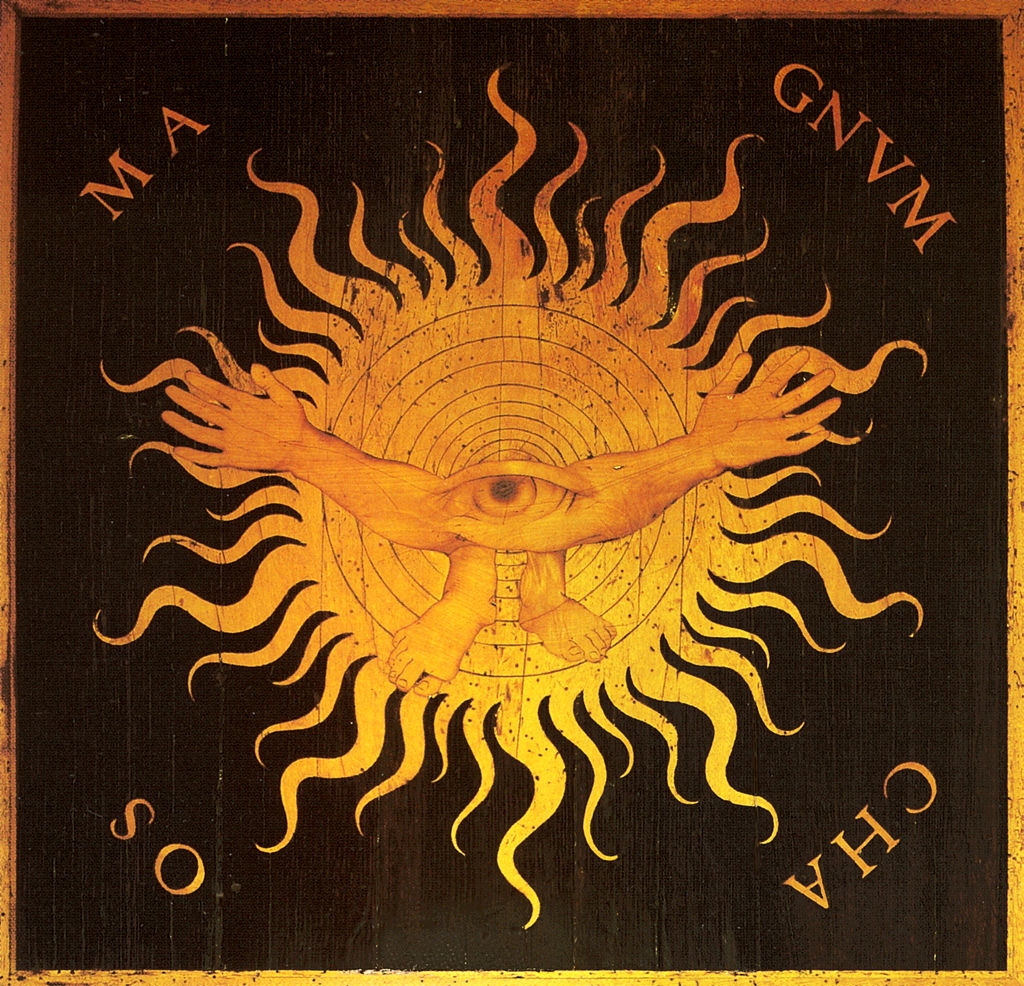
Santa Maria Chaos

Santa Maria Chaos

CM can also be described in terms of its historical development, a particular approach of style of spiritual endeavour. One that developed from a confluence of late 20th century ideas; ceremonal magic, neo-paganism, Discordianism and more. As a style it was influenced by the punk, do-it-yourself approach; an intensely personal quest to discover magic for ourselves rather than having it filtered through the theology of Thelema or Wicca or whatever.

The use of the term ‘chaos’ does (in its modern sense) suggest, as my colleague had surmised, a certain darkness. But what in practice does this mean? One way of understanding this might be to consider CM as having a particular flavour, a style in the sense that there are styles of clothing, of music or martial arts.

As humans there are different trends that appeal more or less to each of us at certain points in our lives. As a younger man I experimented with dressing in punk, chapish, goth and other styles of clothing (and these days I’ve added museum professional, Freemason and crossdresser to the list). So while chaos magicians (in terms of their practice) might draw on different paradigms or expressions of spirituality (or other methods of esoteric investigation) there is, never the less, a certain style or flavour to something we designate as ‘chaos’ magic.

Of course humans being humans it’s pretty common to find some people (mostly those who are rather new to occultism in my experience) asserting the primacy of their own preferred style ‘CM is just superficial punkery’ or ‘Wicca is just fluffy faggotry’ or ‘Thelema is only for Crowley fan-boys’ etc etc. Yet more experienced practitioners tend to realise that while there are differences in forms of occultism these are outweighed by their similarities. Even apparently über-radical-traditionalist styles of magic (such as the rites described by groups such as the Order of Nine Angles or various forms of Traditional Witchcraft), when one drills down into the guts of the practice, one finds methods for changing consciousness, magic circles, spooky barbarous words and songs etc etc. As they say in the Orient: Same same but different.

Another way of thinking about the relationship between esoteric styles is that of music. Music comes in different genres. It typically consists of sounds (and the absence of sounds) placed into relationships and while it may be challenging to specify exactly what music is we can all recognise the various forms in which it appears (ie what it does).

All those are just labels we know that music is music

All those are just labels we know that music is music

As a former graphic designer one of my favourite ways to consider the relationship of different magicultures is as styles of lettering. A chosen font tells us something about the aspirations and sense of self of any given tradition. It also tells us how that tradition (especially in these days of self-publishing) would like to present iteself to the world. Thus the word ‘chaos’ in the example below is a bit alien/futurist/goth – this is a youthful font, wild and certainly ‘dark’. Then we have ‘Druid’; folkish and friendly. ‘Shaman’ is strong, ‘ethnic’, perhaps carved, delighing in the simplicity of only upper case. ‘Thelema’ is classic, authoritative; perfect for a religion with a sacred book and reams of texts catalogued into classes A, B, C etc. ‘Witch’ suggests a wildness (the letters don’t sit evenly on the line), perhaps a slightly retro feel with those serifs, and a human-scale sense that this writing may have been produced by hand.

Many faced magic

Many faced magic

Taking this method of analysis a little deeper we can focus our attention on just one sector of occulture and see how fonts reflect the various flavours which that style contains.
Mysterious writes

Mysterious writes

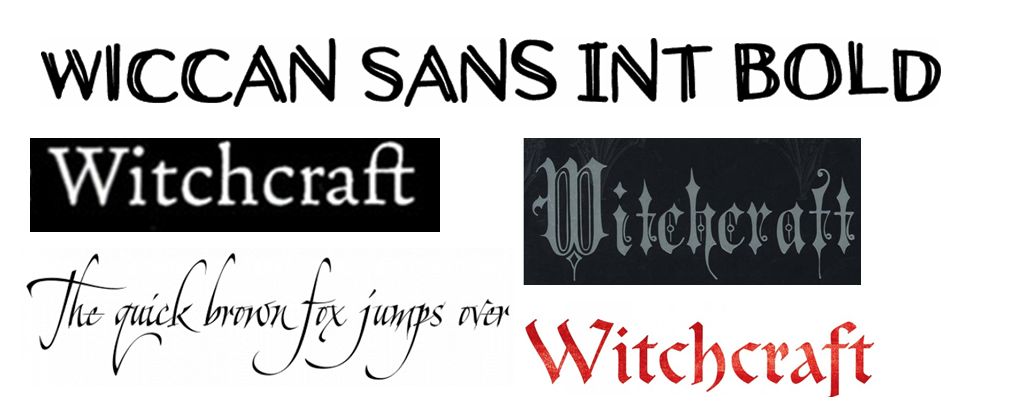
The first font (and yes it is actually called ‘Wiccan’) again suggests something very much at the human-scale, hand Crafted and simple (and the moon like ‘C’s may subtly allude to the the nocturnal aspect of witchcraft). The next reversed out text is more authoritative but maintains an olde worlde feel (the ‘W’ and ligature of the ‘f’ and ‘t’ put one in mind of early modern type). The more elaborate grey text on black goes for that spooky vibe. Based on an imagined late medieval Gothic illuminated lettering, this text has an additional sprinkling of fairy-dust scroll work. The lines ‘The quick brown fox’ is the kind of font one finds in the seminal book Witches by Erica Jong (illustrated by Joseph A. Smith) and similar texts. Again human-scale, romantic and with a suggestion of days of yore. Meanwhile the red lettering reprises the above observations, providing a font that is old skool, hand-written and gothy. By taking examples of fonts like this we can discern the things that appeal to people who like witchcraft.

Take a browse round the library, the bookshop or on-line and one can easily see how the fonts we choose reflect our identity and the spells we hope to cast (through writing) on the world.

So when people ask me ‘what is chaos magic?’, especially if they know something about occulture, the letter style analogy is one I often use. What we are all doing, in our different ways is ‘magic’, the wrapper we choose for our practice, like the selection of typefaces, is about the style we find most evocative and inspirational (at any given time) as we make our journey into the Mystery.

JV

Pop Magic will eat itself!

In Feeding Part-Made Gods I got down to some speculative musing about how Vampire dynamics might be at play in our engagement with strange god-forms. As we feed on the magic they embody, so also their presence in the realm of ideas is strengthened as they sup on our attention. While some may be dismayed by such visceral metaphors and what they say about our universe, it was my contention that they can be helpful when worked with consciously.

This vampiric principle, while certainly susceptible to a degree of gothic excess, is also quite helpful in understanding how Chaos Magic (CM) seems to interact with other more ‘traditional’ religious paths. In seeking to describe the type of ragged, punk rock energy often associated with CM, we are presented with a current that has a rather irreverent, shifting and arguably consumerist engagement with the religious traditions they engage with. At best this relationship seems symbiotic, at worst it could be depicted as parasitic and vulnerable to accusations of cultural appropriation.

Culture vulture

Culture vulture

In a recent dialogue with some magical friends, one colleague observed that CM seemed to be like the serpent swallowing its own tail. What my friend was seeking to convey was that while it may have brought new energy to western occultism, without traditional material to engage with it would ultimately prove barren if its relentless deconstruction was eventually turned in on itself.

This question of what constitutes ‘tradition’ and ‘traditional religion’, is fraught with potential confusion and the construction of false dichotomies. If we start with the root concept that traditio (Latin) relates to that which is handed down from a group who have had a shared experience, then we are already faced with questions like ‘how long have they had to be engaged in doing it?’ and, ‘how many of them?’. If folks within pagan communities are pointing towards forms of ‘traditional Wicca’ and ‘traditional’ forms of Crowley’s Gnostic Mass, this illustrates the fairly recent time frames we are working within.

Many of us, in walking more ‘left-field’ spiritual paths, are in search of anchor points via which our self-narrative can feel more secure. Reference to historic precedents for what we are doing often feels appealing as we seek to legitimise the risks we are taking and the spiritual terrain that we are hoping to navigate. The prevalence of this tendency seems to provide some evidence for such myth-making to be a shared human need.

Chaos magicians are no different. Certainly in seeking to understand my own love for this approach, I have sought to locate the historic examples of magical practice that help me (somewhat ironically) to create my own sense of ‘historic’ Chaos magic. Whether it be appeals to the ‘dual-observance’ mash-ups of Cunning men, or Austin Osman Spares’ use of sigils and concept of Kia, I’m undoubtedly keen to find others ‘who did it like I do it.’

Ia! Ia! It's the Kia!

Ia! Ia! It’s the Kia!

What probably separates CM from most other magical paths is the way it seeks to engage with the concept of Truth. While many paganisms and magical philosophies tend to start with a certain mythic theology or religious revelation (e.g. Wicca or Thelema), CM in its Postmodernism is far more focused on the performance and practice of magical ‘doing’ in response to the cultures that it finds itself within. Rather than claiming a revelation of some great ‘truth’, it is openly symbiotic and relational in expressing itself in the terms of something that it is responding to.

For some this may seem shallow, rootless or overly adaptive, but at best I believe that such an approach openly highlights the syncretistic dynamic that is at work within culture anyway. As magicians the interface between ideas presents us with a liminal space, within which new ways of being can be explored.

For many the concept of syncretism has something of a bad name, it speaks of blurred boundaries, conceptual overlap and a dilution of tradition. Personally I believe syncretism is all of these things, and, that it is inevitable. In thinking about an ideology, be it a political or religious one, even those that make claims to being revealed rather than emergent, are reliant on context and the adaptation of or reaction to existing ideas. As I have written about elsewhere – Slow Chaos – it may be that our discomfort with syncretism is more about the pace at which it occurs rather than it happening it all. In contrast to a more organic process whereby two or more differing perspectives interact over time, perhaps our sense of psychic indigestion relates to the rate in which we are bombarded by a plethora of competing worldviews day in, day out.

Perhaps the beginnings of an answer to how the process of syncretism can be both slowed down and directed creatively can be found via the process of hybridisation. In trying to tease apart the possible differences between the process of syncretism and that of hybridisation, one of the primary differences seems to be the degree of consciousness brought to the activity. While syncretism often occurs unconsciously via proximity, hybridisation usually involves the deliberate splicing together of at least two differing perspectives in order to produce a new entity that functions more effectively within the context that it is developed. In reflecting on my own adventures in hybridising Zen sitting practice with Heathenry. I have begun my own process of trying to identify some of the common traits that might be shared by those engaging in conscious hybridisation. Some of my suggestions are as follows:

  1. A sense of vision related to the hybrid being proposed- rather than it being just an amusing ‘mash-up’ the individual or group involved feel that something important is being offered and that there is a sense of aesthetic coherence between the paths involved; for me the combining of Zen and Heathenry related to ideas around personal responsibility and stoicism, as well as my own perception of a more minimalist sensibility.
  2. A desire to engage as thoroughly as possible with the primary source material of whichever traditions or ideologies are being combined.
  3. A high degree of transparency with regards to both the sources being worked with and the process of combination itself.

Probably like any good art, the sacred technician seeking to work with these hybridising processes needs to combine both vision and discipline. Vision ensures that the endeavour itself is fuelled by the uprising of creative energy inspired by the need to contextualize spiritual ideals. Discipline hopefully reduces the likelihood of simply using religious buzz words in order to legitimise personal whim.

SD