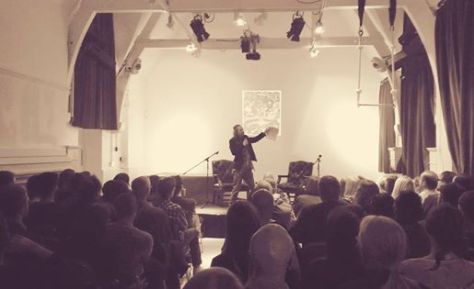
I was very pleased to be an invited speaker at Breaking Convention and honoured to find that the lecture theatre was full to capacity. The vast majority of the presentations filmed at Breaking Convention will be uploaded over the next few weeks to the Youtube and Vimeo channels. However, as is traditional, the film of my talk (and that of Bruce Parry, John Crow, Karen Lawton & Fiona Heckles) disappeared in a puff of digital fairy dust. Luckily the Seed SistAs were able to re-record their talk and I’ve promised to plonk myself in front of a (working) video camera and record my talk before too long. In lieu of that recording here’s the text of my presentation at BC. Many thanks to all the people who found me afterwards to let me how much they enjoyed my talk.
I’m going to talk about psychedelic ceremony. I’m going to give a range of examples and finish by considering the opportunities and challenges that face us, the growing, planet wide, psychedelic community.
I suspect we the people in this room have a broadly shared consensus of what we mean by ‘psychedelic’. Our consensus would probably be around ideas like altered or extraordinary states of consciousness. The conscious bit matters; these are states of awareness, things we can recall, however imperfectly, when back in what we typically describe as our baseline or ‘normal’ states of awareness. The ‘extraordinary’ component of our definition reflects our subjective perception that these states are ones that are different, sometimes radically different, from the states of awareness that we usually in. To use one of the latest descriptions for what what the psychedelic state is; we can describe it as one in which the connectivity across brain regions is significantly changed, and increased (or perhaps more accurately ‘normal’ cognition is down regulated and other connections emerge). We know that these mind states can be induced through a wide variety of practices; sex, dance, meditation, protracted periods of darkness, breathwork and of course by introducing various substances into our bodies.
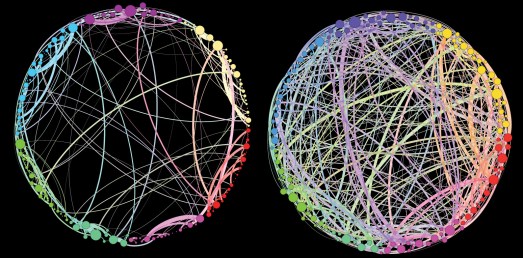
This is your brain on drugs…
But what is ceremony? When we think of ritual and ceremony we may imagine military or civic rites. Those of formal religious or public occasions. Celebrations of a particular event, achievement, or anniversary. We may imagine that words like ritual or ceremony indicate a series of actions performed according to a prescribed order. We might imagine a solemn act, formal and dignified, characterized by deep sincerity. Equally we might imagine the wild bacchanalia or carnival. Ritual and ceremony is a broad church but in the sense that I using it here I’m interested in ceremony as the intentional use of metaphor to affect the imaginal world.

Colourful ceremony
Ceremony for me is a natural activity for symbol using, meaning making creatures such as ourselves. Sure sometimes it may be formal in nature; at other times it may well up as a spontaneous gesture. Laying flowers at the site of a tragic event, wrapping presents, ritually disposing of our dead. These are things our species does. Ceremony then is the deployment of acts that are symbolic, often metaphorical, sometimes carefully planned, sometimes free-form and spontaneously arising in the moment.
In context of the use of psychedelic drugs, psychedelic ceremony is the manipulation of sets and settings within which we might explore those remarkably potent and remarkably safe experiences offered by medicines such as DMT, ayahuasca, mescaline, LSD and all those other fascinating chemicals, the power and significance of which we are celebrating and exploring at this conference.
Why not ‘psychedelic session’? Why use the religious sounding word ‘ceremony?’ Well there are two reasons for this.
The first is that I come to psychedelics as an occultist, an indigenous shaman of the British Isles, and so I tend to think in those terms. Occultism is course the study of that which is hidden, such as the relationship between matter and mind that psychedelic drugs bring into stark relief. The practice by which this exploration happens is usually called magic which we could think of as the use of the imaginal world to extend the limits of our achievable reality.

Me being totes shamanic
The second and bigger reason is that the sense of the sacred that these substances can generate I feel demands the use of a word that goes beyond the apparently ‘secular’ expressions ‘session’ or ‘experiment’. The word ‘ceremony’ itself derives from a Latin root that suggests ideals of holiness, sacredness and awe. Sure many people eschew anything that sounds ‘religious’ but I feel that using this word shows both respect to those indigenous traditions who use entheogens, and reclaims the word from the dead hand of doctrinal belief. We need not throw the baby of the sacred out with the bathwater of dogma.
Looked at through the lens of contemporary neurology we could say that this sense of the divine is what we experience when the psychedelicized brain lights like a christmas tree in an fMRI scanner. Considered in a historical sense we can see how psychedelic substances are often implicated in the genesis of religions; the blue-throated mushroom of Shiva, the burning acacia of Moses, the kykeon of Eleusis.
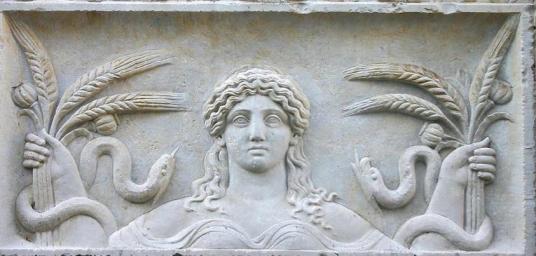
Ancient advert for kykeon
We are fortunate to be living in a time when knowledge about methods to hold, support and direct the psychedelic state is abundant. There is a great confluence of wisdom from ‘traditional’ practitioners, underground psychonauts and licensed scientific researchers. In the West, since the time of Tim Leary et al., we have known that the mental state and the environment can profoundly influence the way that our drug trip unfolds. Western culture itself has created ceremonial settings in response to the emergence of two widely availabile psychedelic drugs. Our first attempt at this was the creation of the music festival, our culture’s collective response to LSD. Later we created the rave to hold the experience of MDMA. Our indigenous shamanic intelligence gave rise to the First and Second Summers of Love.

Oh my God look at the litter, blah blah blah…
Psychedelic drugs are special, powerful things that by their very nature stimulate a feeling of ‘the sacred’ and this feeling runs deep. This feeling often inspires people not only to create specific environments, and ceremonies for their psychedelic sessions, but also during the process of producing the drugs in the first place.
Whether we are mindfully rolling a joint, or singing as we stir the bubbling pot of ayahuasca, the preparation of these medicines that can evoke a sense of the divine is itself a sacred process.
There is, for example, some fascinating research to be done on the use of ceremony by contemporary clandestine chemists. I spoke with Casey Hardison and asked whether he did anything he would consider to be a ceremony when he produced, for instance, LSD. Casey told me that he used crystals, smudging with sage and other practices during some of this work. He had a practice of setting LSD to crystalize while music played. ‘Righteous Rasta music’ structured to echo the pattern of the chakras in Asian esoteric anatomy. Asked why, Casey said that his intention was that the molecule would somehow be affected the music, helping those who took the drug to “absorb the energy of loving themselves, allowing them to have the highest vibrational experience”.

Casey Hardison – the naked LSD chemist
Casey was by no means unique in this practice. To quote Cosmo Feilding Mellen in an interview about the film he directed The Sunshine Makers:
The purity of different types of acids was an important part of psychedelic culture. People believed that the purer the acid, the better the trip. It was all very subjective, of course – Owsley would pay attention to the music they were playing in the lab at the point of crystallisation, and would then pray over the equipment to imbue it with positive vibes. Tim (Scully) was a rational scientist and initially thought it was all mumbo jumbo, but he eventually got sucked into it.
The unfortunately still incarcerated LSD chemist William Leonard Pickard mentions the ritualization of psychedelic synthesis in his wonderful book The Rose of Paracelsus. In a recent email to me he wrote:
“Indigo [an LSD chemist] mentions Gregorian chant during synthesis or crystallization, often Amazonian shamanic, soft, gentle chanting. From my interviews of very high-level mfgs in the 80’s-90’s for drug policy research, I recall most fondly one individual [who would] never dream of conducting a crystallization without Vivaldi’s ‘The Four Seasons’ playing in one continuous loop, quite loud, for many hours from start to finish. He did so for years. Something about the beauty of the molecules finding each other, and the harmony of the seasons. The Vivaldi seems to be a lineage in certain groups.”
In all these examples, leaving aside any parapsychological or subtle physical interpretations of what may or may not happen when one crystallizes LSD in the presence of music, what we can see is that these chemists are doing ceremony. They are creating a set of poetic, metaphorical relationships to influence their set by changing their setting (putting on certain music). They are doing so while in a psychedelically altered state (lab accidents, as even extremely thorough Swiss chemists know very well, can happen). They are using this poetic language of behavior with a specific intention – that of making the best LSD, making good medicine.
So let’s break down the idea of psychedelic ceremony in a little more detail and give a few examples of practices.

The toasted Hof
When we drink alcohol we say ‘cheers’! We make an invocation to the spirit of happiness, perhaps a toast of greater or lesser complexity. So too in many traditions and approaches to psychedelics will people take a moment before they take the drug. That pregnant pause we have, sat before the awesome reality of the loaded DMT pipe. Some like to say a prayer over their drugs, some do this by offering their lover a pill in their mouth, ending the kiss with the words ‘have a good one’.
Depending on the nature of the psychedelic adventure the location where the experience will unfold may have been specially prepared. The style may be very varied. From complex patterned fabrics and ready-to-undulate-when-the-mushrooms-kick-in wooden floors, through to white walls and soft cushions. The point about the space is that it supports and directs the experience and therefore, in whatever way we choose, it demands our attention. Re-set your Set by sorting out your Setting. As we clean the room, and place our power objects around us; pictures of our family perhaps, or of deities, of sports cars or kittens (if that’s our thing) we develop a deep sense that all is well. The mutual relationship of Set and Setting means any act of preparation (which could instead be about getting all glammed up if we are going out clubbing) is an instinctive ceremonial process.
Some spaces look very clearly like psychedelic ceremony. The beautiful crescent altar of the peyote circle, marked with the long glorious road that the participants take through the night together. Other ritual spaces may have a more modern look, with specially selected images projected upon the walls, sigils glowing in the blacklight and rotating dream machines. As psychonauts we make these chemical autonomous zones, these ceremonial spaces, in many ways. From spontaneously arising moments when we realise and respond to the sacred, through more formal group rituals, to gatherings so large we call them festivals.
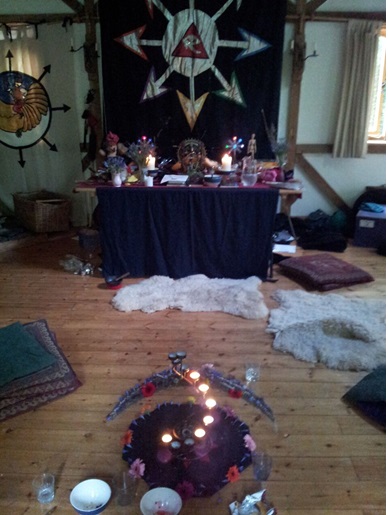
Ceremonial space
There are many groups in many countries that meet to do these kinds of ceremonies; some are peer-led, others with more formal structures, often inspired by indigenous entheogenic cultures of the Americas For some people their psychedelic ceremonies are solitary affairs, perhaps lone psychogeographical wanderings or night long solitary vigils, still others make pilgrimage to the temples where God is a DJ.
Once we are tripping we can use our skills to make the best use of our time in that space however it is constructed. While sometimes all we need is to lie down and let the experience take us, at other points we may like to do stuff; anything from contemplating the aeons old architecture of our own hands, through to creative practices such as making art or singing and dancing.
As the psychedelic state is so plastic we can make interventions here; in some contexts we might think of these as acts of psychological neurohacking, or perhaps acts which sound more like sorcery, in any case these are examples of deploying symbolic activity with an intention.
For example. We can use mimetic magic also known as sympathetic magic. We create a psychological link as X happens so Y follows, magical thinking or perhaps thinking magically. This works especially well when we are high and different (novel) parts of our minds are connected. The embodied psychedelic experience recalls the magicians’ axiom ‘as above so below, as within so without’. In psychedelic ceremony we are deploying symbolic action within the interrelated network of all things which, when not high, we experience as discreet objects.
Let’s take a not too woo-woo psychological example of how this works: We might for example become aware that, when difficult memories of a failed relationship arise during the trip, that we screw our face up and hunch our shoulders. In the psychedelic state, where everything in the mind (and who knows, perhaps all things in the universe) is connected, we make a magical link; ‘as I relax my tense muscles so I find a way to sit in equanimity with the pain of my past’. As we relax, passing through the journey of that intention, our state of mind while tripping, and our subsequent relationships with others after we come down, also relaxes and becomes easier.
Then there can be things that look more like spells in the proper witchcraft pointy hat sense. One might do a spell to encourage the conditions in society in which the benefits of psychedelic drugs can be appreciated. This spell could aim to find ourselves in a better relationship, as a species, with these divine medicines. One might do this by creating a magical sculpture, a physical form for a spirit, giving it a name and celebrating it as a god. Offering our psychedelic gnosis to it, desiring that it is empowered to carry this intention into the complex web of wyrd that connects all things. (You can see what we in magic call the ‘material base’ of such a spell, cast from within psychedelic ceremony, in the museum here at Breaking Convention).
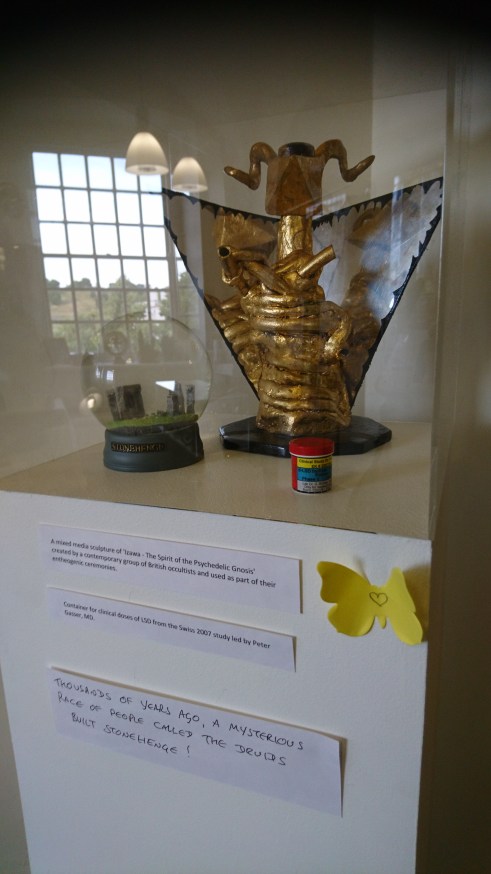
Magical things in The Psychedelic Museum
Let’s consider another ceremony which can be deployed very easily by the psychonaut. We can think of this as a handy neurohack.
We know that our bodies primarily get our conscious attention when things go wrong. We experience the alert of pain and discomfort when there is a problem. Most of the time we don’t notice our left foot unless it hurts.
We also know that cultivating an optimistic and grateful attitude has benefits on everything from the functionality of our own immune systems and mental health and that this well-being in turn affects others. This practice boosts us, and thereby helps those around us, it’s a particularly powerful charm against depression both individually and culturally.
(Technically this is left-hand path vajrayana, fourth turning of the wheel of dharma shit we’re talking here; check it out if you’ve not already grokked that stuff).
To cultivate this beneficial attitude we take a moment to thank all those things that are good. To deliberately take our attention away from the painful and the incessant human desire to solve whatever current is ‘the problem’. One way of by doing this is by smoking in a ceremonial style.
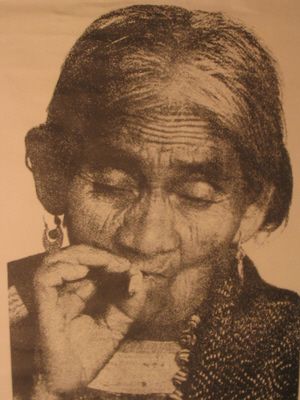
Smokin’ Sabina
Let’s set the scene for this easy to do psychedelic ceremony: I walk away from the bonfire and the pumping sound system. I’ve got a pre-rolled joint or tobacco smoke in hand. I kneel down on the dry grass. I am here to pray. I ceremonially breathe the smoke of the joint up to the sky, then directly down onto the earth, I then blow it to the left and right and finally towards the moon above me. This metaphorical ritual process orientates me within the world. I use the joint to focus me in the moment and I pray, speaking about what I love, counting my blessings. There are many imagined locations to which we might address our prayer. Simply to ‘The Universe’, or for the those more theologically inclined ‘the Great Goddess’. Personally I rather like ‘Great Spirit’ and ‘Great Mystery’, and sometimes ‘Baphomet’. We may silently formulate our prayer or it speak aloud. Our prayer remembers all those things we are grateful for; those who love us, our health, this life, these medicines, the cool of the night air. Whatever we really love and what fills us with joy and we take delight in.
When I’m done I bury the end of the joint in the earth, nod my thanks to the moon and return to the pumping sound of the party…
Our psychedelic ceremony, however we do it, unfolds…

Cards and crystal
Perhaps, for example, towards the tail end of the trip, you decide to do some divination by consulting the tarot, using those obscure occult images to explore the relationships of things in your life that are important. Changing your perspective and looking on the problem as though from the outside, finding new possibilities. You can do something similar through a process which psychologists call a ‘sculpt’ using found objects to represent characters or situations. Just as the psychedelic state joins up bits of our brains so we can express and reflect on this process by using external symbol sets to discern the new meanings that arise. These techniques of divination can be usefully employed when we are high: from ones where a meaning is sought in what some claim is random stuff, such as clouds, the shapes in fire or the first three runes picked from a bag. By interpreting these symbols, and perhaps manipulating them in some way, we open ourselves to new possibilities. It’s also the case that, in my experience, what parapsychologists call ‘hits’ happen more commonly when we are in an altered state of awareness.
Whether simple or highly structured, lasting just half an hour or several days, eventually our psychedelic ceremony comes to an end.
As the dawn breaks we perhaps sweep clear the circle around the crescent altar and place the final sticks with impeccable care on the arrow fire. We tidy up after the party. We thank the spirits or the power of the time, the place, the medicine. We allow ourselves time to come down, to enjoy the shamanic return to a world renewed and full of possibility. To reflect, to eat, to sleep, to dream.
And, each of us a shaman, we bring back the insights from that trip into the ultraworld for the benefit of ourselves and community.

Psychedelic insights
What insights might we gather from these psychedelic adventures? Too many to list of course, but considering the value of these substances in themselves, what might be learnt?
- That psychedelics have the potential to be amazing, fascinating medicines that feed our souls and inspire our spirits.
- That the benefits of these experience could be just the medicine our species needs.
- That we could live in a culture which nurtures settings in which the self-administered and autonomously interpreted psychedelic experience is open to all who seek it
And to realise this possibility we know that in many ways, and many places, there is work to be done.
We are living in a time of increased licensed research and I’m deeply appreciative of the work of organisations such as the Beckley Foundation, MAPS, The Tyringham institute and others for their herculean efforts. But their work is hampered by both the laws and culture surrounding the prohibition of these substances. Both things that need to change.
As things are now we know that the law relating to psychedelics is critical to our story. Most of us here, I would conjecture, took our first psychedelics in unlicensed and therefore possibly criminal circumstances. Given the severity with which some states punish the use of psychedelic sacraments, but for the Grace of God, we are all potentially the prisoners of prohibition.
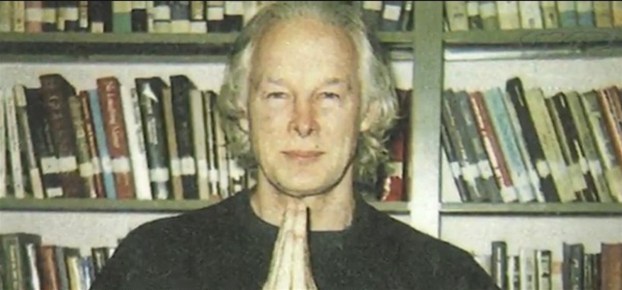
William Leonard Pickard
For some people prohibition hits hard. I mentioned my chickens in an aside when writing an email to Leonard Pickard, who is in jail (serving two life sentences) for LSD manufacture. He told me in his reply that he’d not seen any creatures, besides humans, for 17 years. This is the real horror, the real bad trip – as we speak Leonard is shut away in his prison and we ourselves are only part-way free. So we must use all the strategies we have to transform this situation, even as these sacraments we have taken have changed us.
As a community of practice, we share our insights at gatherings such as this conference. Inspired, respectful and considerate of the teachings of contemporary indigenous psychedelic cultures, and informed by the discoveries of licensed and underground researchers.
We have a tremendous opportunity in this, the psychedelic renaissance. By sharing our collective wisdom I hope that we can build a culture suitable for a post prohibition psychedelically upgraded world. More intelligent, more creative, more humane, more curious than perhaps ever before. Because, while it’s easy to get Messianic about drugs, we could really be onto something here. Perhaps these substances really are that powerful, that important to our species. These are medicines for the mind and therefore for our culture, and we should not be afraid to use them.
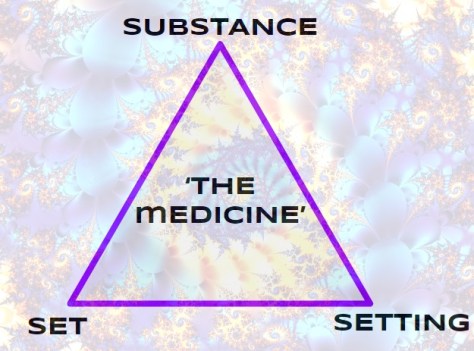
The psychedelic triangle
Through deploying psychedelic ceremony we are learning to make our own medicine. ‘The medicine’ as a whole is the combination of the psychedelic experience within a set and setting designed to enhance its transformative and entheogenic potential. The medicine is the complete psychedelic triangle of set, setting and substance.
Ceremony does not necessarily imply orthodoxy and I would like to see us maintain a variety of psychedelic spaces. Spaces for psychedelics as legitimate tools for healing, for research, for spiritual and for recreational use in our society. There are many medicines.
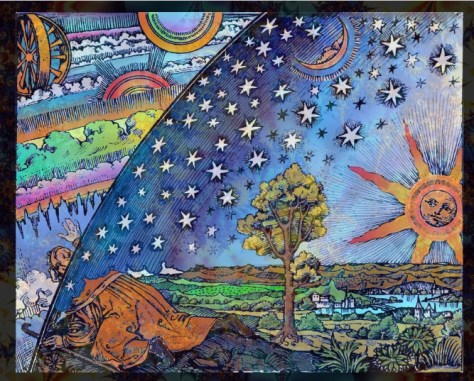
Searching for meaning
The medicine of psychedelic ceremony can heal our souls by providing opportunities for revelation, rapture and fun. Used as medicines these substances offer opportunities to transcend our limitations. Psychedelics employed in this manner can support our human search for meaning in a way predicated on personal spiritual inquiry rather than rote doctrine of any stripe. These are substances that entwine the scientific and the sacred, the religious and recreational, substances that can help make us whole.
With our wounded cultures and ecocidal behaviors it is clear that some wholeness and healing would not go amiss. We could do with this good medicine.
Stay high and stay free!
Ahoy!
JV
 The Blog of Baphomet