Magic about to Spring

Around this time of year, between Imbolc and the March Equinox, I begin the totes majix process of purification and cleansing, otherwise known as The Spring Cleaning. There is sufficient light to see that the windows of the house need a good wash, and the areas of the garden in need of repair after winter. Within me the spring rises up, my mood lifts and I spontaneously smile when I see the first snowdrops and daffodils emerge.

I’ve written before about the importance, in my view, of locating magic in the everyday and not only in explicitly ceremonial settings. This is the role of magic to ‘intensify the normal‘ as Austin Spare expressed it. Thus, as I potter about the garden, cutting some wood for the fire, sweeping the path, I allow my mind to mull over the projects that are coming up with the spring. I’m co-facilitating a workshop next month with David Luke and Nikki Wyrd in Snowdonia, Wales. This is the second Neuro-Magica retreat, where we use (to quote Uncle Al) ‘the method of science, (for) the aim of religion’. Informed by psychology and ethnography, using technologies derived from various spiritual traditions, we collaboratively create a space designed to generate insights and even peak experiences for our participants. That’s what we do.

Halfway up the stone steps, between the lower terrace and the enclosed grove of the second one, I find myself absent mindedly rotating a root between my finger and thumb. I’d unconsciously picked this up from the floor whilst sweeping, perhaps attracted by its alien gnarled shape. I am playing with this root, my hand above a ceramic planter in which a purple crocus valiantly pushes skywards. I take my attention to the Neuro-Magica project. I let my mind flow into the spaces that we intend to create. Mentally I step back and see how this project looks in terms of the some of the larger stuff that I (and the other two facilitators) are involved with (especially now that the psychedelic express train that is Breaking Convention 2017 is  filling up with speakers, artists, performers, films, installations, volunteers and ticket holders). I am aware of how the old root and the new shoot are emblematic of various processes connected with the projects and transformations I’m currently engaged in.

This example is not one of a planned ritual. Rather it is an instance of discovering the magical in the mundane; again of ‘intensifying the normal’. Ritual itself (to use my current favorite description) is ‘a series of inhabited metaphors’. I described it thus recently at a workshop I ran at The Museum of Witchcraft and Magic. ‘What does that mean?’ asked one student, a perfectly good question, so I gave an example, something along the lines of this…
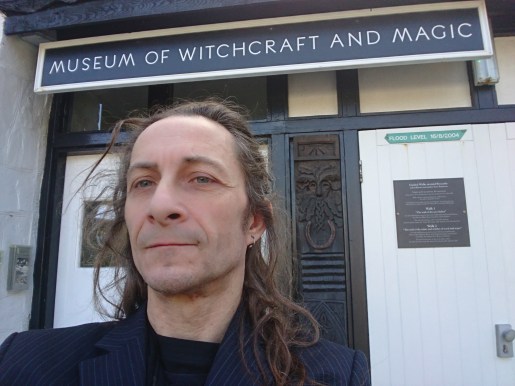
dsc_0108

In Boscastle, Cornwall.

“Today in this workshop we are working within the library of the Museum of Witchcraft and Magic. The library is a complex web of history, words, authors, collectors and many other stories. It is full of knowledge, and of truth, and of lies. For the purposes of today we are going to imagine that the library is an entity, a being, a person, a spirit. We do this because relating to other beings is what our brains are good at (see this article for more on spirits). In a moment we are going to leave the library and go outside for a short time. We will ask Judith as our host, and co-manager of the museum [who was also attending the course] to formally welcome us into the library. As we come back in, we each need to greet the library as though it were a person (perhaps aloud, perhaps mentally). By doing this we are inhabiting (i.e. doing stuff) within a metaphor (i.e. that the library is an intelligent spirit which we are looking to be on good terms with).”

(There’s a full report about this workshop on the Museum blog if you want to know more.)

Sometimes these metaphors are ones we know and create (perhaps in a ritual), sometimes there are ones that we stumble upon (me with the root and the shoot), and others are ones we only see once we have done the work. To provide an example of the latter: I am acting as mentor in magic to a friend in the USA, using a combination of Skype and email communication. This person, acting on the discussions we had, created a devotional ritual to a saint. The ritual was an original composition and, like any art, grew out of the interface between the raw media (in this case text about and images of the saint), and the artist/magician’s creative genius. Having used the ritual for a while my friend began to see things in the rite that hadn’t been obvious when it was first created. (This included some rather lovely links to the iconography of kundalini  yoga and Thelemic cosmology.) This isn’t surprising since plenty of artists create their work and only later, sometimes with the help of critics and commentators, become aware of (potentially) deeper levels of interpretation in their creation.

When we do magic we are working with these archetypal forces or perhaps ‘deep structures’ of the ‘unconscious’or, to use that lovely term from Paul Huson, the ‘Deep Mind’. Our praxis is the reflection and articulation of these deep structures of the Deep Mind. This is why human rituals, however elaborate their cultural costume, when undressed, all look pretty much the same.

Another instance of a deep structure can be found in an example I used in my Museum presentation (and, coincidentally that same weekend,  also used by Nikki Wyrd in her workshop at the fabulous Glastonbury Occult Conference). There are complex relationships between written and spoken words and sounds. In magic we often use sounds and words to do stuff, to change the universe. Occulture is full of vibrated words of power, hidden names of God, mantras and sacred letterforms. While the languages (spoken and written) may be as different as Mayan, Mandarin or Sumerian (the cultural costume) nevertheless they still share deep structures, such as that demonstrated by Bouba and Kiki.

The bouba/kiki effect is strongly suggestive of the idea that word sounds are non-arbitrary, and that there is a deep relationship between speech sounds and the visual shape of objects. (This effect was first observed by German-American psychologist Wolfgang Köhler in 1929.)

500px-booba-kiki-svg

How do these shapes sound?

Which shape is bouba and which is kiki? The vast majority of neurotypical people would say that bouba is the rounded shape, whereas kiki is spiky. When we talk about ‘high’ and ‘low’ notes or suggest that bouba is the rounded (soft, welcoming, perhaps feminine etc. etc.) we are articulating the common relationships between the psychic structures of our shared humanity. These deep structures are something magic taps into. Though they can perhaps never be precisely defined (within the conscious mind) through explorations, such as art or magical practice or scientific investigation, we can get a sense of them (we have a sense of ‘what is right’). These deep structures are our common heritage as humans (and indeed probably as mammals). Deep structures may also contain echoes of past patterns; from our families, our species and maybe beyond. To give an example of this consider the brilliantly poetic (and scientifically verifiable) example given by arch-mythographer Joseph Campell: Baby chicks from the moment they hatch know to fall silent and motionless at the sight or even the shadow of a hawk. Campbell observes: ‘Furthermore, even if all the hawks in the world were to vanish, their image would still sleep in the soul of the chick.’

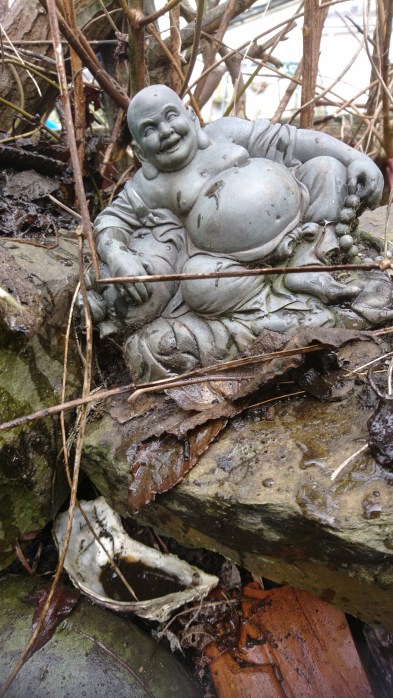
As I pull the rotting leaves from the pond in the garden I am both doing a pragmatic job if I want to provide a useful environment for the amphibians and insects, and, if I pay attention, entering a metaphorical space. Turning such everyday actions into acts of magic is about being sensitive to the poetics pregnant in every moment of existence, and using our ability to notice these opportunities and align them with our desires.
dsc_0127

Pond edge

Desire is what makes magic magic. Our wish, our intention, our (True) Will is what drives the magician to seize these moments of power. For me desire is like the concept of motivation in Vajrayāna. It is something that emerges in and through us; desire happens within the network of relationships. Thus we ‘keep pure our highest idea’ (again to paraphrase Crowley). My desire to clean the pond serves as a practice in which I clear out the clogged winter detritus of my own psyche and in doing so conjure a place for animals and plants to flourish in my garden. A win-win set of mutually beneficial outcomes. I get what I want and so does everyone else. I come to recognize my own Buddha nature by striving for my own liberation in a context where my desire becomes part of the larger project for the liberation of all beings.

JV


An Audience with Charlotte Rodgers

Charlotte Rodgers is a writer, artist and magical person. She kindly agreed to tell Steve Dee more about her life and work.

SD: Could you tell us a little about your own magical background? (How you got into it.)

CR: I don’t think one’s intrinsic being changes much from early childhood, aside from layering up a load of behavioral baggage and experiences to obscure, and hopefully at times to enhance, our essential self. I always had a spiritual world view, highlighted by a personality that had a great deal of difficulty relating to others. At times, I lived with my grandmother where I was overexposed to fundamentalist Catholicism which I found fascinating; but I found the premise of good and evil made no sense to me (I was a precocious child… and looking back perhaps a bit ADD or sociopathic). As a child, I was obsessed with books, my microscope, astronomy, archaeology and mythology; constantly looking for other worlds that I could relate to as this one made no sense!

I was seven or so when I came across Man, Myth and Magic and it was like boom bang…this was IT!

I used to see colours and shapes and always believed in magic. I remember being about ten and walking home from the cinema with my little sister and telling her, ‘I’m a witch, watch… the lights at every crossing we come to will turn green when we approach them’… there were about seven I think on our walk home and indeed each one did turn green.

By age 12 I was into tarot and palmistry and started studying various magickal practices consciously. I also later studied Phenomenology of Religion for O levels and A levels and simply enough, was always searching for something.

As with inherent approaches to learning that tailor for individuals through hearing, seeing or experiencing, people have different ways of understanding their reality. Philosophical (relating to ideas) political (relating to structures) and spiritual (relating to ‘other’). A bit simplistic perhaps but it makes sense to me, and my frame for experience and perception is very much a spiritual one.

So, I’ve always been magical, and constantly been trying to understand and work with this, whilst trying to sort my life out on a mundane level.

charlotte1

The Hermit by Charlotte Rodgers

You’ve worked in a few different traditions, could you tell us about those and which approaches you currently find most meaningful?

My answer for this is a continuation from the above in many ways. I’m not a group person in that I cannot cope with the structures and power plays that often deviate (some may say develop) a tradition and cause it to lose its original premise. Conversely, I love the inspirational buzz and play I get from working with a group. For a long time, there was a sense of ‘should do’ or ‘should be’ in my practice. I ‘should’ develop discipline in my practice by adhering to a certain tradition and following its rules, I ‘should’ validate myself by reading certain books or following the rules, though my essential magical self just loves to play and when I’m working with the right current, it’s a flow, a key to a lock.

I’m also no good with names and that is a big problem with some traditions… I just can’t get my head around identification of energies with certain titles… works in my head but my magickal self just wants to toss it all aside.

I immersed myself in Crowley’s teachings for many years. It was accessible at the time and very interesting. Parts of them I found very workable and at that time I felt that as a woman it gave me more validity than accepting more nature related witchcraft which came so naturally to me living in New Zealand and later in Asia. I was a member of a few groups, and seemed to work well with certain currents that though I didn’t relate to a specific named god or spirit form, say Set, I could relate to their essence and work incredibly well with them.  Later I was initiated into the Uttara Kaula and AMOOKOS which also made sense to me on many levels but I reached a point of self-confidence where I started stripping back, and realizing that my magic was an intuitive path, and I was trying to follow the rules of others, a method which had become counterproductive.

Some of the traditions that resonate for me, such as Haitian Voodoo or Santeria I’ve learned from and respect but take no further.  Others such as Bengali Folk Tantra press my buttons and made me realize my magic is incredibly simple.

I’m an animist and a generator of energy so whilst I can work well in many spheres, for me finding a tradition and structure had become a very human need to find a place amongst others, rather than finding the right practice for myself.

spirit

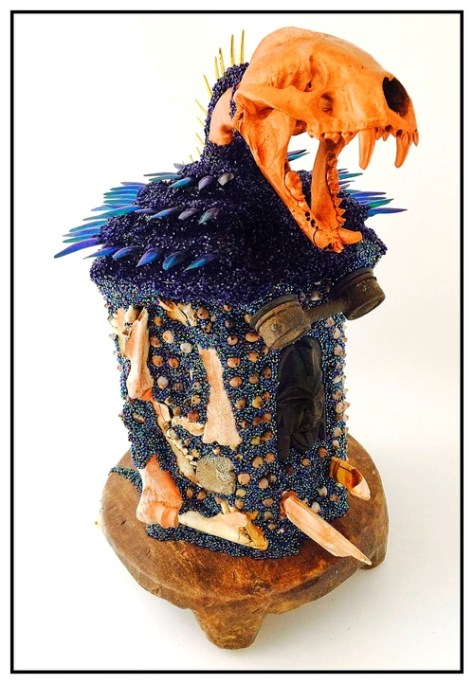
Spirit House by Charlotte Rodgers

As an artist who works in a number of differing mediums, could you describe something of your artist process and how it may (or may not!) overlap with Magical work?

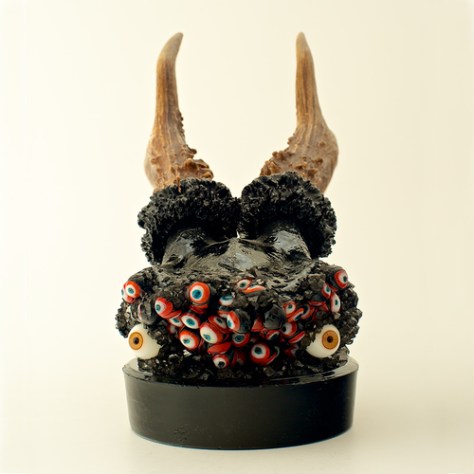
O the more I immerse myself in my art the more I realise that art and magic are the same; expressions that can be directed. I don’t plan anything that I do, just amass ingredients then when the time is right I go on automatic and channel the piece as it evolves. My creative process and magic run side by side, different facets of the same thing. The most conscious pieces that I make are charms, fetishes or elemental conductors and my larger pieces tend to be spirit houses or effect orientated portals, although often I don’t realise what I’ve done until it is completed and the piece tells me.

For a long time, I was primarily working with bones and remnants of death as they were the most obvious conduits to certain characteristics or properties, but as I realised that everything has memory, I started working more with discarded and found objects and what was contained within them.

In your (excellent) book The Bloody Sacrifice you explore the way in which practitioners use their bodies to explore and create change; how has your own work with the body evolved since its publication?

Hah! Hugely! I went through a very early menopause and my last period coincided with the completion of the book. Also, the book was written as my own blood was dealing with all the chemo that had been pumped into it to try and rid myself of hep C and which took about two years to be expelled (the treatment didn’t work).

Menopause is fascinating, and my energy is much more contained now. There is all the social stuff that goes with it… aging and perceived power loss etc., but in most ways my body is the strongest it has ever been.

I’m much more aware of the physical impact that magic has on me now, especially on my immune system (for people with long term hep c, your 50’s is often the age it can really kick off and become problematic) and work with that.

I’m more careful about my body at magical gatherings as I find my metabolic rate goes into overdrive (this used to happen to me years ago, when I did readings for people) and I lose way too much weight and get run down.

Yoga is more important than ever for me and dance is a necessary joy.

I still regularly have ritualised tattoo work done on myself but mainly I am aware of an integration of my magickal self and my physical self that I think is a combination of my past work and perhaps just growing older and stronger in myself.

In many ways, my art work is intensely physical in that I am channelling part of myself into the art to bind it together and need to keep my back, hands and shoulders strong… if I want to channel I need to work with my physicality simply enough.

family

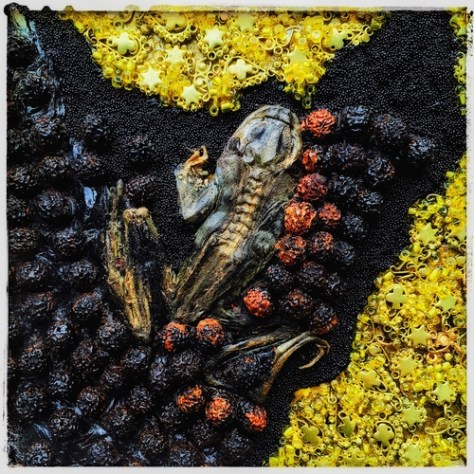
Family Dynamics (detail) by Charlotte Rodgers

Given your focus on the body and your use of animal remains in your Art, how well do you think contemporary Occultism is doing in its engagement with Death?

I’m not as much in the loop of what’s going on in the occult community as I was… It seems that rituals of death and burial have progressed hugely, although I still think there is a great need of support for pagans and magickal practitioners after they have ‘lost’ someone. The acceptance in Western based occultism of ancestor worship has helped a lot, but I think many feel their beliefs are challenged when someone they love dies and could do with support that is non-denominational and unconditional, but still essentially magickal.

There is still a fascination with darkness and death in certain sections of Occultism that is perhaps blinkered but that is the nature of working with taboo… easier to go for the dark and forbidden rather than something like unconditional love and joy! (I can say this I think because I’ve had that struggle myself!).

Over the last few years there have been some deaths of people who were incredibly important to me magickally, Michael Howard, Donald Kraig and David Blank. There have also been important practitioners who have died that I’ve not had direct personal involvement with and it is worth thinking how their lives and deaths have contributed to the growth and development of the present magickal current, and what changes will occur in it due to their loss.

Lastly, can I ask what your hopes are for the future evolution of both your Magical and Artist practice?

Now there’s a question. Recently I’ve felt a need to go slow (not my usual way!) and make no major decisions.

The world is very crazy with major changes going on, so treading careful seems to be the best option.

I’ve started worked more, both magickally and creatively, with rust and discarded modern objects, and finding with ways to integrate it with nature and ‘the old ways’ to bring forth a progressive evolution.

I’d briefly touched on this in 2011 when I integrated broken glass from the London riots and car accidents into sculptures trying to positively redirect the rage and impotence at injustice, that fuelled these riots.

Now it seems the right time to carry on with this modern alchemy!

Aside from that I’m in the process of a final edit of The Fulcrum Method, a divinatory system that I’ve created with Roberto Migliussi, and also organising a Summer Solstice based exhibition in Bath, ‘Rust, Blood and Bone’.

What I want in the long term and general sense? To carry on progressing with my art and magick, to carry on learning and to have fun.

I want to retain that joy in adventuring spiritually and creatively whilst not getting bogged down by games and infighting and power plays. I’d love to be able to make a living out of what I do, so I can focus all my attention on it and see how far I can take the journey, and to where.

Thanks very much Charlotte. SD.

To see more of Charlotte’s work visit her blog and gallery.