
Most spiritual paths seem to have as part of their focus a desire to help us create a sense of certainty and security as we try to try to engage with the challenging messiness of human experience. Whether via the provision of a coherent world view or at least a set of practices that help provide meaning and alleviate boredom, religions of various stripes work hard at trying to create a buffer between ourselves and the existential anxiety that appears to be innate to our shared humanity.
One of the core questions that Gnosticism seeks to grapple with is whether the religious answers that we seek are real solutions, or whether they are more likely to perpetuate a sleepy engagement with a world that actually needs answers with a sharper edge. Do our attempts at meaning help us grow to our full potential as human beings; or do they sustain a child-like dependence and immaturity?
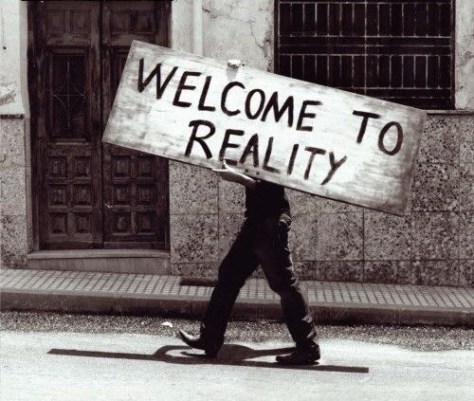
Existential shock
Scott Peck in A Different Drum sought to identify the various developmental stages that a person might go through as they try to grow within their chosen world view. Peck saw an adherence to formal/institutional forms of faith as being quite childlike in its desire for certainty. To remain in this state requires a degree of blinkeredness in shutting off new information that might be viewed as introducing unnecessary confusion. These believers may well deal with high levels of stress and complexity in other areas of their lives, but in the realm of metaphysics and faith, dependence and clarity are vital.
In contrast with the position of the child, the rebellious adolescent is perpetually sceptical and questioning. This highly individualistic perspective when imbued with rebellion and punk rock energy seeks to actively deconstruct those literal, less critical versions of belief that they formerly embraced. While this approach might be ideal for generating heresy and polemic, it may not be so great at sustaining an enterprise.
For Peck the more mature, integrated adult position is that of the Mystic who is able to approach the mythic richness of a given faith with a more nuanced and communal perspective. The questioning of the rebel is retained, but their sceptical energy is directed at trying to access a richer, more archetypal appreciation of stories that were once scorned. The exploration of spiritual meaning will (by necessity) have a more collaborative dimension, in which we allow our relationships to support us in tolerating uncertainty and allowing us to explore greater psychological openness.
The Gnostics were often keen to push us toward this more adult position, challenging us to adopt radical reinterpretations of biblical myth that were often triggered by a daring trust in personal religious insight (Gnosis). In their perception of humanity’s core dilemma, the Gnostics also mapped out a three-fold schema of the differing responses that people gave. In contrast to the hylic’s coarse materialism and the psychic’s inability to rise above their immediate context, the pneumatic aims of the Gnostics asked them to seek a spiritual dimension (the divine spark) that transcended the sensory bombardment and impermanence of the material world.
While the Gnostics were often startling in the originality of their vision, it would seem fair to ask whether their approach was simply too stark and demanding a path to follow. If this is growing up, do I even want to?

Gnostic vision
To be fair to the Gnostics they never claimed that life was easy or that their path was universal. To reflect on impermanence and the path of liberation necessitates a greater awareness of the tricky nature of reality, and the lack of fulfillment that our current paths are providing. To seek Gnosis as a means of greater freedom will always involve risk and the possibility of rejection by those seeking more orthodox answers.
Recent commentators on the Gnostic revival (e.g. Stephan Hoeller and Hans Jonas) have been keen to point out the similarities between the aims of the Gnosticism and the philosophical pursuits of existentialism. In struggling to find coherent meaning in our experience of life, the existentialists often proposed a heroic engagement with uncertainty, and an exploration of how personal action into the world might affect it. Both of these paths seem to be pointing to a place where our struggle with meaning asks us to take responsibility for the path we take. As the existential psychologist Rollo May observed, “courage is not the absence of despair; it is, rather the capacity to move ahead in spite of despair.” (The Courage to Create)
The call “to put away childish things” will have different implications for all of us. For me this call to adulthood is not one in which playfulness or simplicity are abandoned, rather it presents a challenge to stop expecting either spoon-fed answers or to pay too much attention to my own inner-parent’s demands that my current path is not quite good enough (“meditate more, acquire more information!”).
Unlike the moody rebel this path is not one of arid isolation and false independence. As much as this path is uniquely my own, I gain much from the company and encouragement of others. The connections that I make and sustain are hopefully more shaped by shared adulthood and the desire to co-create; and while I continue to respect and seek counsel from those further along the path, I no longer expect them to have the answers that only my own internal alchemy can produce.
SD

 The Blog of Baphomet