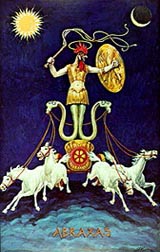
In my last post, I got to thinking about the way in which certain god forms (such as Abraxas and Baphomet) seemed to allow a process in which apparent dualities could be danced with. Rather than certain qualities being located in oppositional members of a given pantheon, these strange hybrid deities seemed to hold such polarities within their beings.
For me as a gnostic explorer these are gods that I am drawn to precisely because they mirror the project of personal integration that I find myself wrestling with. On some level such an admission may seem like high narcissism, but I believe that a degree of honest self-reflection is warranted as we walk this path. Often we choose (and create) the gods most like ourselves as we seek to both make sense of our current experiences and also in our aspiration to become something more, something greater that we currently are. As a magician who is continually seeking to explore and understand the role that belief has in shifting consciousness, I also have a strong suspicion that this is far from one-way traffic i.e. our gods are feeding on us as much as we are feeding on them!
The need and desire to feed is for many of us, an uncomfortable aspect of our existence on earth that we might want to hide from. At a basic biological level in order to survive, humans need to consume, destroy and absorb the life of something else. As much as we may want to whitewash the process, our day-to-day survival is premised on a degree of violence. Once we step outside the boundaries of “civilisation”, we quickly comprehend that we also can become the hunted as well as the hunter; such are the dynamics of the biosphere. Awareness of this principle may well influence our dietary and lifestyle choices, but it remains none-the-less.
For those seeking to explore more magical perspectives on the world, such awareness may also extend to how feeding occurs on an energetic level. In for example, the work of Gurdjieff and other Fourth Way teachers we find the idea of reciprocal feeding i.e. everything in the universe feeds on and in turn are fed upon energetically. To me this feels decidedly vampiric and as long as the feeding is mutual, it maybe a helpful metaphor for understanding our relationship with the any imagined numinous realm.
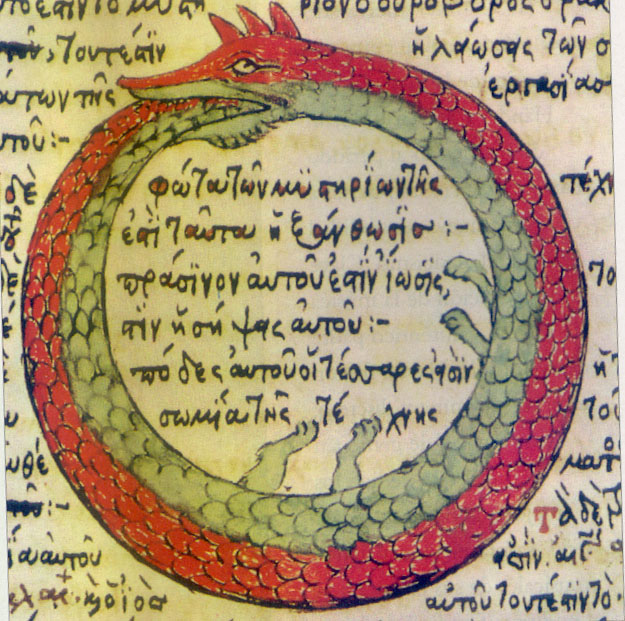
The universe feeding on itself
Any scan of the Internet will provide a startling array of individuals and groups seeking to engage with Vampire and Otherkin identities as a means for making sense of their lives (I have written at greater length about these themes here). However fumbling we may view these attempts to engage with these potent archetypal images, at best the Vampire represents a conscious engagement with the dynamic of feeding, in order to maximize its potential for wellbeing and the pursuit of initiatory goals.
It feels less than coincidental that that the popularity of the Vampire myth in western society seems also to parallel and increased awareness of many Asian religious traditions that make more explicit reference to the “subtle body” and the possibility of energetic exchange. Time does not currently permit a detailed examination of these sources, but those alchemical practices broadly described as “tantric” or Taoist often dealt with the cultivation and movement of subtle energy and the physical uses of bodily “elixirs”. Any contemporary explorer of the vampiric would be wise to integrate the insights of such traditions in evolving their own magical experiments.
Feeding need not be parasitic and there are many models of magical practice that promote an approach that is far more symbiotic and consensual (insights may well be gained from the devotional work undertaken by many practitioners working with African traditional religions). The idea of feeding is hardly new within the realm of religious expression. Whether it be a Catholic high mass, a Vaishnava’s offering of Prashadam (sacred food) to Krishna and Radha or a Heathen sumble, the use of ingesting food to express faith is as old as humanity itself. How we eat and what we eat, are unavoidable expressions of who we are and what we want to become-this is true of both our shopping habits and also the way we use food in the context of our own spiritual journeys. What more powerful way to connect to your god, than ingesting his “body and blood” and fusing them with your own physiology?

Classic vamp
We need to pick our gods and heroes with care in that the very acts of our devotion generate seismic ripples within our psyches that yield inevitable consequences. Others (e.g. social media and advertising) may well have a strong interest in what we are “fed” and what feeds upon us. For those of us seeking to cultivate a certain degree of cognitive liberty, we may well need to employ our best banishing practices in order to create our own space.
As a magician working with the chaos tradition, I may value the odd psychic take-away or ritual “ready meal”, but in the longer term I know the value of slowing down and making sure that my sources of sustenance have a more balanced nutritional value. My own work with Abraxas and the whole Chaos Craft approach described in our blog have been an attempt to adopt a “slow” method that seeks to foster a more long-term, creative relationship to working with those Spirits that I would like to see at work in my world.
In devoting my time and focus on these beings I both feed my own inspiration and seek to allow them to utilize my energy in manifesting their presence in our world. My gods of choice may well be fluid, liminal and strange, but at a time when the subtle and complex are often sacrificed in favour of the big, bold message, as an aspiring cultural alchemist I continue to invoke my part-made Gods.
Io Abraxas!
SD

 The Blog of Baphomet