Digging in the Dirt

“No tree, it is said, can grow to heaven unless its roots reach down to hell.”

Carl Jung

Digging in the dirt
Stay with me, I need support
I’m digging in the dirt
To find the places I got hurt
Open up the places I got hurt

The more I look, the more I find
As I close on in, I get so blind
I feel…

The more I look, the more I find
As I close on in, I get so blind
I feel it in my head, I feel it in my toes
I feel it in my sex, that’s the place it goes

Peter Gabriel  Digging in the Dirt

When we enter onto a path of initiatory magic that seeks to transform the Self it can be easy to lose perspective. In exercising the antinomian bravery of putting our own evolution before the concerns of the gods (real or imagined), we can still get caught-up in becoming overly attached to our own reflection. In the project of awakening and self-sovereignty we can easily become delusional about where our humanity and divinity intersect. Even so-called “living Gods” have to clean the litter tray and push the shopping cart!

In seeking to assess the potential value of the plethora of resources claiming to offer progress along the Left-Hand Path, I would be highly skeptical about any source or school that doesn’t account for failure. Organisations and Orders may well want to emphasize the potential greatness of what their methods might help you attain and obtain, but we still need to show discernment in evaluating the actual method in getting there. While I may be drawn to night-side aesthetics that Kennet Granholm helpfully described as “the Post-Satanic” (cf. his article in the anthology The Devil’s Party), we still need to answer the question: “what is actually required of me for such feats of alchemy to be accomplished?”

dirty

Getting dirty with Peter Gabriel  

The initial Faustian act of taking responsibility for our spiritual development can be fuelled by a healthy dose of adolescent punk-rock rebellion or Black Metal grimacing, but without a depth psychology they eventually risk becoming little more than posturing. For such transformational work to have authentic power and true sustainability it needs to actually engage with the darkness that it is so keen to espouse. As the above quote from Jung maintains, the roots of our being need to be deeply engaged with the dark soil of the unconscious and the shadow aspects of the self.

One magical curriculum that I feel successfully embodies an engagement with these dimensions is the Nine Doors of Midgard that is used within the Rune Gild. This work authored by Edred Thorsson outlines a somewhat terrifying course of work that can take anywhere between 3 and 5 years to complete. The Nine Doors demands a profound engagement with the elder furthark and requires extensive use of body, mind, emotions and voice as a way of internalizing these mysteries.

In the early phases of the Nine doors (the first door), the new apprentice is required to reflect on both their strengths and areas of difficulty. These are termed “Bright” and “Murk” aspects of the self and for me there is significant wisdom in the placement of this activity at the beginning of such a potentially arduous journey.

Often in the early stages of any new relationship (whether friendship, a romance or an initiatory connection), we are keen to emphasize the positive aspects of who we think we are. Whether consciously or unconsciously we have maximized those bits of ourselves that we deem most attractive and desirable to others. This is completely understandable at a human level, but the maintenance of such a relentlessly positive persona will inevitably fail to bring about psychic maturity.

In contrast to the penitent believer, the acknowledgement of such weaknesses need not entail compulsory repentance. This is not about the pardon of an imaginary friend, but rather a challenge to self-examination and an honest assessment of what we need to do in order to create change. While we will certainly be required to refine our strengths in the course of any serious undertaking, it is inevitable that our areas of fragility will be the place in which we either falter or find new dimensions of being.

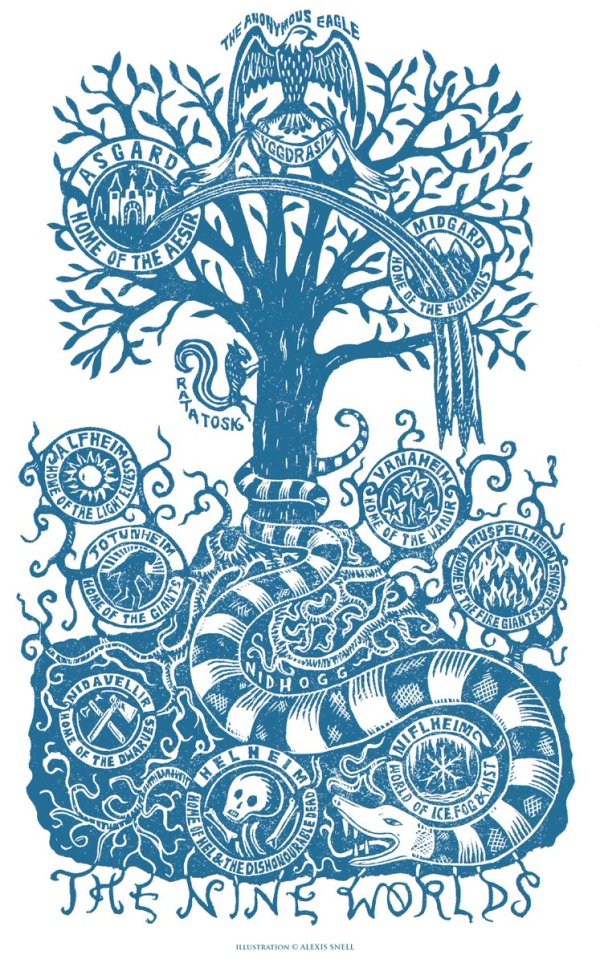
Whatever cosmological map we use to track our progress, be it Yggdrasil, the Tree of Life or chakras, the enduring value of such schemas is that they embody the challenge to pursue balance and eventual holism. If our eventual goal is to fully actualize our potential as a human being, it would seem inevitable that the keys to our liberation lie with those aspects of self that we are currently most likely to reject or shy away from.
treeworld

The Nine Worlds (illustration by Alexis Snell)

To embrace these fragile and fractured aspects of who we are represents a profound act of self-compassion. This is far from glorifying our failings or wallowing in dysfunction, rather it represents a profound realization that the hope of becoming something new is fueled by the potency of what is currently blocked or stuck. Your explorations may take the form of ritual, artistic play or via seeking therapy, but when our heroism allows us look clearly at the shadows, so transformation begins to become possible.

“Filling the conscious mind with ideal conceptions is a characteristic of Western theosophy, but not the confrontation with the shadow and the world of darkness. One does not become enlightened by imagining figures of light, but by making the darkness conscious.”

Carl Jung  “The Philosophical Tree” (1945). In CW 13: Alchemical Studies. P.335

Steve Dee


Vision and Discipline

Once upon a time my spiritual path was firmly situated in a type of theism that viewed all human activity as flawed. As a result we lowly worms were reliant upon the grace and favour of a rather changeable deity/demiurge. His book told me that not only was I doomed, but I was doubly doomed if I chose to exercise the Faustian audacity to question his divine authoritarianism.

Although my adolescent longing for identity and certainty made me vulnerable to the promises of orthodoxy, I have never responded well to bullies and attempts to control, and it wasn’t too long before the cracks in my faith grew from being hairline to truly cavernous. Ironically it was study of Christian theology itself that hastened my departure from the fold. Amongst the inevitable deconstruction that occurred via Biblical criticism and the irrational claims of systematic theology, one of the key books that helped me expand my understanding of spirituality was Celebration of Discipline by Richard Foster.

While this book is written by a devout Christian who is unapologetic about the language and imagery he uses, what affected me was the way in which he highlighted effective habits and practices that were able to allow the development of psychological and spiritual fitness. The disciplines of study, meditation, fasting, ritual and pilgrimage were all means for increasing ones’ openness to the incoming of the numinous. Such an approach had a profound resonance for me given the value I had found in the structure and discipline of the Yogic practice I had explored in my early teens and the way they sought to engage all aspects of being.

Throughout the meandering journey that my personal religious instincts have taken me, I have often been suspicious of the type of vulnerable subservience that can feel innate to those paths that have a heavy emphasis on the grace and largesse of supernatural beings. Whatever metaphors or masks that I seek to employ in engaging with Mystery, I am more interested in developing a relationship that allows for the co-construction of meaning rather the wholesale consumption of a “revealed” truth.

I don’t want to minimize the potential importance of strange revelations and non-ordinary states of consciousness, I love a weird gnostic experience as much as the next person. Non-linear insights coming out of the blue? Check! Profound devotional needs expressed to dark deities? Hold my coat. My own practice as a magician has always been as much about what I do and might experience as it has been about the acquisition of arcane lore.

heads

Okay…that was weird!

For me the visionary dimensions of initiatory development acts like a trail of bread crumbs leading me along a path that has often been hard going and overgrown; and yet on their own they are not enough. While this incoming of gnosis and insight has been essential I am still left with the question of how I might create the ideal environment to receive and sustain such experiences so that they might be translated into patterns of change within myself. For me this is a question about the development of character, the quality of my self-awareness and an appreciation of the combination of qualities that make me uniquely me. For me this a question of Soul.

Theologians and psychologists can argue endlessly about the structure of the Self and whether the Soul is innate or developed. Many of us in the West are slowly unlearning the simplicity of the models proposed by orthodoxies of both the Christian and Freudian variety so as to recover richer languages for our internal processes. Whether via pre-Christian Egyptian or Norse models or the Post-Freudian transpersonal work of Assagioli, we are gradually recovering more functional maps of alchemical self-change. Given this, what feels clear to me is that whether or not we view the Soul as ontologically innate, it is something that can be evolved and strengthened through consciously applied effort.

In Systemic Family Therapy we often talk about first and second order change. First order change is a shift in behaviour in response to a direct challenge or stimulus, while second order change is a change of our scripts or patterns of behaviour so that a new way of being is established in an on-going way. Our visionary encounters may provide the initial jolt away from the routine and mundane, but the application of discipline feels critical if we are fully utilize the shocking energy of gnosis in accessing more profound levels of transformation that are sustainable.

The early stages of applied discipline can feel like hard work. As we try to move from conscious incompetence to the mastery of relaxed competence it is inevitable that we need to grit our teeth in overcoming the forces of inertia. In my own experience, those times where I have been able to persist have been when I have kept returning to my initial motivation and goals. Why did I choose this path? Why this one and not another? What am I hoping to gain via this effort? How would I feel if stepped away from this current path?

henry

Henry knows the score.

Your method of developing soul will inevitably unique to you as an individual, but if I would offer advice I would recommend those models of change that advocate a holism that tries to account for the fullness of our human experience. Models such as Leary’s Eight-Circuit model or Gurdjieff’s Fourth Way ideas have much of their strength in the fact that they seek to actualize the physical, the emotional and intellectual dimensions of who we are rather than advocating lopsided forms of development.

The creation of Soul and magical character is never about merely knowing stuff. The mighty Don Webb in describing the work of the Order of Setne Khamuast rightly identifies the three critical stages in ensuring initiatory change: learning, enacting and then finally communicating about our discoveries. Knowledge and even the divine glimpses of gnosis are vital in providing the spark of inspiration but they will rarely keep the flame alight for long. To stay warm and to survive we also need oxygen and fuel. Here’s to keeping the flame alive!

Steve Dee


Things & Stuff – magical happenings…

The Glastonbury Occult Conference is on the 23-24th February and both Nikki and Julian will be there speaking independently and providing a workshop together on Sunday.

Next month:There are still a couple of places available on Julian’s workshop on Queer Magic at Treadwell’s Books on Saturday 9th March in London.

Both Nikki and Julian will be leading a workshop on shamanism in Wales on Saturday 23rd March.

This is the year of Breaking Convention, one of the biggest and best conferences on psychedelics in the known multiverse. Details of tickets can be found here along with how to submit a paper, performance, workshop etc as well as information on volunteering opportunities. This is going to be an amazing event with over 1500 people taking part!

September 13-14th will see the second Trance-States Conference in sunny Northampton at the University. If you fancy a comprehensive download from the leading edge of  occulture this is the place to be.

There will be more events coming up at Treadwell’s and The Museum of Witchcraft & Magic later this year. Please see our Deep Magic page for details

Wishing all our friends in the northern hemisphere a bright new spring!