New Christian Polytheism

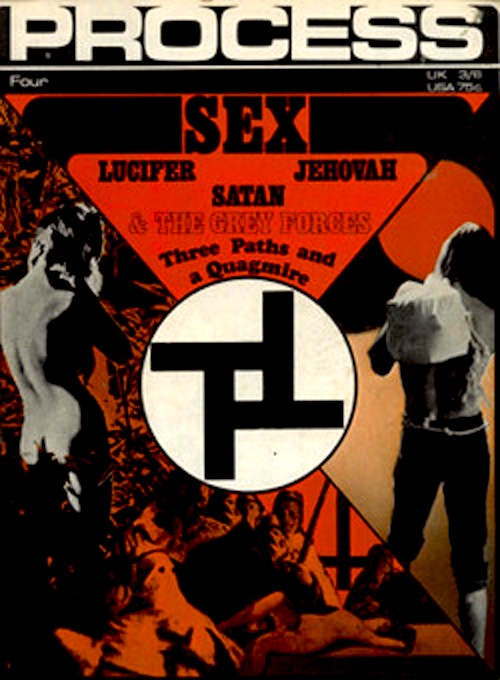
I’ve recently been re-reading Love, Sex, Fear, Death by Timothy Wyllie and was once again struck by the potent iconography and influence of The Process Church of the Final Judgement. The 1960s were undeniably a time of heady social ferment and cultural creativity – the love and peace idealism of the Haight Ashbury set, cross pollinating with student unrest and a growing awareness of the inequalities that were present for many people on both sides of the Atlantic. While many were intoxicated by the popularity of spiritual traditions generically described as “Eastern”, it was perhaps surprising that through a haze of dope and incense, strode the hard-edged Gnostics of the Process.
Business Process

Business Process

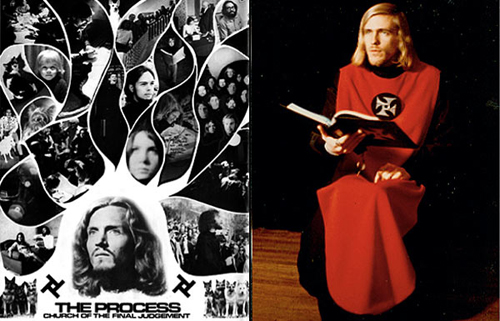
“The Process” stood in stark contrast to the loose limbed ascetic of the flower powered. Sporting long robes and satanically shaped beards (optional), The Process appeared to be responding to a darker more visceral vision than many of their peers. In the 9 years during which its co-founder Robert De Grimston was at the helm, the Process integrated some initial insights gained from Scientology with a radical re-working of Judeo-Christian mythology.

Responding to a series of visionary experiences gained while in Mexico, the group set out a polarity in which Christ, Satan, Jehovah and Lucifer were in dynamic tension with each other. As is so often the case, this cosmology then provided much of the focus for initiatory work within the Process. Processeans would often identify which of the specific primary deities reflected their core psychological profile, and, which balancing quality they might need to pursue in seeking integration.

I would highly recommend Wyllie’s book, not only for its brilliant collection of original Process art work and magazine articles, but also its reflections on how group dynamics function within new religious movements. While it undoubtedly displayed many traits that raise concerns about cult-like behaviour, for those of us interested in how Luciferian/Gnostic imagery has been utilised in initiatory work, they provide us with much to learn from.
Data Processing

Data Processing

In my recent series of blog posts Gnostic Musings I sought to explore the potential value of trying to view the players on that mythic stage from a more systemic perspective. While the Gnostic scriptures provide us with a theological model that is full of dualism and oppositional tensions, it can also be helpful to view them with a more pantheon-focused or polytheistic lens. Whatever beliefs that we might hold regarding the ultimate unity (or not) of the Mystery, the reality is that as humans we tend to adopt religious frameworks that allow for some allowance of multiplicity and complexity.

Historians of religious history might consider the virtual impossibility of maintaining absolute monotheism. However desirable the Oneness of God may be at a philosophical level, the messy phenomena of how we do our religions seems to point toward a more team based approach. Whether it’s the 99 names of Allah or the evolution of the doctrine of the Trinity, when faced with the Mystery or “Runa” of whatever is out there, we often need a number of masks for our gods to wear.

As to the “why?” we do this, I’m sure there are a whole raft of reasons, but for brevity’s sake I will touch briefly on two:

Firstly the allowance for multiplicity allows us to make sense of new experiences of the numinous that disrupt our current worldviews. For the first century Jewish community trying to make sense of their encounter with Jesus, there was an inevitable struggle as they sought to harmonize their experience of the risen Christ with their existing monotheism – was this being a God? Should we address our perceived messiah as “Lord”? Certainly we can see the evolution of competing interpretations as the church evolved its thinking in the centuries prior to the Nicene creed (for those interested in this check out “Christology in the Making” by James Dunn). Multiplicity allows us to ‘upload’ new insights and experiences into our perception of the numinous.

As a Gnostic explorer travelling my path, I am aware of my own process of canonisation as I promote and demote incoming ideas and insights within my personal pantheon. While a degree of narcissism is somewhat inevitable for the magician, ideally this process is one slow evolution rather than merely being brash consumerism. In the pursuit of depth in my relationship with god-forms, I cast a spell on my self as their faces are reflected in my art, relationships and the altars I make.

Secondly, I think that many of us seek models of divine multiplicity because they more accurately reflect our experience of self. As human beings trying to make sense of our universe, we have to deal with a whole host of competing desires and demands as we try and prioritise the needs of individual, family and tribe. These competing and sometimes conflicting needs then become translated into self-states that we oscillate between, dependant on a complex mash-up of genes, conditioning and personality structure. To experience such tensions seems to be an inevitable part of the human condition and it is perhaps unsurprising that we seek spiritual myths and metaphors that make sense of them.

My own interest in weird cosmologies like that of the Process and the early Gnostics is that the maps that they were working with seem to have a more creative engagement with both darkness and dynamic tension. Unlike the rather safe stylings of a Father, Son and Holy Spirit who are rarely at odds with each other, the various players of the Gnostic stage often represent stages of unfolding and the resolution of various core conflicts. It was hardly surprising that as Jung sought to evolve his model of depth psychology, he found so much of interest in these strange waters. Such rich mythic multiplicities steer us away from the shallows of safe ‘belief’ and ask that we push out into the depths of the unknown.

Bon Voyage!

SD

Top Secret Occult Secrets

Dear readers, I have recently been enjoying Yvonne Aburrow’s excellent All Acts of Love & Pleasure: Inclusive Wicca published by Avalonia Press. What I have really enjoyed is Yvonne’s thoughtful and inspiring reflection on how a contemporary Pagan path (in this case Wicca) can evolve and become more conscious regarding issues around inclusivity and power. For our magic to be real, it needs to impact directly on issues regarding justice, freedom and seeking political change within society. To meet with the Gods means not only to access archetypal forces from times past, it can also ask that we engage with the on-going impulse of cultural transformation that fed into the Neo-Pagan revival.

Let Hir worship be within the heart that rejoiceth

Let Hir worship be within the heart that rejoiceth

Inspired by Julian’s recent musings on Priesthood, I’ve got to thinking about the exoteric dimensions of our occult or esoteric paths. As magicians it can be easy to get lost within the labyrinthine halls of our spooky clubs. In seeking to plumb the depths of mystery and our own process of psychological change we can be endlessly inventive in developing techniques and elaborate symbol systems. While folks may find value in roaming the paths of the Qliphoth or in liaising with denizens of the Nightside, it seems fair that at some point we should ask “and what difference does that actually make?”

Personally I think that the socio-political implications of our paganisms will be as diverse and complex as the religions themselves. It may well be that the libertarianism of a Setian and the eco-collectivism of a druid are equally valid ethical stances generated by their personal philosophies. To me what feels critical is that our claims to personal development or magical advancement need to birth something that contributes to the betterment of humanity.

This is not to suggest that we all need to be reduced to blanket prescriptions as to the focus and shape that our activism should take. The manifestation of our spiritual passion into the realm of Midgard can take many forms. Whether via writing, music, marching, advocacy or innovative financial investment, the forms of our engagement are rightly tailored to our personal preferences and drives.

In Yvonne’s book, we are given a really helpful overview of Wicca’s historical development and the wide variety of theological positions that initiates into that tradition might hold e.g. forms of monism, duotheism, polytheism and animism. These are rarely neatly delineated positions and there are often huge overlap and apparent inconsistency as people seek to live the reality of how they engage with their experience of the Gods.

As with all good books, Yvonne’s work triggered my own reflections as to how my own take on Pagan Theology might help shape my own attempts to evolve a deeper sense of engagement. This list is by no means definitive and each deserves a blog post of its own:

  1. Multiplicity: Even if one’s Paganism takes a decidedly scientific and monistic form, there is usually an engagement with the concept of Polytheism at a mythic/psychological level. The idea that we should understand the divine as a series of differing beings (or principles) that have an interaction or relationship with each other is appealing for many of us. While Polytheism can take many theological forms, what it does seem to entail is a move towards acknowledging the multiple, the complex and the relational nature of how we experience life and contemplate the numinous-what we might call “Pantheonic” consciousness.

In our devotional work we may well chose to focus our energies towards a specific deity within a given pantheon e.g. the God of consciousness, the female destroyer, the Son of new endeavours etc. but we remain conscious of the whole. Similarly in our activism we may focus on a given issue (Indeed we have only such much time and energy) but seek to resist becoming overly narrow in perspective.

In reflecting on this emphasis on theological interconnection, I couldn’t help but think about the general increase in awareness of intersectionality with regards both identity and social issues- issues rarely (if ever) stand in isolation, rather the parts effect the whole in a way that demonstrates the subtle ecology of any given situation. Such awareness helps us more fully appreciate both the weight of multiple struggles and also the positive impact that change in one sphere can have in creating larger scale change.

  1. Localised discourse: In my practice, much attention is given to location and what might loosely be called “the spirit of place”. As much as my being a magician is located somewhere my head and heart, it only really becomes activated within the context of “what’s out there”. I can only really focus and shape magical attention when I am in the place of doing it.

In many ways my activism (i.e. living my life in relationship with self and others) is profoundly shaped by the place I find myself in. Yes I am increasingly connected globally and engaged in struggling to evolve macro scale principles, but “small is beautiful” still has meaning. Yes I may contribute by signing numerous on-line petitions, but what am I willing to do within my immediate communities. How can I use a form of “social animism” to tune-in to how reflection and change might occur at a grass-roots level?

  1. Importance of human drives: In her book Yvonne helpfully seeks to examine ideas of what holiness, piety and sacredness might mean for the modern pagan. In contrasting an integrative Wiccan perspective with potentially more dualistic paths, we can begin to evolve ethical and spiritual positions that have sensuality at their core.

While issues such as sexual liberty and artistic expression may be seen as somewhat periphery when confronted by issues such as poverty, war and terrorism, it is my view that they are often at the very heart of why these conflicts take place. The drives to experience pleasure and to express creativity are central to humanities’ attempt to find meaning in life. Many conflicts and the resulting social inequalities seem to result from trying to overly police these passions via either religious or political means. In seeking such constraint and potential suppression, it is sadly all too common that that those threatened by their own humanity then project onto an “Other” who becomes demonised in the process. For our spiritual paths to take seriously the pursuit of sacredness in its fullest sense, it must call us back to the sensual and provide a challenge to thin-lipped piety.

While there are always dangers inherent in the process of seeking to evolve forms of religion that are more inclusive and liberal (consumerism and over-simplicity spring to mind!), they do offer the possibility of informing any process of social change. Yvonne’s book provides us with an excellent example of how religions can evolve. These are processes that rejoice in the way in which our ever inventive humanity interacts with the divine. To be open about this unfolding does not rob our religions of power, rather they ask us to seek and use power consciously.

SD