In Search of Depth – A Review of ‘The Magickal Union of East and West’ by Gregory Peters

Much of the writing on this blog is preoccupied with the question of how we as Magicians of varying stripes seek to develop both depth and meaningful direction in our spiritual work. Rather than signing up to the concept of “one teleos fits all”, I hope that team Baphomet manages to balance a lively interest in the development of mature practice while revelling in the many potential ways that this might be pursued.

Once we move beyond the initial stages of understanding the core myths and ritual techniques of a given tradition it can feel bewildering as to how one can put down the type of deep roots that will enable more long term sustenance. While finding a helpful teacher or a structured Order may provide guidance for those lucky enough to locate them, I would not underestimate the role of a good book in providing us with new insight. Thankfully in The Magickal Union of East and West Gregory Peters has provided us with one of these volumes.

east

Peters comes from a rich background of Thelemic ceremonial magic and various lineages of both  Hindu and Buddhist tantra. In this work he seeks to outline some of the key ideas and practices that he and other magical colleagues have worked with, within the Ordo Sunyata Vajra (OSV) over the past 18 years.  As is suggested by its English translation as an Order of the “Adamantine Void”, this is a curriculum that seeks to equip the magician with both philosophy and ritual technique for exploring dimensions of the “true” and “silent” self.

Peters is an open and enthusiastic guide who offers the insights he has gained with a deep sense of gratitude to those teachers and currents that have informed his work. Whether it be the work of Kaula Nath lineage of AMOOKOS, Dzogchen or Chan Buddhist practices, he presents these approaches within an explicitly Thelemic world view. However much he has gained from these Eastern traditions, his work seeks to engage with them as means for getting to the deeper dimensions of Crowley’s work as it was carried forward by Kenneth Grant, and Greg’s own mentor Soror Meral (Phyllis Seckler).

If we are to move beyond superficial heavy metal styling’s regarding the expression of “true will”, we will need to explore what will this mean in terms of the transformation of self and the manifestation of Thelema and Agape within our everyday lives. This is not a rejection of the Western magical tradition, rather it is an attempt to reconnect us to those spiritual traditions that were critical to the reconstitution of Neo-pagan paths long deprived of their own change technologies.

Our author is a big fan of Kenneth Grant and clearly sees the focus of the OSV as being profoundly connected to the recovery of a perennial form of “Stellar Gnosis”. In contrast to Grant however, Greg (as a Tantric and ceremonial practitioner) provides us with plenty of guidance with regards things we can do. Malas can be blessed and altars can be created and there are plenty of ritual outlines that we are invited to explore and adapt depending on setting and inclination. We also spend time thinking about what it means to inhabit the “dragon seat” of meditation in order to explore the oscillating sense of being and non-being.

For me, this work provides some helpful maps for exploring the limited spatial metaphors that we as magical types can get hung-up on. If we adopt a psyche-centric focus for work, are we seeking to reinforce concepts like ego-strength or are we pursuing the dissolution of our self-concept? In seeking to simultaneously deepen our engagement with both True Will and the formlessness of the Void, Peters seems to be acknowledging the inevitable spiralling movement of the self as it dances between such poles. In sitting with a spaciousness that demands the alchemical transformation of our Will, Self is ultimately embraced even though its newer form may now seem barely recognisable.

I would highly recommend this book to those magicians interested in how the Aeon of Horus can shake-off some of its dustier, pseudo-masonic origins. In the spirit of Grant’s Typhonic work and Nema’s Maat magick, the work of the OSV provides some highly helpful guidance as to how we as contemporary practitioners can work with both Eastern and Western magical currents in a manner that feels at once respectful, deep and innovative.

SD
Writing on Drugs: Three fabulous books to Feed your Head.

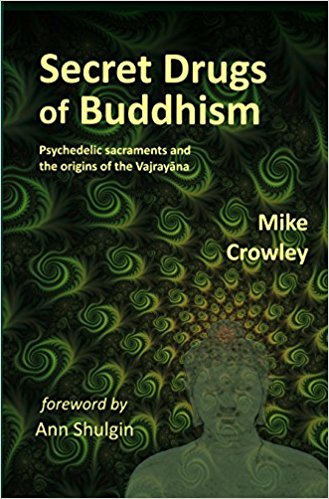
Secret Drugs of Buddhism: Psychedelic sacraments and the origins of the Vajrayana

The Buddhist tradition generally eschews the use of substances that cloud the mind but psychedelics (which, by definition, make manifest the mind) are by no means absent from the story of Asian religion. While modern Buddhists may take refuge in the idea that ‘drugs are bad’ (with certain notable exceptions such as the Zig Zag Zen school of Allan Badiner et al.) both Buddhism and Hinduism emerged from a cultural landscape rich in Amanita muscaria, Cannabis sativa and Panaeolus cambodginiensis.

In this book Mike Crowley hunts the questing beast of soma through layers of Sanskrit metaphor and potential botanic sources, following this elusive substance as it emerges into Vajrayana Buddhism as the sacramental nectar of immortality amrita. This analysis is the entheogenic equivalent of ‘who shot JFK?’,  and many theorists have spilt much ink trying to nail down the culprit; what kind of stuff was this food of the gods really? Our author, an accomplished scholar of  Sanskrit, Tibetan and Mandarin Chinese takes the broad view and intelligently and generously explores the options and opinions on this matter. Crowley, as well as being a fan of psychedelics, is also deeply embedded in the spiritual culture of Asia, having become an Upāsaka of the Kagyud lineage in 1970.

Mike’s suggestion is that it is the psychedelic effect that maketh soma, not its exact pharmacological identity. His view, that the Vedic soma may have started out (in the north) as Amanita and later (as cultures spread south) became psilocybin rich mushrooms, makes a lot of sense. It’s the entheogenic experience, this embodied encounter with the divine, that matters – whether that state is provoked endogenously through pranayama and protracted periods of fasting and solitary medication or by any number of substances – the effect is much the same.

crowley

While the debate about the psychedelic nature (or not) of Soma and Amrita is far from over Mike has made a valuable contribution to the discussion and does so in a book which is well supported by notes and references and that, in itself, is a delightful read.

Check out this lecture by Mike Crowley on The Secret Drugs.

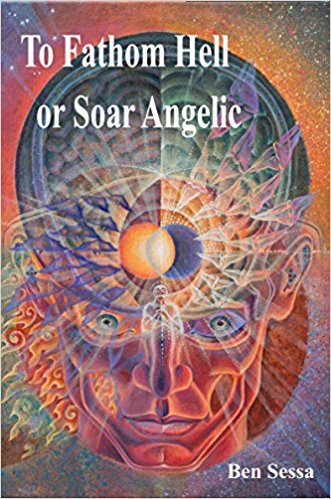
To Fathom Hell or Soar Angelic

To Fathom Hell… is a brilliant and very engaging book. Our story begins with a depressed psychotherapist seeing his clients (while secretly fantasizing about the gruesome ways they might die), painfully conscious that the therapy he provides has very little effect. Accidentally attending a conference on psychedelic medicine, our despondent hero teams up with psychedelic therapist and maverick Dr. Langley. Their partnership works, and together they embark on a project to create a centre in which they can deploy psychedelic medicine.

Author Ben Sessa is the perfect person to imagine such a story, as a well respected psychiatrist and advocate of the value of psychedelic psychotherapy. (Check out Ben’s wonderful TED talk). Psychedelic therapy sessions using MDMA, LSD, and psilocybin are described, expertly written by one of the few people in Britain legally qualified to undertake this kind of work.

sessa

The novel skillfully leads us into this world and, while there is an engaging plot, much of what happens are conversations in which the theory and practice of psychedelic therapy is expounded. In this way To Fathom Hell… stands in the lineage of Aldous Huxley’s works where the narrative provides a setting in which ideas can be elucidated and explored.

Our Somerset Pala (the fictional psychedelic Island of Huxley) becomes the template for numerous therapeutic communities up and down the British isles. This isn’t just about getting squaddies PTSD sorted by arming them with MDMA – it’s about the transformation of culture; starting with the broken and moving towards healing those who do the breaking. The novel builds to a tremendous climax which put me in mind of the denouement from The Illuminatus Trilogy; a crescendo that feels both riotous and joyous.

A rollercoaster of a good read this tale is engaging, funny, dark and transcendent much like the psychedelic experience itself.  You can read more about To Fathom Hell, Sessa’s debut novel, and purchase your copy of the book via Psychedelic Press UK.

The Rose of Paracelsus: On Secrets & Sacraments

The final book I want to recommend is the genuinely awesome (in the proper sense of the word) volume by William Leonard Pickard The Rose of Paracelsus. This book was written by Leonard, using paper and pencil, in the US prison where he is incarcerated for “conspiracy to manufacture LSD”. Before he was busted (or set up…) Leonard was a research associate in neurobiology at Harvard Medical School, a Fellow of the Interfaculty Initiative on Drugs and Addictions at Harvard, and Deputy Director of the Drug Policy Analysis Program at UCLA. On all levels this is a Brother who knows what he’s talking about.

leonard

Reading The Rose… is, quite honestly, like tripping on acid. The long text (656 pages) can’t be adequately defined as a either a novel or autobiography. The language is rich, powerful, lyric, poetic, terrifying, visceral, sublime. Reminiscent in style to the work of Jorge Luis Borges, the narrative of clandestine acid chemists, governmental intrigue, simple human stories of suffering and (sometimes) redemption weaves a spell over the reader. Add to this the real-world knowledge of the grotesque circumstances of Leonard’s imprisonment (he is serving two life sentences, has already served 17 years, is 71 years of age and is in a high security prison) and this book becomes even more poignant. The Rose… pulls the reader in, but has to be put down. The chapters, as rich and dense with references and allusions as they are, require time to be digested. I needed periods to reflect and frankly sometimes time to meditate and pray, during my first reading of The Rose…

I was pleased to be present at the Breaking Convention session on The Rose… where we were treated to readings from the text, including a recording of Leonard himself (once a month Leonard gets to make a 15 minute monitored phone call from jail).

I cannot recommend this book highly enough. The proceeds go to support Leonard’s family (his son was a newborn as his father went to trial) and I would encourage readers of the text to check out his page and, in whatever way they can, to send thoughtful correspondence and messages of solidarity to him (he does have some access to email).

With Leonard’s permission, here is a recording of me reading an excerpt from the early section of the book where the hero meets one of ‘The Six’. (This hexad of high level psychedelic chemists, rather like the Guild Navigators in Frank Herbert’s Dune novels, have developed super powers following years of exposure to vast quantities of LSD.) In this section our protagonist makes contact with Crimson, the first of The Six.

The Rose of Paracelsus is a truly psychedelic read. Highly recommended.

JV